
Retirement Living takes an unbiased approach to our reviews. We may earn money when you click a partner link. Learn More
Gold Certificates Explained
Gold certificates are retired U.S. paper notes once redeemable for gold, now collectible.


Updated:
AT A GLANCE:
- Gold certificate holders aren’t able to exchange the notes for gold, but most series can be redeemed as legal tender for their face value.
- The Treasury issued large-size gold certificates from 1865 to 1928 and small-size notes beginning with Series 1928, including a $100,000 Series 1934 note it never released to the public.
- A gold certificate’s series, rarity, and condition determine its value to collectors, and grading services such as Paper Money Guaranty (PMG) and PCGS Banknote authenticate notes and grade their condition.
From 1865 to 1933, the U.S. Treasury issued gold certificates as paper receipts for gold coins it held in its vaults. If you’ve found an old bill with a gold seal and a bright orange back in a relative’s papers, you may be holding one of these fascinating paper notes.
Though the certificates once represented claims on gold, today they are simply collectibles. In 1933, the federal government ordered Americans to turn in their gold coins, bullion, and gold certificates. Book-entry gold certificates later took the place of the paper notes. Today, the Federal Reserve holds about $11 billion of this more modern version, valued at a fixed legal price of $42.2222 per ounce.
To learn how gold certificates worked, which series are most in demand by collectors, and how to buy or sell gold certificates safely, read on.
Gold Certificates Explained
The U.S. Treasury issued gold certificates as paper receipts for gold coins it held on deposit. They represented promises to the notes’ bearers that they could be exchanged for their face value in gold.
Congress authorized gold certificates under the same Civil War-era legislation that created United States Notes. Though the law dates to March 3, 1863, the Treasury didn’t issue the first certificates until November 1865.
How Gold Certificates Worked
Gold certificates worked like receipts: someone deposited a gold coin with the Treasury and received paper notes worth the same amount, redeemable for gold on demand. The Treasury created them during the Civil War to build up its gold supply, though it didn’t issue the first notes until after the war ended.
After the war, the notes became popular with banks and businesses that handled large sums of money. They found that exchanging paper receipts was much easier and cheaper than doing so with heavy gold coins.
The years that followed saw several changes to how gold certificates were issued and used:
- In 1882, a new law allowed the Secretary of the Treasury to stop issuing new certificates if gold reserves ran low, as was the case during the banking panic of 1893.
- In 1907, Congress created a $10 version of the notes, as gold certificates came into everyday use.
- In 1919, Congress passed a law that made gold certificates legal tender.
Can Gold Certificates Still Be Used As Legal Tender?
You can still use most gold certificates as legal tender, but you can’t redeem them for gold coins the way you could in the past. That’s because of President Franklin D. Roosevelt’s Executive Order 6102, which required most Americans to turn in their gold coins, bullion and gold certificates by May 1, 1933, in response to the Great Depression. Following that, the Treasury ordered that any remaining gold certificates be delivered to the Treasurer of the United States.
In April 1964, the Treasury lifted the ban on holding gold certificates issued before 1934, so that collectors could legally own them. The shift didn’t include the Series 1934 notes because the government printed them exclusively for its own use and never released them to the public. Now, all U.S. currency is legal tender no matter when it was issued, though you can’t exchange eligible gold certificates for gold. Each is worth at least its face value.
Paper Notes vs. Book-Entry Certificates
Historic gold certificates are physical paper notes that people once carried and couldn’t redeem for gold coin. Book-entry gold certificates, by contrast, exist only as accounting records between the Treasury and the Federal Reserve.
After the Gold Reserve Act of 1934, gold certificates became internal government instruments. Today, the book entries represent the government’s gold at a fixed value of $42.2222 per ounce, and consumers can’t buy or hold them. Anything sold to the public as a “gold certificate” today is either a historic collectible note or a private product from a bank or dealer.
Gold Certificates Types and Series
The Treasury issued gold certificates as either large-size notes from 1865 through the Series 1922 notes or small-size notes beginning with Series 1928. The public could use denominations from $10 to $10,000, while a $100,000 note circulated only inside the government.
| Type | Years Issued | Size | Typical Seal Color | Back Color | Common Denominations | Key identifiers |
|---|---|---|---|---|---|---|
| Large-size 1865–1928 | 1865 to 1928 (last series dated 1922) | 7.375 by 3.125 inches | Gold on later series; red or brown on many earlier ones | Orange on most series | $10 to $10,000 | Bigger, elaborate notes; orange “goldback” on reverse |
| Small-size 1928 | Series 1928 | 6.14 by 2.61 inches | Gold | Green | 10 to $10,000 | Today’s bill size; gold seal and serial numbers |
| Series 1934 $100,000 | Printed December 18, 1934, to January 9, 1935 | 6.14 by 2.61 inches | Gold | Orange | $100,000 | Featured portrait of Woodrow Wilson; issued for government use only |
| Modern book-entry gold certificates | 1934 to present | Electronic record, no paper | None | None | Dollar balances, not fixed denominations | Held only by Federal Reserve Banks |
Large-Size Gold Certificates
The large-size notes issued until 1928 were noticeably bigger than today’s bills, measuring about 7.375 by 3.125 inches. Collectors call them “goldbacks” because most have bright orange backs.
After the first issues, the Treasury added more denominations, including the Series 1882 $50 note and the Series 1907 $10 note. By 1907, people were using gold certificates in everyday transactions.
Small-Size Gold Certificates
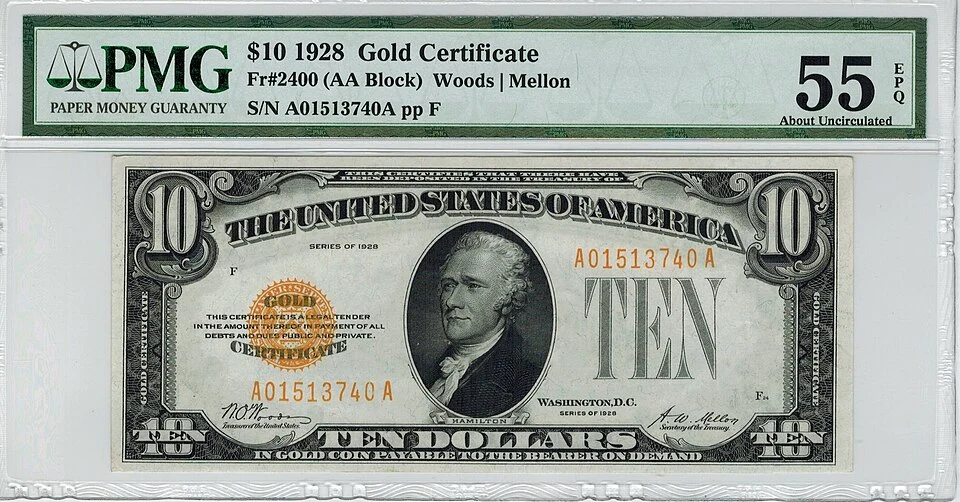
The Series 1928 notes introduced small-size gold certificates that are the same size as today’s currency. They are distinctive for their bright gold-yellow Treasury seal.
The Treasury also printed Series 1934 small-size gold certificates in $100, $1,000, $10,000 and $100,000 denominations, only for use by the Treasury and the Federal Reserve System.
Series 1934 $100,000 Note
The Series 1934 $100,000 gold certificates are the largest denomination notes the U.S. has ever printed. The government printed 42,000 of them between December 1934 and January 1935. Featuring a portrait of President Woodrow Wilson, they were used to move large amounts of money between the Federal Reserve Banks and the Treasury.
These high-value notes never entered general circulation, and the government has accounted for all 42,000. Private ownership is still illegal. The government destroyed most of them, but visitors can see a few demonetized certificates at the Smithsonian, the Federal Reserve Bank of San Francisco and similar locations.
Rarities and Dates of Interest
The rarest gold certificates are those that were issued between 1865 and 1875. For some of these, only one example still exists. Series 1882 and later notes, especially in $10 to $100 denominations, are far more common.
One of the most unusual stories pertaining to the gold certificates involved the Series 1900 $10,000 notes. The government had redeemed and canceled all of them and stored them at a Washington, D.C., post office. When the building caught fire on December 13, 1935, workers threw boxes of records that included the notes into the street. Onlookers picked up hundreds of the canceled notes, and those that survived now trade as valuable collectibles.
Gold Certificates Value and Grading
Today, a gold certificate’s series, denomination, rarity and condition determine its value. Most sell for more than their face value. The range is broad: while the Greysheet price guide lists a circulated Series 1928 $10 or $20 note at about $85, the same notes in top condition can reach about $10,000. Collectors generally find that large-size Series 1922 $10 and $20 notes start between $110 and $130.
| Factor | What to Check | Why It Matters |
|---|---|---|
| Series and denomination | Series date and dollar amount on the front | Early series and high denomination notes are scarce; $10 and $20 notes from 1922 and 1928 are the most common |
| Condition grade | Folds, wear, corners, paper crispness | Higher grades on the 1-to-70 scale bring higher prices |
| PMG or PCGS holder | Sealed holder with a certification number you can look up online | Confirms the note is genuine and sets an agreed-on grade that buyers trust |
| EPQ or PPQ designation | “EPQ” (Exceptional Paper Quality, PMG) or “PPQ” (Premium Paper Quality, PCGS Banknote) on the label | Shows the paper hasn’t been pressed, cleaned, or repaired |
| Star notes | A star symbol found next to the note’s serial number | Replacement notes were printed in small numbers and usually sell for more |
| Damage or details notes | “NET” (PMG) or “Details” (PCGS Banknote) on the label | These flag problems like repairs, stains, or trimming that cut value |
| Provenance | Auction records, prior collection names, receipts | A documented history can boost a buyer’s confidence and the price |
The Basics of Condition and Grading
Both PMG and PCGS Banknote grade gold certificate notes on a 70-point scale that ranges from heavily worn (single-digit rating) to a grade of 70 for notes that are considered to be flawless. Graders consider the amount of wear, folds, centering, margins, and paper condition.
In addition to condition, the other important valuation factor is the rarity of the note. With most gold certificates having been turned in and destroyed after 1933, even those categorized as being from a common series have significantly added value. The higher the denomination, the more it is likely to sell for; while a Series 1928 $100 note generally lists from about $300, a $500 note from the same series starts around $2,500.
Understanding Third-Party Grading Labels
There are a few key terms important to understanding the labels on graded notes:
- EPQ (Exceptional Paper Quality): This is PMG’s mark indicating that it considers a certificate to be completely original. PMG evaluates notes graded 20 and above for EPQ, and a note must earn EPQ to grade 65 or higher.
- PPQ (Premium Paper Quality): This is PCGS Banknote’s equivalent to PMG’s EPQ label. Circulated notes must grade Very Fine 25 or higher to qualify, and a note must meet PPQ standards to grade 65 or above.
- PMG Star (★): This is PMG’s indication of a note having exceptional eye appeal within a grade, based on factors such as strong embossing or vibrant ink.
- Star notes: These replacement notes carry a star in the serial number, which shows that they replaced misprinted sheets. A $10 star-noted version of the 1928 series commands roughly $200, compared with $85 for a note without the star.
Flags for Common Damage and Other Issues
When gold certificate notes have repairs or other damage that go beyond normal wear, PMG graders use a special designation of NET. PMG’s grade guarantee doesn’t apply to notes with this designation. PCGS Banknote indicates issues including heavy staining, significant trimming, or repairs with the designation “Details.”
Certain types of damage significantly reduce the collectible value of a gold certificate. These include pinholes or tears, missing pieces, writing on the note, water stains, and attempts to hide folds by pressing the note. Do not attempt to clean, flatten, or repair a note with this type of damage, as doing so can further lower its value.
Gold Certificates Buying and Selling Tips
If you have a gold certificate to sell, or are looking to buy one of these collectible notes, the safest way is to do so through an auction house or a reputable currency dealer. In both situations, it is best to have the note pre-graded by PMG or PCGS Banknote and contained in a sealed holder with a certification number that can be checked online.
Before you buy or sell, run through these checks:
- Look up the series, denomination, and Friedberg number. Friedberg numbers are the standard catalog numbers collectors use to identify which specific U.S. note design and variety, so you’ll know exactly what you’re dealing with.
- Investigate what notes with similar grades have sold for. Recent price guides and auction results will tell you.
- Opt for notes graded by PMG or PCGS Banknote, especially for certificates worth more than a few hundred dollars, and confirm on the grader’s website that the certification number matches the note.
- If you’re paying for original paper, check that the label shows EPQ or PPQ, and watch for NET or “Details” notations, which signal repairs or damage.
- Request clear photos of the front and back from the seller, or inspect the note in person when possible. Before paying, make sure you understand the seller’s return policy and authenticity guarantee.
Keep in mind that private ownership of Series 1934 gold certificates is illegal, so avoid any seller offering one. Whether you’re buying or selling, keep all receipts and grading records, along with photos and other documentation, since proof of provenance matters for both insurance and resale.
Where Can You Buy Gold Certificates?
In most cases, it’s best to buy gold certificates from established paper money dealers, major numismatic auction houses, and reputable online marketplaces. Common notes, including Series 1922 and 1928 $10 and $20 certificates, are often available from dealers that also sell coins and bullion. It’s a good idea for new collectors to get prices and information from reputable gold dealers. Be sure to ask whether they guarantee authenticity, and compare what each says before moving forward.
Estate sales or online listings often sell ungraded notes that cost less. These are a riskier purchase for buyers, especially for valuable notes. Paying for gold certificates to be graded or purchasing notes that have been pre-graded is generally worth the additional cost.
Identifying Counterfeit Gold Certificates
There are several elements that help distinguish counterfeit gold certificates from the real thing. One of the most obvious is the raised ink and fine, sharp lines found on genuine U.S. currency. This subtle three-dimensional detail is a result of a printing process called intaglio. Another method is magnification, which reveals the flat, blurry printing typical of counterfeits made with offset or digital printing. Collectors can also check for the red and blue fibers that are embedded in modern currency paper.
Other signs of a counterfeit include an orange back on a note that should be green, paper that feels too smooth or glossy, and mismatched serial numbers or seals. Watch for altered notes, too, such as a common note pressed to look uncirculated. Detecting these fakes is one of the areas where authenticating through a grading service can save money and disappointment.
Storing and Insuring Your Notes
The best tools for storing notes are polyester sleeves or acid-free holders. Never store them in PVC plastic. Keep them in a cool, stable spot at about 35% to 50% humidity and away from bright light, attics and basements.
If you’ve purchased gold certificates valued at more than a few thousand dollars, confirm the limitations of your homeowners policy. You may need to upgrade your coverage with either a rider or a scheduled personal property endorsement that covers each one at its appraised value. Our guide on how to insure gold provides additional information.
Selling Options and Fees
There are generally three options for selling gold certificates:
- Selling directly to a dealer: Though dealers pay less than retail value, this is one of the quickest ways to sell.
- Consignment or auction: These venues generally command higher prices for rare notes. Before going this route, ask about the buyer’s premium and any seller’s commission and get it in writing.
- Online marketplaces: Many sellers decide to go through eBay. If you choose this route, keep in mind that the platform charges most coin and paper money sellers without a store a 13.25% final value fee, plus a per-order fee.
When selling gold certificates, also budget for grading fees, shipping insurance, and taxes on any gain.
Frequently Asked Questions (FAQs) About Gold Certificates
Yes, gold certificates are worth at least their face value, and most sell to collectors for more, depending on series, condition, denomination, and rarity. Common circulated Series 1922 and 1928 $10 and $20 notes start between $85 and $130, while rare high-denomination notes can bring six figures.
A circulated Series 1928 $100 gold certificate typically commands about $300 or more. Large-size Series 1922 $100 notes start near $485, but high-grade examples of either type can sell for tens of thousands of dollars.
Yes, most gold certificates can still be cashed in, but only for their face value in modern currency, not for gold. U.S. currency remains legal tender no matter its age, but because the gold certificates are so valued by collectors, you can usually get more for them by selling to a dealer or at auction.
Gold certificates are generally not a good investment if you want exposure to gold, because their value comes from collector demand rather than the gold market. If you’re interested in the gold market, your best course of action is learning how to invest in gold, studying the pros and cons of investing in gold, and comparing the best gold IRA accounts.
In 1933, the federal government ended the ability to redeem gold certificates for gold and ordered Americans to turn in their gold certificates, gold coins, and bullion. After this, owning gold certificates was illegal until April 24, 1964.
Article Sources
Retirement Living writers primarily rely on government data, industry experts, and original research from other reputable publications to inform their work. Specific sources for this guide include:
- Bureau of Engraving and Printing, “BEP History Fact Sheet: Gold Certificates.” Accessed Oct. 26, 2026.
- Bureau of Engraving and Printing, “BEP History Fact Sheet: Federal Reserve Notes.” Accessed Oct. 26, 2026.
- The American Presidency Project, “Executive Order 6102: Forbidding the Hoarding of Gold Coin, Gold Bullion and Gold Certificates.” Accessed Oct. 26, 2026.
- Federal Reserve Bank of New York, “Order of the Secretary of the Treasury Requiring the Delivery of Gold Coin, Gold Bullion, and Gold Certificates.” Accessed Oct. 26, 2026.
- Federal Reserve Bank of New York, “Treasury Removes Restrictions on United States Gold Certificates Issued before 1934.” Accessed Oct. 26, 2026.
- U.S. Currency Education Program, “The $100,000 Certificate.” Accessed Oct. 26, 2026.
- Federal Reserve Bank of St. Louis, “Assets: Other: Gold Certificate Account: Wednesday Level.” Accessed Oct. 26, 2026.
- U.S. Department of the Treasury, “Issuance and Redemption of Gold Certificates.” Accessed Oct. 26, 2026.
- Greysheet, “Gold Certificates – Small.” Accessed Oct. 26, 2026.
- Greysheet, “1922 Gold Certificates – Large.” Accessed Oct. 26, 2026.
- Greysheet, “1913 Gold Certificates – Large.” Accessed Oct. 26, 2026.
- Paper Money Guaranty, “PMG Paper Money Grading Scale.” Accessed Oct. 26, 2026.
- Paper Money Guaranty, “Frequently Asked Questions.” Accessed Oct. 26, 2026.
- Paper Money Guaranty, “Friedberg 1225: The Series 1900 $10,000.” Accessed Oct. 26, 2026.
- PCGS, “PCGS Banknote Grading Standards.” Accessed Oct. 26, 2026.
- PCGS, “PCGS Banknote Accepting Paper Money Submissions.” Accessed Oct. 26, 2026.
- National Academies Press, “Counterfeit Deterrent Features for the Next-Generation Currency Design.” Accessed Oct. 26, 2026.
- U.S. Currency Education Program, “Quick Reference Guide.” Accessed Oct. 26, 2026.
- Library of Congress, “How do I preserve my letters or paper documents?” Accessed Oct. 26, 2026.
- California Department of Insurance, “Residential Insurance.” Accessed Oct. 26, 2026.
- eBay, “Final value fee changes in most categories.” Accessed Oct. 26, 2026.
Help us improve our guides! If you’ve bought, sold, or inherited gold certificates, or have insights on how collectors evaluate and grade these notes, we’d love to hear from you. Share your experience with us at [email protected]. Your personal details will stay completely confidential.