
Caregiving Survey: 51% of Family Caregivers Are Unpaid


Updated:
Open Access
When you think of “caregiving,” you may imagine a quiet afternoon with Grandma. Baking cookies, weeding the garden. Maybe heading to a doctor’s appointment or two, but definitely getting ice cream afterwards.
In reality, however, caregiving is more than simply driving a loved one to an appointment or dropping off a bag of groceries. For millions of families, it’s a time-consuming, emotionally exhausting responsibility that often comes with real financial consequences — even if you’re avoiding the high costs of in-home care.
Key Insights
Half of caregivers (50.9%) receive no compensation for the care they provide to family members.
↓ Jump to insight
42.6% of caregivers are part of the sandwich generation, caring for seniors while raising children of their own.
↓ Jump to insight
Over 70% of sandwich-generation caregivers say managing both roles is moderately to extremely challenging.
↓ Jump to insight
55.4% of caregivers who haven’t hired professional help say they’ve been deterred by high costs.
↓ Jump to insight
For a growing number of adults, caring for an aging relative overlaps with another challenge: raising young children. This group has earned the nickname “the sandwich generation” —caught between caring for aging loved ones while also supporting their children. The National Alliance for Caregiving has described this strain as “burning the candle at both ends.” As the U.S. population ages, more adults will be thrust into the role of carers for not only their children, but also their aging parents.
What is unpaid family caregiving really like? To find out, Retirement Living surveyed 1,000 people across the U.S. who provide caregiving to a loved one to ask about the time, financial and personal costs.
What Does a Family Caregiver Do?
Caregiving is far more than companionship — it often involves medical tasks, personal care and financial support. Nearly a quarter (24.5%) of caretakers surveyed spend at least 20 hours per week on caregiving tasks, with 8.3% spending over 40 hours. It’s clear, then, that elder care can quickly become an overwhelming commitment. “It is effectively a full-time job on top of working a normal nine-to-five,” one survey respondent told Retirement Living, “but with vastly more responsibilities than one person can typically handle.”
Here are just a few of the tasks unpaid caretakers perform:
- 62.5% help with everyday tasks such as preparing meals, running errands and providing transportation.
- 58.4% offer emotional support and companionship to their loved ones.
- 42.7% assist with personal care, including bathing and dressing, or help with mobility and getting around.
- 41.2% coordinate care, like scheduling appointments and communicating with doctors or other health care providers.
- And another 40.3% assist with medical tasks such as managing medications, monitoring health and carrying out nursing tasks.
What do these caregivers wish others understood about caring for a loved one? Many of our survey respondents offered themes of time, energy and patience. “I wish more people understood how emotionally and physically demanding caring for a senior loved one can be,” one caregiver told us. Another wrote, “It is very rewarding that you’re able to help your family member, but it hurts seeing them hurting!”
“It is very rewarding…but it hurts seeing them hurting!”
Family caregiver
Survey respondent
Financial Realities of Caregiving
Caregiving can take the time and energy of a full-time job — minus the compensation. Half of caregivers surveyed (50.9%) receive no compensation for their work with loved ones. When caregivers do receive compensation, “payment” is often unorthodox. Nearly 18% are reimbursed for transportation or gas money, 13.4% get help with housing costs, 18.2% get help with household bills, and 12.9% are given groceries or meals. One in five report getting paid directly with cash or check, and 13.2% are paid through a stipend or government program.
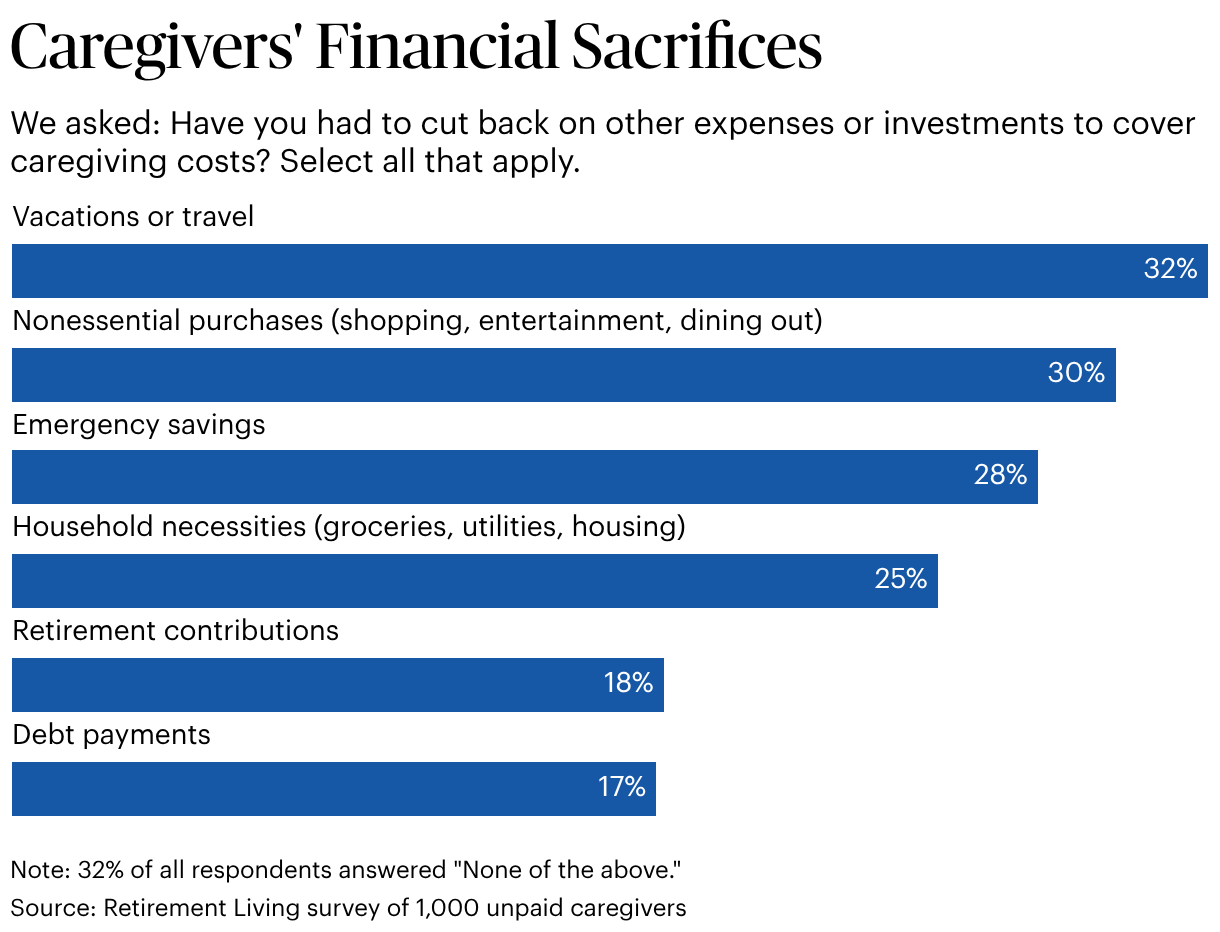
Even while caretakers are paid little to nothing for their work, they can face out-of-pocket costs associated with caregiving. Almost half (45.8%) of caregivers describe the financial strain of caring for a loved one as either moderate, high or severe, and 27.9% spent over $1,000 in the past year caring for a senior loved one.
Sandwich Generation: Caring for Aging Parents and Children
The sandwich generation is a catchy name for a tough situation. It refers to adults who have children under 18 living at home while they are also caring for an adult — and it applies to nearly 43% of caregivers we surveyed.
Among sandwich-generation caregivers, 51.9% report increased stress or fatigue, 43.3% struggle to balance children’s needs with those of adults, and 29.1% experience financial strain. One respondent captured this struggle in a write-in response: “It’s very complicated balancing work, raising a child and caring for a grandparent all at the same time. It drains you completely.”

Why Families Struggle to Use Professional Care
For caregivers “burning the candle at both ends,” why not turn to professional care? Some do, but cost, quality of care and loved ones’ preferences all factor into the decision.
It’s also important to remember that turning to professional care isn’t a choice for everyone. The high cost of nursing homes and senior living — and the often-higher cost of in-home care — make those options inaccessible to many. Among those who have not hired a caregiver, 55.4% say it’s because professional care is too expensive.
Other caregivers don’t hire professional care for different reasons: They can’t find anyone they trust to care for their loved one (28.6%), or their loved one won’t accept outside help (23.1%). These challenges leave family caregiving as the only option.

Why Caregivers Say It’s Worth It
We’ve established that family caregiving can be challenging, time-consuming and expensive. But it’s also about family — and that’s something you can’t put a price on. Despite facing difficulties, caregivers we surveyed described their roles as deeply meaningful. When asked what they wish more people understood about caregiving, several wrote about the emotional reward.
“It’s not an easy job. And not everyone can do it,” one caregiver wrote. “But if you can, do it. Your loved ones will appreciate you doing it rather than a stranger.”
“It is a small burden to care for an ailing parent, considering all the things parents do and give up for us as children,” another said. “We owe them so much more.”
Finally, here’s how one caregiver described the caregiving relationship: “It is the most rewarding thing you can do.”
“It is a small burden to care for an ailing parent…”
Family caregiver
Survey respondent
Resources for Caregivers
For all the caregivers out there — we see you. Explore Retirement Living’s resource hub and check out our tips for finding support below.
Give the primary caregiver a day off. Create a roster of trusted friends and family who can step in when you need to step away.
- Use your resources:
- Access government assistance to relieve some of the costs of caregiving, including Medicare, Medicaid and veterans’ benefits.
- Track caregiving-related expenses early to understand costs and make informed decisions.
- Share the burden:
- Explore volunteer programs, community services or shared caregiving among friends and family.
- Ask employers about flexibility, caregiving leave or employee assistance programs.
- Prioritize self-care:
- Join local or online caregiver support groups.
- Check out free resources offered by your city’s family and children’s services department.
- Create a family caregiving calendar to track appointments and assign tasks.
- Prevent caregiver burnout by starting a daily self-care routine, whether it includes yoga, journaling, meditation or just playing Candy Crush.
- Family communication:
- Have open conversations with family about caregiving roles and expectations.
- Encourage sharing responsibilities to prevent one person from carrying the full burden.
Methodology
To better understand the financial, emotional and daily impact of caregiving on U.S. families, Retirement Living surveyed 1,000 adults aged 18 and older in January 2026 who had provided unpaid care for a senior loved one over the past 12 months.
The online survey asked about caregiving responsibilities, including time spent per week, the types of care provided and the financial impact of caregiving. Respondents were also invited to share open-ended responses about what they wish more people understood about caring for a senior loved one. Some questions allowed for multiple responses. Percentages are rounded and may not total 100%.
This research is part of Retirement Living’s ongoing effort to highlight the realities of unpaid caregiving and its effects on families across the U.S.
Reference Policy
We love it when people share our findings! If you do, please link back to our original article to credit our research.
Questions?
For questions about the data or if you’d like to set up an interview, please contact [email protected].
Article Sources
Retirement Living writers primarily rely on government data, industry experts, and original research from other reputable publications to inform their work. Specific sources for this article include:
- Caring Across Generations, “Burning the Candle at Both Ends: Sandwich Generation Caregiving in the U.S.” Accessed Feb. 9, 2026
- Urban Institute, “The US Population Is Aging.” Accessed Feb. 9, 2026.