
Retirement Living takes an unbiased approach to our reviews. We may earn money when you click a partner link. Learn More
How Fast Do Home Elevators Move?
Most residential elevator systems move at 10 to 40 feet per minute (fpm), but some high-speed elevators in commercial settings can reach over 1,000 fpm.


Updated:
At a glance:
- Elevator speed largely depends on the drive system, with shaftless through-the-floor lifts moving the slowest on average (around 25 fpm), while most traction elevators travel at speeds of 40 fpm or faster.
- Elevators in high-rise buildings or skyscrapers tend to move faster, with buildings like the Burj Khalifa supporting speeds of up to 1,800 fpm. Elevator technology designed to move between two floors can move as slowly as 15 fpm.
- According to the American Society of Mechanical Engineers (ASME A17.1), residential elevators usually have a maximum legal speed of 40 fpm.
Commercial vs. Residential Elevator Speeds
Did you know? The ultra-high-speed express elevators installed in the Shanghai Tower and Guangzhou CTF Finance Centre travel at speeds of over 4,000 fpm (45 mph). In commercial applications, elevators are typically designed to reach the upper floors of skyscrapers quickly while carrying large passenger loads, with speeds of 200 fpm or more. In an American setting, the Empire State Building travels at up to 1,200 feet per minute (roughly 13.6 mph).
Conversely, ASME A17.1 states that US residential elevators should not exceed 40 fpm or travel higher than 50 ft. For seniors and other homeowners, this range provides a smooth, stable ride with slower acceleration and deceleration, reducing overall wear and the risk of dizziness.
Average Speed of Elevator Types
While limited in residential settings, the average speed of an elevator largely depends on its type/drive system. Here are some of the most common types of residential installations and their average speeds:
Traction Elevator
40+ fpm
One of the most conventional elevator types, traction systems can travel well over 100 fpm but are usually capped at 40 fpm in residential buildings. A counterweight balances the motor-driven sheave and steel cables, offsetting most of the elevator car’s weight so the motor doesn’t have to work as hard to lift it. This allows for smoother acceleration and a faster, more consistent speed than other residential systems.
Hydraulic Elevator
20 to 40 fpm
One of the oldest elevator types, hydraulic systems have an impressive weight capacity while still traveling at 20 to 40 fpm. Unlike the other drive systems, they achieve lift using a fluid-powered (usually oil) hydraulic pump. Speed here is limited by how quickly the pump can move fluid into the cylinder, with slower flow rates producing a gentler ride but also limiting travel height.
Winding Drum Elevator
30 to 40 fpm
Working somewhat similarly to traction elevators, but without the counterweight, winding drum installations generally move at 30 to 40 fpm. Think of them like a human-sized dumbwaiter, as a motor-driven drum winds and unwinds cables to raise or lower the car directly. Without a counterweight, the system must work harder to control overall speed and has a limited range compared to traction systems.
Through-the-Floor Elevator
10 to 40 fpm
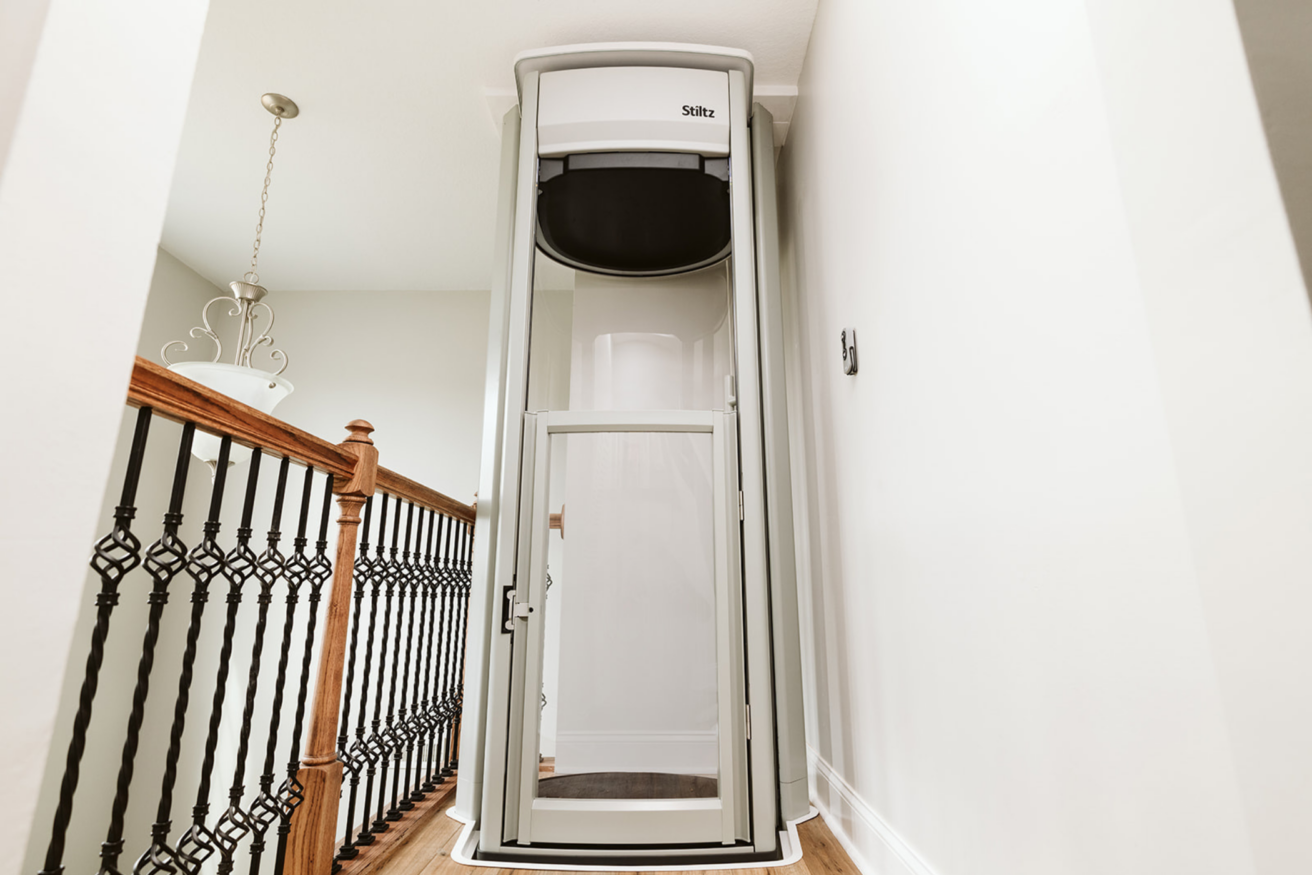
While fully shaftless, allowing them to save considerable space compared to hydraulic or traction systems that need a dedicated elevator shaft and separate machine room, the compact design of through-the-floor lifts does come with costs. They’re generally the slowest residential option, averaging 10–40 fpm. Because there’s no shaft to guide or stabilize the car, manufacturers intentionally cap the speed low for safety and structural stability.
Pneumatic Vacuum Elevator
30 to 40 fpm
Another shaftless option, pneumatic vacuum elevators (PVE), typically move at 30 to 40 fpm. They utilize air pressure to move the cab, rather than fluid or counterweights. More specifically, a turbine at the top of a sealed cylindrical tube creates a pressure differential that either pulls the car upwards or allows it to descend slowly. Speeds are intentionally kept low to allow for controlled changes in air pressure.
Other Factors That Influence Elevator Speed
Beyond the drive system, there are additional structural and practical factors that impact elevator speed. When installing your new system, technicians will consider these factors to maximize comfort while meeting local safety codes.
- Travel distance: Elevators that need to travel higher tend to move faster, out of both necessity and to keep travel times reasonable. After all, taller buildings require more powerful motors and reinforced shafts, boosting the overall speed. In some cases, skyscrapers use a sky lobby system, in which high-speed express elevators carry passengers to a transfer floor, where local elevators complete the trip to individual floors. This allows each system to be optimized for a specific speed range.
- Building structure: Aside from building height, residential and commercial structures also have unique layouts and traffic flow. For instance, a residential condo that frequently stops at multiple floors will have a lower average travel speed than commercial buildings like Taipei 101 or CTF Finance Center, which regularly transport passengers to the top floors. In the same vein, buildings with heavy foot traffic typically use advanced Variable Voltage, Variable Frequency (VVVF) drives to optimize acceleration and deceleration.
- Weight capacity: Elevators designed to carry heavy loads, including mobility aids like wheelchairs, scooters, and walkers, often move more slowly. The more weight that’s added, the more carefully acceleration and deceleration need to be controlled to maintain safety and reduce strain on the motor and cables.
- Long-term maintenance: Regardless of drive system type, regular checkups help properly maintain elevator components (motors, cables, pulleys, hydraulic pumps, etc.). That way, the elevator can keep moving at its intended speed. Neglected systems tend to slow down or become less consistent, as wear and tear affects both performance and safety.
Which Option Provides the Best Passenger Comfort For Seniors?
ll of the elevator types mentioned above can work great for seniors aging in place, though systems with higher weight capacities should be considered if you have a wheelchair.
As far as speed is concerned, a range of 20-30 fpm is preferable for elderly and disabled residents. Slower speeds provide a more comfortable and secure ride, especially during acceleration and deceleration, making it easier for seniors with limited mobility to enter, ride, and exit the system safely. Of course, if you live in a high-rise building or are looking for faster transportation, 40 fpm is also acceptable.
Frequently Asked Questions (FAQs) About How Fast Home Elevators Move
Commercial elevators can go very fast, with skyscrapers like the Burj Khalifa, Jeddah Tower, and Empire State Building regularly supporting speeds well over 1,000 fpm. Some Chinese skyscrapers even have elevators that travel over 4,000 fpm. In residential settings, however, speeds are usually capped at around 40 fpm.
The American Society of Mechanical Engineers (ASME A17.1) states that residential elevators should not exceed 40 fpm. With that in mind, most in-home installations range between 10 and 40 fpm, depending on the drive system.
Generally, no. Aside from the ASME A17.1 regulations, high-speed elevators also require reinforced shafts, specialized safety mechanisms, and far more powerful motors than a typical home can accommodate. This makes them impractical and unnecessary for residential use.
Yes, faster elevators are usually pricier because they require more powerful motors and reinforced shafts. For example, traction elevators are among the fastest residential installations and have a price range of $26,500 to $85,000+. On the other hand, through-the-floor lifts are one of the slowest options and usually cost less than $60,000.
Consistent maintenance is key to keeping your elevator running at its intended speed. For instance, motors, cables, and pulleys should be inspected periodically for wear, while hydraulic systems need their fluid levels and seals checked regularly. We generally recommend scheduling routine professional inspections once a year to help maintain its speed, comply with local safety regulations, and extend its overall lifespan.
Help us improve our data! Email your latest home elevator quote to [email protected] or submit a review about your experience. Your personal details will remain completely confidential.