
Retirement Living takes an unbiased approach to our reviews. We may earn money when you click a partner link. Learn More
Wearable sensors show promise for tracking mobility in knee osteoarthritis
They could replace more sophisticated and expensive technology

Updated:
key insights:
- Foot-mounted wearable sensors measured walking speed, stride length, and step frequency with accuracy comparable to laboratory motion-capture systems.
- The Yale-led pilot study included 20 people — half with knee osteoarthritis — and analyzed thousands of strides across three walking tests.
- Researchers say larger, longer studies are needed before the technology can be used to monitor patients’ everyday mobility or treatment response.
Small sensors worn on the feet could eventually help clinicians monitor how people with knee osteoarthritis move outside the doctor’s office, according to a new Yale-led study.
The research found that wearable sensors produced measurements closely matching those of sophisticated laboratory motion-capture equipment. The results point to a potentially more practical way of collecting objective information about patients’ mobility during daily life.
Knee osteoarthritis causes pain, cartilage deterioration, and reduced mobility. Clinicians typically assess its progression using X-rays, patient questionnaires, and examinations, but those methods offer limited insight into how people move beyond the clinic.
“Clinical evaluations in a doctor’s office only give us a snapshot,” said Dr. Charles Odonkor, an associate professor of orthopedics and rehabilitation at Yale School of Medicine and the study’s first author. The researchers wanted to determine whether wearable devices could provide an accurate view of movement without requiring a dedicated motion laboratory.
Small study
For the pilot study, investigators recruited 20 participants: 10 with clinically confirmed knee osteoarthritis and 10 without conditions affecting lower-body movement.
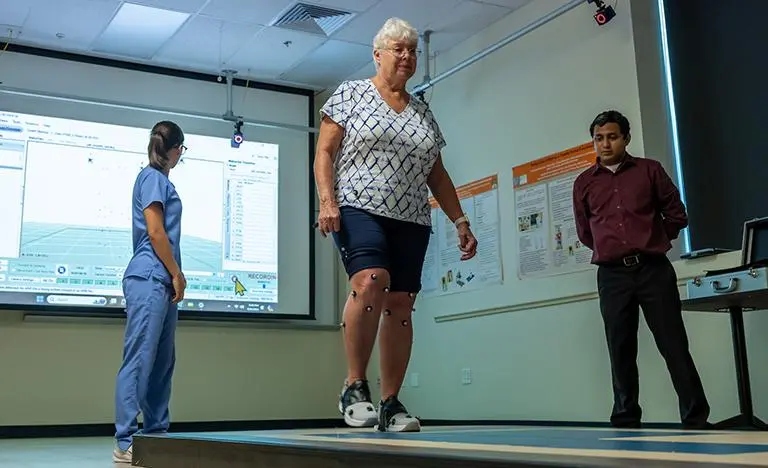
Each participant completed three standardized assessments — a self-paced walk, a fast-paced walk, and a six-minute endurance test. Small sensors attached to the top of each foot recorded acceleration and rotation, while an optical motion-capture system simultaneously tracked reflective markers placed on the participants’ bodies.
Motion-capture laboratories use multiple infrared cameras and are considered the gold standard for movement analysis. By analyzing thousands of individual strides, the researchers were able to compare measurements from the wearable devices directly with those from the laboratory system.
The two methods showed near-perfect agreement when measuring walking speed, stride length, and cadence – the number of steps taken per minute. Agreement was particularly strong for walking speed, according to the researchers.
The study also explored whether sensor data reflected differences in participants’ self-reported physical activity. More active participants tended to walk faster and take longer strides. Those who described themselves as inactive appeared to spend more time with their feet flat on the ground and displayed different push-off patterns.
Those activity-related differences did not reach statistical significance, however, and should be interpreted cautiously because of the study’s small sample. Researchers said the findings nevertheless suggest that wearable devices may be capable of detecting subtle changes in walking mechanics associated with activity levels.
What it means
If validated in larger studies, such measurements could help identify functional decline before it becomes apparent during a routine examination. The technology might also allow clinicians and researchers to assess how mobility changes as osteoarthritis progresses or in response to treatments such as physical therapy and surgery.
Wearable sensors could address some of the limitations of patient questionnaires, which depend on memory and may understate or overstate symptoms and activity. They could also provide information about everyday movement that cannot be captured by an X-ray or a short clinical assessment.
The researchers cautioned that the present study evaluated participants during a single laboratory session and compared groups at only one point in time. Longer studies involving more participants — and testing the sensors in homes and other real-world settings — will be necessary before the technology can be adopted for routine monitoring.