
Retirement Living takes an unbiased approach to our reviews. We may earn money when you click a partner link. Learn More
Best Waterproof Medical Alert Systems of 2026
Our top waterproof medical alert devices let you shower independently while still feeling safe.


Updated:
Medical alert devices are lifesaving tools that connect you to a monitoring center and emergency services (if needed). A waterproof one is even more valuable. Water-resistant is nice, but waterproof is where the real safety lies. You can wear a waterproof device in the shower, during a full tub soak, or even while swimming, where fall risks increase. Our research revealed four brands – Bay Alarm Medical, Medical Guardian, ADT Medical Alert, and Lifeline – that are waterproof and meet our other criteria.
Bay Alarm Medical
4.7
- Great customer service
- Vial of Life included with purchase
- Free spouse monitoring
See More
Bay Alarm Medical is a medical alert system offering 24/7 monitoring and trained professionals to help in urgent times of need. Bay Alarm Medical has been protecting its clients for almost 70 years. Highlights for the company include free monitoring for spouses and for other family members, as well as overwhelmingly positive customer reviews. Considering the customer accolades, Bay Alarm Medical deserves our 2018 “Great Service” award.
Medical Guardian
4.7
- Great variety
- Call chain for caregivers
- Sleek, stylish wearable devices
See More
Medical Guardian offers five medical alert system packages, including options for use at home and on the go. Monthly subscription prices start around $30.
ADT Medical Alert
4.4
- Great plans
- Home temperature monitoring
- Fixed-rate service
See More
ADT Medical Alert is part of ADT Security Services, which has been in business for more than 140 years. The first product was a telegraph box designed to call for help when police departments could not always be summoned quickly. Today, ADT Medical Alert and On-the-Go personal emergency response systems provide seniors with immediate access to help along with home and GPS location monitoring.
Lifeline

4.4
- Great reputation
- Professional installation option
- GPS with five location technologies
See More
Lifeline, formerly Philips Lifeline, offers On the Go and HomeSafe medical alert systems. The HomeSafe works with a landline or cell signal. Both systems include access to the My Lifeline mobile app, which allows you to contact support, test your system, and update your contact list.
Compare Our Top Waterproof Medical Alert Picks
| Company | Best For | Waterproof IP Rating | Submersion Depth and Time | Fall Detection |
|---|---|---|---|---|
| Bay Alarm Medical | Easiest to use waterproof devices | IP67 | Not specified | Optional |
| Medical Guardian | Longest range for waterproof alert buttons | IP67 | Not specified | Optional |
| ADT Medical Alert System | Best for bathroom safety | IP67 | 3 feet for 30 mins | Optional |
| Lifeline | Best for AARP members | IP67 | 1 meter for 30 mins | Optional |
Waterproof Medical Alert Systems Reviews
Bay Alarm Medical Review
Great customer service
|
Why we chose it
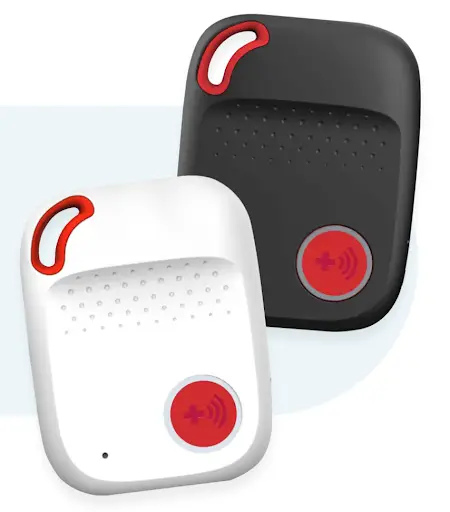
Bay Alarm Medical sells four medical alert systems, with wearable medical alert pendant or wristband buttons you can wear in the shower. The SOS All-In-One 2 is IP67-rated and designed for full submersion. Setup is exceptionally easy: a single button, no mobile app, no screens, and no settings. Automatic fall detection is optional and an add-on cost. A 15-day risk-free trial lets you test the device before committing to payment.
Pros
- 45-second response time from the monitoring center
- 15-day risk-free trial period
- Free spouse monitoring add-on
Cons
- Additional equipment fees for additional emergency buttons
- Frequently need to be charged
- No landline-only option beyond SOS Home
Waterproof performance
The SOS All-In-One 2 survives about three feet of water for 30 minutes, well past shower exposure, though it shouldn’t sit fully submerged in a pool or bathtub for long stretches. Waterproof wall help buttons are also available as an add-on.
What reviewers say
Bay Alarm Medical holds a 4.8 out of 5 rating on Google from over 19,000 reviews, with fast response times the most common praise.
For more information, read our full Bay Alarm Medical review.
Medical Guardian Review
Great variety
|
Why we chose it
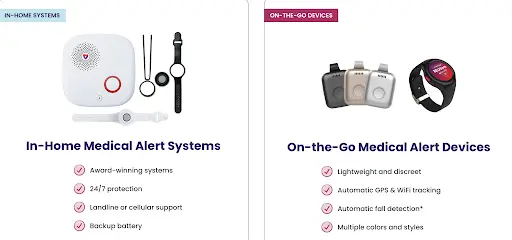
Medical Guardian offers five systems, two for the home and three for on the go: MGHome Landline, MGHome Cellular, MG Mini, MG Mini Lite, and MG Move. Every wearable device in the lineup is IP67-rated and shower-safe.
The Medical Guardian in-home systems have a range of up to 1,400 feet, the longest on our list. The equipment is backed by a lifetime warranty covering normal wear as long as you keep your subscription active.
Pros
- Every wearable device is waterproof
- In-home range reaches up to 1,400 feet
- Choosing annual billing waives the equipment fee and covers shipping
Cons
- Equipment fee applies unless you choose annual billing
- Runs slightly higher in price than some competitors
- Fall detection is a paid add-on
Waterproof performance
The MGMove and MGMini devices are IP67-rated, safe for the shower. All devices work the same wet or dry, giving you that extra peace of mind as you age in place.
What reviewers say
Medical Guardian holds a 4.6 out of 5 rating on Google from over 1,500 reviews, with billing and returns the most common complaints.
For more information, read our full Medical Guardian review.
ADT Medical Alert Review
Great plans
|
Why we chose it
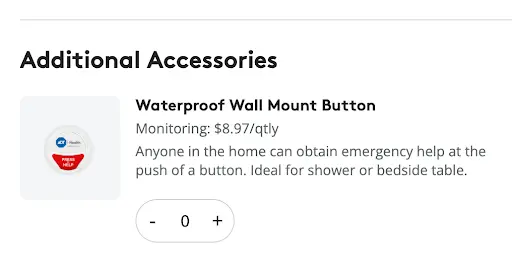
ADT’s lineup includes Medical Alert Basic, Medical Alert Plus, and On-The-Go. Your monthly rate is fixed and locked in – great if you’re on a fixed monthly budget. ADT’s standout device is a waterproof, wall-mounted button you can mount low near the tub or shower, where falls are most likely. This puts help within reach even if you aren’t wearing a medical alert device.
Pros
- Wall button with an IP67 rating, just like the wearable pendant
- Locked-in monthly price that won’t increase after signup
- Includes home temperature monitoring
Cons
- Smallest in-home range of our four picks
- Activation fee
- Wall button is a paid add-on, not included by default
Waterproof performance
ADT builds the wall button from the same sealed hardware as its wearable buttons, so it carries the same IP67 rating even though it stays mounted rather than worn. That means it can take a direct shower spray without issue. It comes with adhesive mounting hardware, so you can place it within easy reach if you fall. The button has no speaker. Pressing it opens communication through your base unit instead.
What reviewers say
ADT Medical Alert holds a 4.6-star rating on ConsumerAffairs from more than 600 reviews, with a short in-home range the most common complaint.
For more information, read our full ADT Medical Alert review.
Lifeline Review
Great reputation
|
Why we chose it
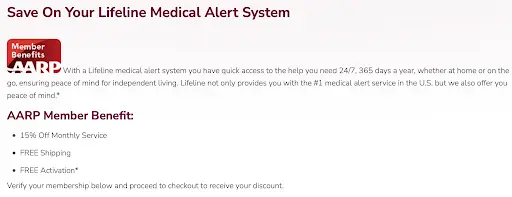
Lifeline, formerly Philips Lifeline, has monitored seniors since 1974 and now serves more than 7.5 million subscribers. The average response time is about 12 seconds. It’s the top pick for AARP members because of a partnership that other brands simply don’t have. Members save 15 percent on monthly service and get free shipping and activation.
Pros
- More affordable for AARP members: 15 percent monthly savings plus free shipping and activation
- All devices are waterproof
- Advanced GPS tracking
Cons
- Setup fee on most systems
- Smaller in-home range than others
- Limited device lineup compared to competitors
Waterproof performance
Lifeline states its help buttons, mobile devices, and smartwatch are all waterproof up to one meter of water for 30 minutes. This matches an IP67 rating. AARP-discounted plans use the same equipment as standard plans.
What reviewers say
Lifeline holds a 2.7 out of 5 rating on ConsumerAffairs from more than 5,000 reviews, with billing disputes the most common complaint. However, reviewers frequently praise the response center’s communication and ease of use.
For more information, read our full Lifeline review.
Methodology: How We Chose the Best Waterproof Medical Alert Systems
We narrowed this list to four companies from our broader guide on the best medical alert systems. This time we focused on the brands’ IP rating, subscription depth and time limits, fall detection, GPS, and ease of use. We verified pricing and ratings directly against each company’s own website. Our standout brands include: Bay Alarm Medical, Medical Guardian, ADT Medical Alert, and Lifeline.
Waterproof Medical Alert Buyers Guide
When looking for a waterproof medical alert system, waterproofing is just one piece of choosing the right option for you. Range, GPS location tracking, monthly cost, and fall detection matter just as much and are worth researching and comparing.
What to Look for In a Medical Alert System That Is Waterproof
As you research waterproof medical alerts, the biggest thing to look for is the waterproof rating. Some devices are water-resistant, meaning they can handle a splash or two; others are waterproof. Waterproof medical alert devices work the same, but they’re designed to withstand full submersion. They’re tested against an IP rating, and most medical alert brands aim for IP67. A 6 rating handles a hard spray, not a dunk. A 7 survives underwater, about a meter deep, for 30 minutes. In-home systems only need the wearable button sealed that well, since the base plugs are usually outside the bathroom. Mobile GPS devices don’t get that shortcut. The whole unit has to be sealed, which is one reason mobile plans cost more.
Waterproof Medical Alert Features
Specific features to look for in a fully waterproof medical alert device include:
- IP rating: Look for IP67 or higher on any device marketed as waterproof. That’s the standard that covers full submersion, not just splashes.
- Submersion depth and time limits: These details vary slightly between brands for pendants and wristbands.
- Fall detection accuracy: Waterproof medical alert necklaces and bracelets tend to register falls more reliably than wrist-worn devices.
- Ease of use: A waterproof medical alert bracelet should work the same wet or dry, but if dexterity or vision is a concern, look for a single large button instead of multiple controls.
Waterproof Medical Alert Limitations
There’s a big misconception that “waterproof” means a device can handle anything wet, when it really means it passed one specific test to determine the waterproof rating. In medical alert devices, that rating means that shower-safe isn’t the same as pool-safe. Push a device past that rating limit and water can reach the internal electronics. Most manufacturers won’t cover that kind of damage under warranty.
Types of Waterproof Medical Alert Systems
The waterproof design varies depending on the type of system you choose. Take a look at your options:
- In-home landline or cellular systems: These connect a base station to a monitoring center over a landline or cellular connection. Only the wearable button needs to be waterproof.
- Mobile GPS systems: Mobile systems put the connection, GPS, and speaker into the wearable itself, so the whole unit has to be waterproofed, not just a button.
- Non-monitored waterproof medical ID jewelry: Non-monitored medical ID jewelry doesn’t connect to a response center. It’s a waterproof medical ID bracelet or pendant with medical information for first responders, a low-cost supplement rather than a replacement.
Waterproof Medical Alert Costs
Monitored medical alert systems typically cost between $20 and $60 a month, according to the National Council on Aging. Most monitored systems bill a flat monthly fee, while fall detection, GPS, and caregiver apps are priced as add-ons. Because waterproofing is built in, it doesn’t affect price. Waterproof medical alerts align with standard medical alert pricing.
Among our picks, plans start around $27.95 a month for basic in-home service and run up to roughly $49.95 a month for mobile GPS plans, with fall detection adding $9.99 to $11 a month. ADT and Lifeline both charge a one-time setup fee (about $99.99 and $99.95). Bay Alarm Medical’s in-home plan and Medical Guardian charge none.
Pros and Cons of Waterproof Medical Alert Systems
Waterproof designs solve one of the most common safety gaps in medical alert systems. A device gets left on the nightstand because it isn’t shower-safe, and then it’s not there when you need it. Buying a specific waterproof medical device can give you peace of mind while you age in place. Take a look.
| Pros | Cons |
|---|---|
| ✅ Can be worn in the shower or bath, where many falls happen | ❌ Water damage from exceeding the rated depth or time limit usually isn’t covered under warranty |
| ✅ More likely to be worn, since it doesn’t need to come off for the shower | ❌ Still needs to be pressed, or paired with fall detection |
| ✅ No extra cost for waterproofing | ❌ Sealed housings can make repairs harder, since the device isn’t designed to be opened |
| ✅ Wall-mounted buttons keep help within reach in the shower or bath, even when a wearable isn’t being worn |
Frequently Asked Questions (FAQs) About Waterproof Medical Alert Systems
Yes, most newer medical alert systems are waterproof. But note that water-resistant and waterproof are different. Modern wearable devices are usually rated IP67 and can be fully submerged. Older or budget devices usually don’t carry that rating and can handle splashes, not full submersion.
If a waterproof medical alert device has an IP67 rating, then it will perform normally when wet.
Lifeline is the only company here with a dedicated AARP discount. Members get 15% off monthly service, plus free shipping and activation, on the same waterproof equipment every customer gets.
An IP, or Ingress Protection, rating is a two-digit standard measuring dust and water resistance. The second digit covers water, from 0 (none) to 9 (high-pressure jets). Look for IP67 for shower safety.
Monitored waterproof systems here start around $27.95 a month for basic in-home plans and run up to roughly $49.95 a month for mobile GPS plans. Waterproofing itself isn’t a separate charge. It’s built into the base device.
Concluding Thoughts on Waterproof Medical Alert Systems
An IP-rated waterproof wearable means you don’t have to take it off for the shower and forget about it. But that’s not all to look for. Range, monthly cost, and fall detection also matter for waterproof devices. The right pick is the one that best meets your needs and that you’ll actually wear and use. Our top picks, Bay Alarm Medical, Medical Guardian, ADT Medical Alert System, and Lifeline all have the waterproof coverage down and offer plenty of options for you to find the right one to meet your needs.