
Retirement Living takes an unbiased approach to our reviews. We may earn money when you click a partner link. Learn More
Does Insurance Cover Walk-In Tubs?
Walk-in tub coverage depends on the insurance policy and your plan’s specific details.


Updated:
At a glance:
- Walk-in tubs are usually excluded from private health insurance because they’re considered a home modification.
- Although Medicare A and B won’t cover a new tub, Medicare Advantage might.
- Your state may offer HCBS programs that can help cover the cost of a walk-in tub.
Does insurance cover walk-in tubs? Nearly 40% of seniors have both Medicare and private insurance to help cover their health expenses, but that doesn’t automatically mean that their policies include the cost to purchase and install a walk-in tub. Find out when insurance is most likely to cover this type of home modification and what alternatives you can explore to get the tub you want.
Does Insurance Cover Walk-In Tubs?
If you’re wondering, “Will insurance cover walk-in tubs,” the answer largely depends on the type of policy you have and where you live. Coverage differs sharply between Medicare, Medicaid, private health insurance and long-term care insurance, so you need to understand how each type of policy works.
Why Walk-In Tubs Are Often Excluded
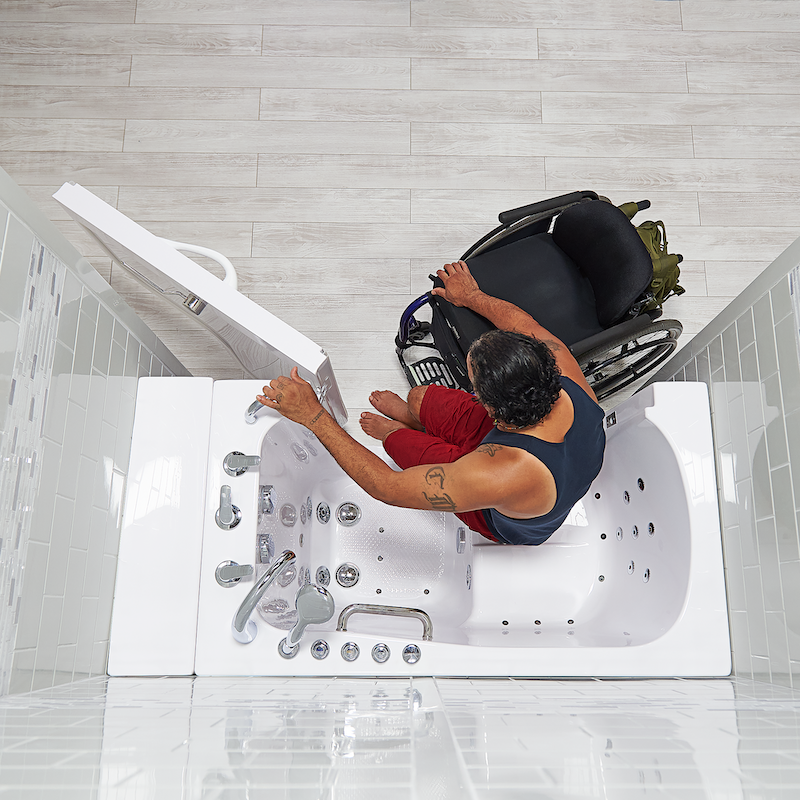
Most insurers deny coverage for walk-in tubs because they’re considered a home modification instead of a piece of medical equipment. Instead of simply bringing in the tub like you would a walker, the tub must be permanently installed in order to work properly.
When Medical Necessity Can Help
Sometimes insurers may approve coverage for a walk-in tub if your doctor formally prescribes it with a letter of medical necessity. Example conditions that may benefit from soaking in a tub include multiple sclerosis and osteoarthritis.
What Costs Insurance Might Reimburse
If you secure a physician’s letter of medical necessity or get an approved occupational therapy recommendation, you may be able to apply for partial coverage or reimbursement for your walk-in tub. Just know that most insurance payouts are distributed as a reimbursement after a claim rather than an upfront payment.
Medicare Coverage for Walk-In Tubs
Medicare can help pay for a variety of types of equipment within the home, but walk-in tubs can pose some difficulty depending on which plan you have. Whether it’s covered depends on which type of Medicare you have.
Original Medicare Part A and B
Walk-in tub insurance coverage is often excluded from Medicare policies because they’re considered home modifications instead of durable medical equipment (DME). Medicare Parts A and B, for example, define eligible DME as not being useful to anyone who doesn’t have an illness or injury. Because anyone in the home could use the walk-in tub, it’s usually not covered by Medicare.
Medicare Advantage Home Modification Benefits
Medicare Advantage (Part C) plans offer better opportunities for coverage than Original, but it still depends on which plan you purchase. However, Part C does include additional coverage for home modifications if they include improvements, such as grab bars, safety equipment, and possibly walk-in tubs.
Some plans even include annual allowances for home modifications. If you have Advantage, read through your Evidence of Coverage document to determine if a walk-in tub would qualify for supplemental benefits.
How to Ask Your Plan About Coverage
If you’re considering purchasing a walk-in tub and you plan on using Medicare benefits to help pay for it, contact your insurer before you fully commit. One study shows that only about 21% of individual Medicare Advantage plans and 47% of Advantage Special Needs plans include coverage for home safety. Whether a particular plan considers walk-in tubs a factor for bathroom safety will depend on the provider.
Speak with a representative and review your EOC (Evidence of Coverage) to learn more about your plan’s benefits. If a walk-in tub is not covered, you may want to consider switching providers and plans. You can use Medicare Plan Finder to locate and compare plans.
If your plan does cover walk-in tubs, you’ll likely need to purchase from an approved provider and have it installed by a licensed contractor. If you don’t, your claim could be denied, which would make you responsible for the full cost of both the tub and its installation.
Medicaid Coverage and HCBS Waivers
Medicaid may help those who are eligible pay for a walk-in tub through programs that cover home accessibility and medical equipment. Coverage varies state by state, and you’ll have to meet certain eligibility requirements to qualify.
How State Rules Affect Coverage
Medicaid may be more likely than Medicare to help pay for a walk-in. However, because Medicaid is jointly funded by federal and state governments, coverage and eligibility requirements vary state by state.
Some states provide financial assistance for home accessibility improvements through Medicaid waiver programs. If a program is available, it may help pay for the purchase and installation of a walk-in tub in your home.
To see if your state offers a program like this, contact your state’s Medicaid agency. A representative will be able to discuss what options are available to you and walk you through the application process if you qualify.
HCBS Waivers and Home Modifications
Some states offer assistance through HCBS waiver programs. Standing for Home and Community Based Services, HCBS programs help people receive aid in their own homes rather than having to go to an external site.
Depending on your state and waiver, a walk-in tub may qualify for funding because it would help address mobility issues and reduce the physical risks that occur with bathing. Funding will vary with each program, but it may help with purchase and installation.
Additionally, HCBS waiver programs have funding caps. Because of this, you may want to try checking back periodically throughout the year. There may be waiting lists, program changes, or funding cycles that open the program back up for applications.
Documentation Needed for Approval
If your state offers Medicaid assistance for a home modification, you may need a letter from your physician or occupational therapist. The program may also require a formal assessment to determine your needs.
It’s possible your state may also require purchase price and contractor estimates before approving the project. If this is the case, start gathering the appropriate paperwork and estimates early so your application isn’t affected by missing documentation.
Start with your state’s Medicaid agency to see what is available. If you have any issues finding programs, move your search to the Centers for Medicare & Medicaid Services (aka CMS). They may have information about Medicaid and HCBS programs you qualify for, what you need to apply, and any paperwork you’ll need to provide throughout the whole process.
Other Ways to Pay for Walk-In Tubs
Medicare and Medicaid may not be your only options for financing a walk-in tub. If you’re a veteran or homeowner, you may qualify for certain grants that cover home improvements for accessibility.
VA Programs
Veterans and service members who have disabilities related to their service may qualify for one of four grant programs through the U.S. Department of Veterans Affairs. Each has its own set of service-connected disabilities and other eligibility requirements.
Home Improvements/Structural Alterations (HISA) Grant
Walk-in tubs may qualify for this grant, as long as it’s not considered a spa, hot tub, or jacuzzi. To qualify, you must show that your home needs medically necessary improvements due to a service-connected disability. The maximum grant amount is $6,800.
Specially Adapted Housing (SAH) Grant
You must own the home you plan to modify with grants up to $126,526. Eligible disabilities include:
- Loss or loss of use of more than one limb
- Loss or loss of use of a lower leg and a related disease or injury
- Total blindness
- Severe burns
- Loss of use of one lower extremity after 9/11/2001
Special Home Adaptation (SHA) Grant
Funding can be used on a home owned by you or a family member. To qualify, you must have lost the use of both hands, have severe burns, or suffer from respiratory or breathing injuries. Get up to $25,350.
Temporary Residence Adaptation (TRA) Grant
This grant is made for updating a family member’s home in which you live. To apply, you need to meet the requirements for either the SAH or SHA grant. The TRA grant provides funds between $9,100 and $50,961.
USDA Programs
The USDA Rural Repair and Rehabilitation Loans and Grants can help low-income seniors in rural areas pay for home safety upgrades. Grants don’t need to be repaid and offer up to $10,000, while loans come with a low interest rate and let you borrow up to $40,000.
To qualify, you must be at least 62 years old, and your income must be below 50% of your area’s median income. Reach out to your nearest USDA Rural Development office to apply.
Insurance Options
There are a few different ways insurance policies beyond Medicare or Medicaid can help cover the costs of a walk-in tub. If you contribute funds to a Health Savings Account (HSA) or Flexible Spending Account (FSA), you could use that money to pay for your walk-in tub as long as your physician gives you a letter of medical necessity.
Another option could be if you have long-term care insurance. Your policy could include coverage for home modification, but the requirements may vary by insurer. Check your policy details to find out if you qualify.
Financing Options
Many walk-in bathtub manufacturers offer in-house financing or payment plans to help spread out the cost of your new tub. Some structure the financing as an installment loan paid over time while accruing interest. Others offer a “buy now, pay later” structure that breaks up payments into a few installments with no interest. But if you can’t meet those payments, you could accrue interest and late fees.
It’s also worth noting that in-house financing covers your tub purchase, but not installation costs. You’ll have to find another way to pay for that expense.
Tax Deductions
It’s possible to claim the cost of a walk-in tub as a tax deduction because it doesn’t improve the value of your home, but you need to meet a few eligibility requirements in order to qualify. You can only deduct eligible medical expenses that are more than 7.5% of your adjusted gross income, and you must itemize your taxes in order to take the deduction.
This also means that you’re responsible for covering the cost of the walk-in tub upfront, and the deduction can help reimburse you later on when you file your taxes for the year.
| Funding source | Who qualifies | What it may cover | How to apply |
|---|---|---|---|
| VA grants | Veterans and service members with eligible disabilities | Medically necessary home adaptations | Apply online through the VA |
| USDA rural grants | – 62+ – Low income – Eligible rural address | – Health and safety concerns – Accessibility modifications | Contact the closest USDA Rural Development office |
| Long-term care insurance | Policyholders with home modification coverage included | Home modification upgrades, potentially including walk-in tubs | Contact your insurance company |
| HSA or FSA | HSA or FSA account holders with a letter of medical necessity from a physician | Paying for your walk-in tub with your account funds | Use your account debit card to purchase your tub |
| Retailer financing | Buyers who meet their financing requirements | Walk-in tub, but not installation | Apply through a retailer’s website or store |
| Tax deduction | Taxpayers whose medical expenses exceed 7.5% of their AGI and who itemize taxes | Expenses related to the walk-in tub, as long as they don’t add value to the home | Claim the deduction on Schedule A of your Form 1040 when you file taxes for the year of purchase and installation |
Frequently Asked Questions (FAQs) About If Insurance Covers Walk-In Tubs
No, Medicare does not pay for walk-in bathtubs for seniors. Walk-in tubs do not meet Medicare’s requirements to qualify as durable medical equipment.
You should expect to pay anywhere between $5,500 and $33,000 or more for a walk-in tub. That includes the tub itself as well as installation costs.
Typically, insurance policies through Medicare or a private insurer do not cover walk-in tubs for seniors. Some long-term care insurance policies cover home modifications, and you may be able to use your HSA or FSA funds if the tub is deemed medically necessary.
Medicaid might pay for a walk-in tub, but it depends on your state’s benefits. In addition to Medicaid coverage, seniors may also qualify for Home and Community-Based Services waivers that could potentially cover the cost of a walk-in tub.
Article Sources
Retirement Living writers primarily rely on government data, industry experts, and original research from other reputable publications to inform their work. Specific sources for this article include:
- United States Census Bureau, “Dual Health Insurance Coverage Declining For Adults Age 65 and Over.” Accessed Nov. 11, 2026.
- Consumers Unified, LLC DBA ConsumerAffairs, “Does Insurance Cover Walk-In Tubs?.” Accessed Nov. 11, 2026.
- National Council on Aging, Inc., “Does Medicare Cover Walk-In Tubs?.” Accessed Nov. 11, 2026.
- Barrier Free Store, “Are Walk-in Tubs Covered by Medicare?.” Accessed Nov. 11, 2026.
- KFF, “Medicare Advantage 2026 Spotlight: A First Look at Plan Premiums and Benefits.” Accessed Nov. 11, 2026.
- Centers for Medicare & Medicaid Services, U.S. Department of Health and Human Services, “Home & Community-Based Services.” Accessed Nov. 11, 2026.
- New York State Department of Health, “GUIDELINES FOR AUTHORIZING ENVIRONMENTAL MODIFICATIONS.” Accessed Nov. 11, 2026.
- Centers for Medicare & Medicaid Services, “Application for a §1915(c) Home and Community-Based Services Waiver.” Accessed Nov. 11, 2026.
- MVP Health Care, “Annual Product Certification: 2025 MVP Medicare Advantage Product Training.” Accessed Nov. 11, 2026.
- U.S. Department of Veterans Affairs, “Home Improvements/Structural Alterations (HISA).” Accessed Nov. 11, 2026.
- U.S. Department of Veterans Affairs, “Disability housing grants for Veterans.” Accessed Nov. 11, 2026.
- National Council on Aging, Inc., “What Is the USDA Single Family Housing Repair Loans and Grants Program?.” Accessed Nov. 11, 2026.
- Consumers Unified, LLC DBA ConsumerAffairs, “Does Insurance Cover Walk-In Tubs?.” Accessed Nov. 11, 2026.
- Ella’s Bubbles, “Finance Walk-In Bathtub – Financing Payment Plan Options.” Accessed Nov. 11, 2026.
- Experian, “What Happens if I Can’t Make My BNPL Payment?.” Accessed Nov. 11, 2026.
- Internal Revenue Service, “Publication 502 (2025), Medical and Dental Expenses.” Accessed Nov. 11, 2026.