
Retirement Living takes an unbiased approach to our reviews. We may earn money when you click a partner link. Learn More
Does the VA Cover Stairlifts?
If you’re an eligible veteran, the U.S. Department of Veterans Affairs (VA) offers financial assistance for stairlifts primarily in the form of Home Improvements and Structural Alterations (HISA), Special Home Adaptation (SHA), and Specially Adapted Housing (SAH) grants.


Updated:
AT A GLANCE:
- Eligibility for VA grant programs not only depends on your veteran status, but also on a VA doctor deeming the stairlift installation medically necessary.
- SAH, SHA and HISA grants each cover different levels of home modification costs depending on a veteran’s disability rating.
- Veterans must meet specific medical, home assessment, and documentation requirements before the VA approves stairlift funding.
Many veterans struggle with limited mobility, which can make aging in place difficult without accessibility equipment. Luckily, the Veterans Administration, referred to above as the VA, offers a few different grant programs that help seniors with service-connected disabilities pay for stairlifts and wheelchair lifts. Read on to learn whether you qualify and how to apply.
Will the VA Pay for a Stairlift?
While the VA doesn’t have a standalone “stairlift benefit” that pays for the equipment directly, veterans can get extra money to cover costs through VA home modification grants. Note that in official paperwork and grant descriptions, lifts are often referred to as “stair glides.”
When the VA May Approve Coverage
Veterans don’t automatically qualify for VA grants. Instead, you’ll first need to prove that the new lift is a medical necessity. Locate the nearest VA medical center, and an affiliate doctor can provide a letter of medical necessity (LMN) that explains why the stairlift is needed. As a general rule, having an official diagnosis or former injury that limits your mobility makes it easier to get this letter.
This is a crucial part of the approval process and also helps determine how much money you’ll qualify for. For instance, veterans with service-connected disabilities generally qualify for higher amounts than those with non-service-connected disabilities.
When Stairlifts Are Not Covered
The VA is unlikely to pay for stairlifts that haven’t been deemed medically necessary. It’s also possible that your disability rating might not be high enough for certain grant programs. However, unlike Medicaid grants, there are no income qualifications or limits that would prevent stairlift financial assistance.
Stairlift Coverage vs. Other Home Modifications
Traditional straight stairlifts fall under the same grant programs that cover many other accessibility upgrades, but because no structural modification is usually needed, they demand less funding. Conversely, other changes that could be approved, like widening doorways, wheelchair ramps, roll-in showers, or even home elevators, all require more extensive and potentially costly construction.
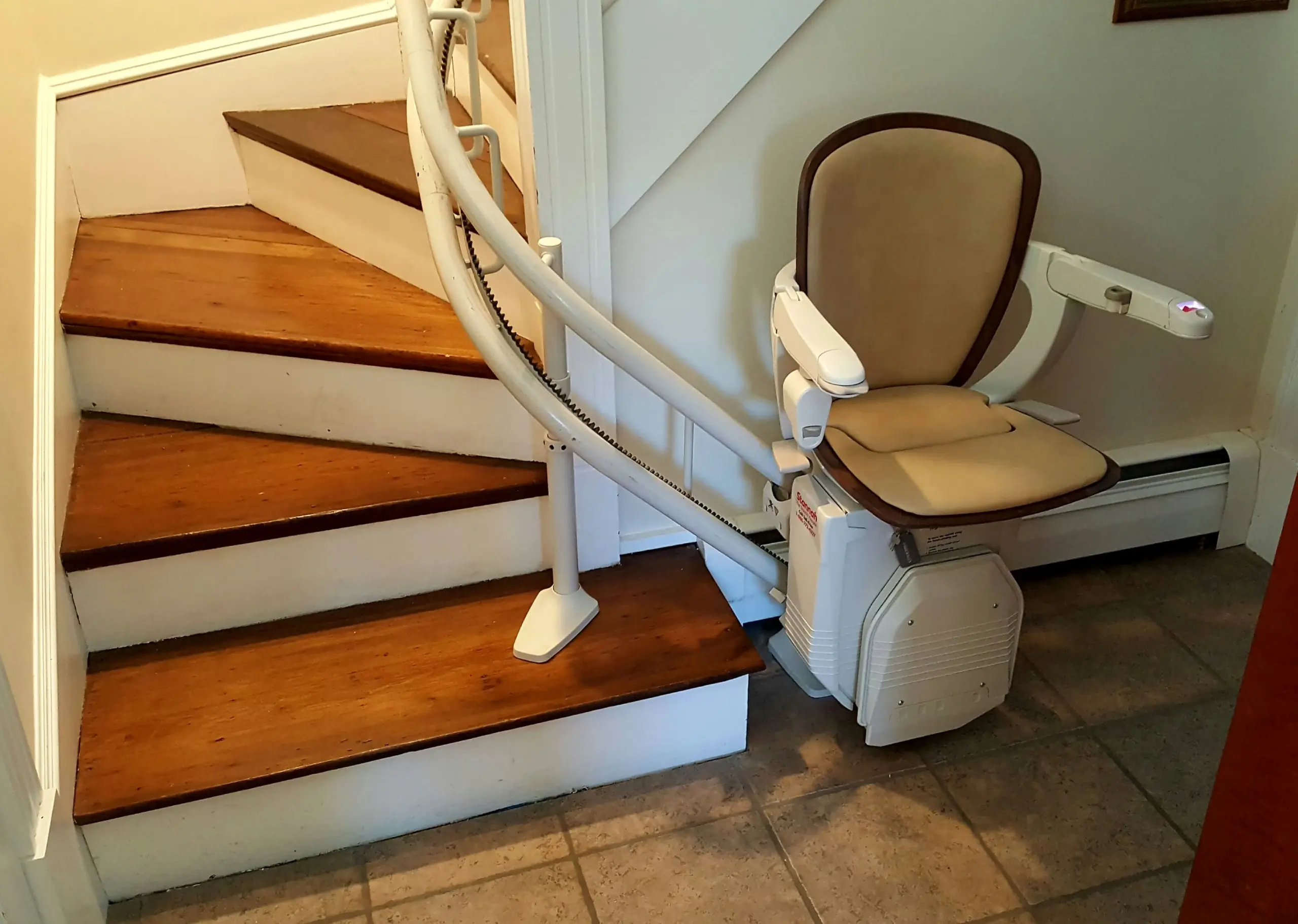
With that in mind, most straight stairlifts fit within lower grant limits. Curved stairlifts and wheelchair lifts might be an exception here, as the former demands expensive custom track pieces and the latter needs a wide enough staircase. So, if you have a curved or narrow staircase, you could benefit from a higher-tier grant program.
VA Grants That Can Help Pay For Stairlifts
There are three main VA grants that help pay for stairlifts:
- Home Improvements and Structural Alterations (HISA) grant
- Specially Adapted Housing (SAH) grant
- Special Home Adaptation (SHA) grant
The first is the most popular, while the latter two offer more funding for veterans with severe service-connected disabilities. Other options that can fill the gaps might be state-specific. Here’s how they all compare side-by-side:
| Program | What it pays for | Who qualifies | Typical max amount (2026) | How to apply |
|---|---|---|---|---|
| SAH grant | Building, buying, or modifying a home for accessibility | Veterans with qualifying service-connected disabilities | $126,526 | VA Form 26-4555 (online or by mail) |
| SHA grant | Adapting an existing home for disabilities | Veterans with qualifying service-connected disabilities | $25,350 | VA Form 26-4555 (online or by mail) |
| HISA grant | Medically necessary home improvements | Veterans enrolled in VA health care with a VA provider’s prescription | $6,800 (service-connected disabilities) or $2,000 (non-service-connected disabilities) | VA Form 10-0103 through your VA medical center’s prosthetics department |
| VA prosthetics and sensory aids | Equipment prescribed by a VA provider | Veterans enrolled in VA health care | Varies by clinical need | Ask your VA primary care provider |
| State veterans’ programs | Varies by state; some help with home modifications | Varies by state | Varies by state | Contact your state’s VA office |
SAH Grant Eligibility and Uses
The SAH grant is the VA’s largest home adaptation benefit. It’s meant for veterans with severe service-connected disabilities like:
- Loss or loss of use of certain limbs
- Blindness in both eyes
- Certain severe burn injuries
- Certain degenerative or neurological conditions (Parkinson’s, multiple sclerosis, ALS, etc.)
When these veterans need to build, buy or significantly modify a permanent home, the grant steps in to provide up to $126,526 in funding (as of 2026). You can use SAH or SHA funds up to six separate times over your lifetime, and you don’t have to use the full amount at once.
Just note that it’s usually used to fund broader structural changes, which most stairlifts don’t require, so it might be worth using it for bigger projects.
SHA Grant Eligibility and Uses
The SHA grant is similar to the previous option in the sense that it covers home changes that help veterans manage disabilities. However, it covers more types of disability, including the inability to use your hands and respiratory injuries. It also carries a lower maximum ($25,350) compared to SAH. Overall, the grant may cover up to 50% of the cost of the adaptations, up to the annual maximum.
HISA Grant Limits and Exclusions
Designed to make medically necessary changes to your home more affordable, an HISA grant is a lifetime benefit veterans can use until they reach the cap. The cap for those with service-connected disabilities is generally $6,800, while those with non-service-connected conditions can receive up to $2,000. If the lift costs more than the cap, you can still use the money for partial funding.
Unlike SAH, HISA also applies to renters as well as homeowners. Though, you’ll need a prescription from a VA provider, and any work must be approved before it begins.
Have a temporary living situation? When you’re eligible for an SAH or SHA grant but are staying with a family member for the time being, the Temporary Residence Adaptation (TRA) grant is another option. It applies to that exact situation, and you can use it once during your lifetime. The maximum is $50,961 for veterans eligible for SAH and $9,100 for those eligible for SHA.
Eligibility Requirements for VA Stairlift Assistance
Whether you qualify for VA grants largely depends on your medical needs and having the paperwork to back everything up. We’ve compiled a general list of eligibility requirements, but if you’re still not sure where to begin, we suggest reaching out to your local VA facility.
- Service-connected disability status: Both veterans with service-connected and non-service-connected disabilities can apply for and receive assistance from an HISA grant. However, those with service-connected disabilities are eligible for a higher benefit amount. Larger SAH and SHA grants require a qualifying service-connected disability.
- Disability rating: The VA ranks the severity of disabilities on a scale of 0% to 100%, in 10% increments. If you’re seeking help for a non-service-connected condition, a single service-connected disability rated at 50% or higher can qualify you for the higher benefit tier. The VA doesn’t combine multiple ratings to reach that 50% threshold.
- Clinical need: Stairlifts funding won’t be approved unless it’s medically necessary. You’ll need to get an LMN from a VA doctor that states your disability and details why you need the installation.
- VA health care enrollment: For the HISA benefit specifically, applications go through your local VA medical center. That means you’ll need to be enrolled in VA health care.
- Home ownership and residence: To get approved for an SAH grant, you’ll need to prove that you own or plan to own a permanent home. HISA is more flexible, though requests for proof of home ownership or landlord consent if you rent are possible.
- Medical prescription: A VA doctor’s prescription connects your medical condition to the home modification. For instance, the HISA application package must include a prescription written or approved by a VA physician, and that prescription should state your diagnosis and the medical reason you need the modification.
- Contractor requirements: You’ll need accurate quotes from contractors before the VA approves funding.
Documentation for VA Grant Applications
For an HISA application, you’ll need to submit VA Form 10-0103 with VA Prosthetic Services, not a regional office. Your submission should also include the VA physician’s prescription, contractor cost estimates, and proof of home ownership or landlord consent.
SAH and SHA applications use a different form. You apply using VA Form 26-4555, either online at VA.gov or by mail.
About Prior Grant Usage
Each program tracks the funds you’ve already used and has different rules regarding usage. As mentioned, HISA is a lifetime benefit, so money you received in the past counts against what’s left. For example, if you used $200 to install grab bars in your bathroom last year, you’ll have either $6,600 (service-connected disabilities) or $1,800 (non-service-connected disabilities) remaining.
For SAH and SHA, eligible veterans can use grant money up to six different times over a lifetime and don’t have to use the full amount in one year. The VA also notes that you can receive a HISA grant together with an SHA or SAH grant.
How to Apply for VA Funding: Step-by-Step
- Talk to your VA primary care provider. They’ll evaluate whether the stairlift is medically necessary and can refer you to a physical therapist or local Prosthetic and Sensory Aids Service.
- Get a prescription from a VA physician. They write and approve a prescription for your application. The prescription should include your diagnosis and the medical reason for the stairlift.
- Get a contractor estimate. Reach out to a local contractor for an itemized quote that breaks down both equipment and installation costs. The VA no longer requires multiple bids, but comparing a few different quotes can help you find the best stairlift price.
- Complete the right application form. Fill out VA Form 10-0103 for HISA grant applications. You can request an advance payment on the form, and you’ll need a notarized statement from the property owner if you’re renting. For an SAH or SHA grant, complete VA Form 26-4555.
- Submit your application package. For HISA, send the signed form, your doctor’s prescription and your itemized contractor estimate to the prosthetics department at the VA hospital. For SAH or SHA, you can apply online at VA.gov, mail the application or bring your form to a VA regional office.
- Wait for the VA’s review and a possible home inspection. Within 30 days of receiving the application, the VA will decide whether a home inspection is needed. If something is missing, you also have 30 days to send it before the application is closed; you can reopen it by submitting what was requested. Approvals for the larger SAH and SHA grants can take longer.
- Schedule the installation. Once approved, you’ll know the amount of money you’re authorized to use. Have the installation done as described in your application.
- Complete the final inspection and payment. For some stairlift projects, a VA rep will need to inspect your home to ensure everything was completed as described. Then, your final grant payment can be approved. If you got an advance payment, you’ll need to submit a request for final payment post-installation.
What if my application is denied? A notice from the VA will explain why you were denied and include your right to appeal. Most of the time, denials are caused by missing documents or a perceived lack of medical need. Ask your VA provider and prosthetics office what’s needed to resubmit.
Frequently Asked Questions (FAQs) About VA Stairlift Funding
The average cost of a stairlift in 2026 is $8,450, with a price range between $2,900 and $14,000. Refurbished and straight stairlifts tend to be on the cheaper end of the spectrum, while curved lifts and wheelchair lifts regularly exceed $10,000.
No veteran is automatically entitled to a free stair lift, but if you have a VA-approved medical need, you can likely get most of the cost covered through a VA home modification grant. It’s generally easier for veterans to get the full cost covered, as programs like Medicare don’t consider stairlifts durable medical equipment (DME) and therefore don’t cover them.
Even through the VA, stairlifts aren’t technically “free,” but the grants can cover most, if not all, of the cost. To qualify, you’ll need to prove that the lift is medically necessary with a VA doctor’s prescription and submit all the proper documentation.
Stairlifts are not directly covered by VA disability benefits. VA disability compensation is a monthly payment and doesn’t pay for accessibility or adaptive equipment. However, having a service-connected disability can help you qualify for VA home modification grants.
Help us improve our guides! If you’ve recently installed a stair lift or have insights on how yours works, we’d love to hear from you. Share your experience with us at [email protected]. Your personal details will stay completely confidential.