
Retirement Living takes an unbiased approach to our reviews. We may earn money when you click a partner link. Learn More
Stair Lift vs. Chair Lift: What’s the Difference?
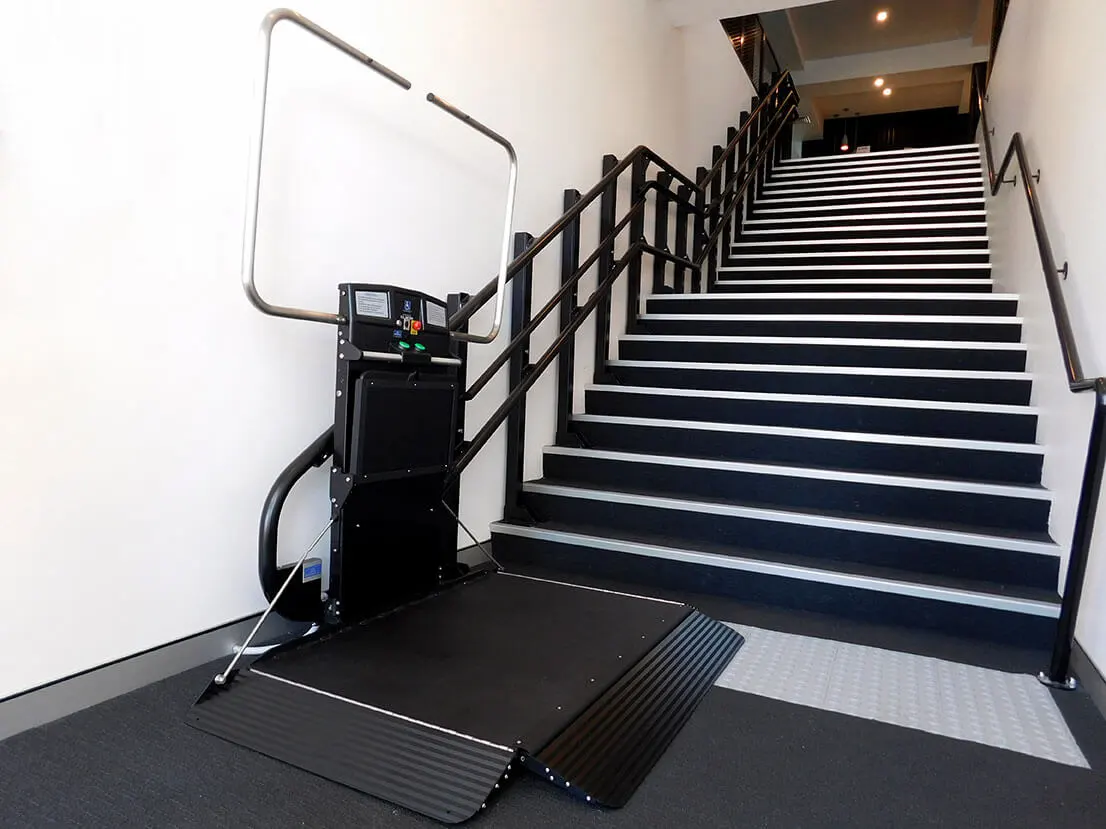
While often used interchangeably, stair lifts specifically refer to a seated, motorized chair that moves along a rail fitted to your staircase. Chair lifts, instead, have a wider platform that supports wheelchairs, scooters, and walkers.


Updated:
At a glance:
- Stair lifts are great for mild mobility challenges, allowing seniors to sit comfortably as they’re transported up the steps. The motorized chair can also be fitted with additional safety features such as swivel seats and footrests.
- A chair lift’s wider platform provides easier access for wheelchair users and others with severe mobility issues, as they don’t need to discard their mobility aids to use the system. Chair lifts typically have a higher weight capacity.
- Stair lifts are usually slightly less expensive ($2,900 to $14,000+) than chair lifts ($3,500 to $15,000+), though the cost for your home will depend on the staircase layout, your region, health insurance, the manufacturer, and your specific needs.
What Is a Stair Lift?
Stair lifts are motorized chairs that travel along a rail connected to the staircase. The chair can be fitted with high-quality seat belts, swivel seats, footrests, and more.
Straight stair lifts usually come pre-manufactured and are cut to size during installation, while curved stair lifts require a fully custom design. Either way, stair lift installation involves mounting the rail directly onto the stair treads with brackets placed at even intervals. The system must also connect to a nearby outlet to power its battery.
Once installed, the chair allows seniors with balance issues and other minor mobility concerns to sit comfortably as it transports them between floors. Because a traditional stair lift cannot carry wheelchairs, it isn’t the best option for wheelchair users, as they would have no easy way of getting their wheelchairs up the stairs.
Stair Lift Costs
Including installation, traditional stair lifts typically cost $8,250 on average ($2,500 to $14,000+). Straight stair lift models are on the lower end of that cost range, $2,500 to $9,000, because they require less customization than their curved counterparts ($10,000–$14,000). Traditional stair lifts can also be fitted with a variety of extra safety features that increase costs, including:
- Lift-up footrests
- Lift-up armrests
- Speed control
- Fold-up rails (manual or automatic)
- Seats that swivel, collapse, or tilt
- Obstruction detection
- Harnesses and seatbelts
- Higher weight capacity
- Calling systems or handheld remotes
Stair Lift Examples
| Brand / Model | Features | Pricing |
|---|---|---|
| Bruno Elite Straight Stair Lift | – 400 lb capacity – Folding rail, armrest, and footrest options – Indoor and outdoor options | $3,000 – $5,500 |
| Bruno Elite Curved | – Custom, hand-crafted railings – 400 lb capacity – Indoor and outdoor options | $10,000 – $20,000 |
| Harmar Pinnacle Stairlifts | – 400 lb capacity – Ultra-slim rail for tight spaces – Easy folding seat and footrest | $3,500 – $5,500 |
| Harmar Helix Curved | – Dual steel rail – Fast fabrication – Modular options for same-day installation | $8,000 – $15,000 |
| Handicare 1000 | – 350-440 lb capacity – Swivel seat for safe entry/exit – Optional powered hinge for the bottom landing | $2,000 – $5,000 |
| Handicare 4000 | – Twin- or single-tube rail options – 2-year manufacturer’s parts warranty – 6″ wall clearance for a tight fit | $9,000 – $16,000 |
| Acorn 130 | – 280-350 lb capacity – Modular design for quick installation and upgrades – foldable arms and seat | $2,800 – $5,000 |
| Acorn 180 | – Modular interlocking rails – Professional installation in just a few days – No structural changes to the home | $7,000 – $12,000 |
| Savaria Alpha Straight Stairlift | – 350-400 lb capacity – Compact folded width – Battery-powered operation | $3,500 – $5,000 |
| Savaria Stairfriend 23 | – Up to 350lb weight capacity – Compact 16″ folded width – LED diagnostics | $9,000 – $14,000 |
What Is a Chair Lift?
A chair lift, also known as a platform or wheelchair lift, operates similarly to a traditional stair lift but does not have a motorized chair. Instead, it offers a wider perch that can carry wheelchairs, scooters, walkers, and other mobility aids. Wheelchair users can rest in their chair as they’re lifted, and walker users can hold onto their walker in a comfortable standing position.
Installation is also similar, relying on a pre-measured rail that’s secured to the stair treads. However, chair lifts typically require more clearance and support for their wider platform and potentially higher weight capacity.
Please note that the terms “chair lift” and “lift chair” are not interchangeable. Lift chairs are powered recliners that help seniors sit and stand in a specific location and do not transport users between floors.
Chair Lift Costs
The cost for chair lift parts and installation averages at around $9,250 ($3,500 to $15,000+). The larger platform can increase costs compared to traditional stair lifts, but ultimately, the type of staircase plays a bigger role in the final price tag. Models built to address curved or multi-landing staircases will likely be on the higher end of the price range. Chair lifts can also be outfitted with a variety of extra features that increase costs, including:
- Larger or heavy-duty platforms
- Foldable or retractable side panels
- Higher weight capacity
- Power-operated wheelchair ramps
- Obstruction detection
- Weather-resistant enclosures
- Calling systems or handheld remotes
- Non-slip platform surfaces
Chair Lift Examples
| Brand / Model | Features | Pricing |
|---|---|---|
| Bruno VPL | – Up to 750 lb capacity – USA-made with a limited lifetime warranty – Customizable indoor and outdoor options | $5,000 – $12,000 |
| Harmar Highlander II | – 750 lb capacity – Stainless steel, rust-resistant coating – 3-year warranty on parts | $6,000 – $15,000 |
| Savaria Prolift | – Enclosed vertical platform – Reliable hydraulic drive – Multiple configurations available | $10,000 – $23,000 |
| Savaria Pegasus Inclined Platform Lift | – 660 lb capacity – For curved, multi-level, or intermediate landings – No major structural renovations required | $12,000 – $35,000 |
Which Mobility Solution Is Right For You
Not sure which mobility solution is right for you? Aside from seeking professional advice from your doctor or physical therapist, here’s a quick comparison to help guide your decision. Remember to consider your specific mobility needs, staircase layout, and budget before you invest.
A stair lift may be right for you if:
- Your mobility challenges don’t prevent you from walking short distances, sitting, or standing.
- You do not rely on a wheelchair, scooter, or walker full-time.
- You have a narrower staircase with limited clearance.
- You’re looking for a more budget-friendly option.
- You want a wider variety of brands and models to choose from.
A chair lift may be right for you if:
- You need a wheelchair, walker, or scooter with a higher weight capacity.
- Your mobility issues make it difficult to transfer in and out of a seated chair.
- You want to bring your mobility aid with you between floors without assistance.
- You are willing to pay more for greater accessibility.
- You need a solution that meets ADA compliance standards.
Our Takeaway: Stair Lift vs. Chair Lift Comes Down to Mobility Needs and Budget
Both stair lifts and chair lifts are an affordable way for seniors to achieve peace of mind in multi-story homes—at least compared to home elevators. Their main difference lies in the user they’re designed for. Stair lifts have a motorized chair that works well in narrow spaces and for seniors without mobility aids, while chair lifts offer a larger platform that can accommodate seniors using wheelchairs, walkers, or scooters.
If budget is your primary concern, a straight stair lift is the most cost-effective starting point. If you need better accessibility for mobility aids, a chair lift’s wider platform and higher weight capacity make it worth the price tag.
Frequently Asked Questions (FAQs) About Stair Lifts vs. Chair Lifts
You should get a traditional stair lift if you only have mild mobility concerns and a limited budget. Chair lifts are specifically designed to accommodate seniors who use wheelchairs and other mobility aids, and they usually come with a higher price tag.
No, the terms “chair lift” and “lift chair” refer to two different devices. A chair lift uses a platform to safely transport users between floors, while a lift chair is a powered recliner that helps users move between sitting and standing at a specific location.
VPLs are often considered wheelchair lifts, which would put them under the chair lift category. However, they are also a distinct type of mobility device designed for indoor or outdoor access to porches, decks, and basements.
Yes, both chair lifts and stair lifts can be custom-designed to fit curved staircases. In both instances, addressing curves increases the overall installation cost.
Original Medicare (Parts A and B) does not cover the cost of traditional stair lifts, but may cover the cost of a medically necessary wheelchair lift (chair lift). Wheelchair lifts are sometimes considered Durable Medical Equipment (DME), whereas traditional stair lifts are not. If you’re having trouble finding coverage, you can also reach out to Medicaid, Veterans Benefits, and local nonprofits.
Some of the best stair lift and chair lift brands include Bruno, Savaria, Lifeway Mobility, Arrow Lift, Harmar, Stannah, and Mobility123. All of these brands are well-reviewed, offer warranties, and have plenty of options that can be fitted to your staircase.
Help us improve our cost data! Email your latest stair lift quote to [email protected]. Rest assured, your personal details will remain completely confidential.