
Retirement Living takes an unbiased approach to our reviews. We may earn money when you click a partner link. Learn More
Home Elevator vs. Stair Lift
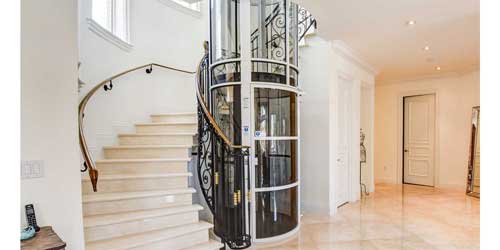
Stair lifts are far more affordable and easier to install than home elevators, while home elevators provide a more comprehensive solution for seniors with severe mobility issues.


Updated:
At a glance:
- On average, home elevators are six times more expensive than stair lifts—costing over $50,000, including installation. Stair lifts have an average cost of only $8,450.
- Stair lifts can be installed on or removed from the stair treads in as little as a few hours.
- Home elevators require structural modifications that can take several weeks, including a dedicated shaft (hoistway) or machine room.
- Home elevators often include platforms for wheelchair users and seniors with other severe mobility issues.
- Stair lifts are more suited for those who can still walk with minimal support.
With 71% of seniors wanting to age in place, rather than live in assisted living facilities or nursing homes, understanding home accessibility solutions has never been more important. Two of the most common options, stair lifts and home elevators, have unique pros and cons.
From cost differences to safety features for wheelchair users, we’ll discuss the key differences between both installations so seniors can choose the best home modification to invest in.
What Is a Stair Lift?
In simple terms, stair lifts are home modifications that help seniors with mobility issues age in place, rather than rely on assisted living facilities or nursing homes. How exactly do they work?
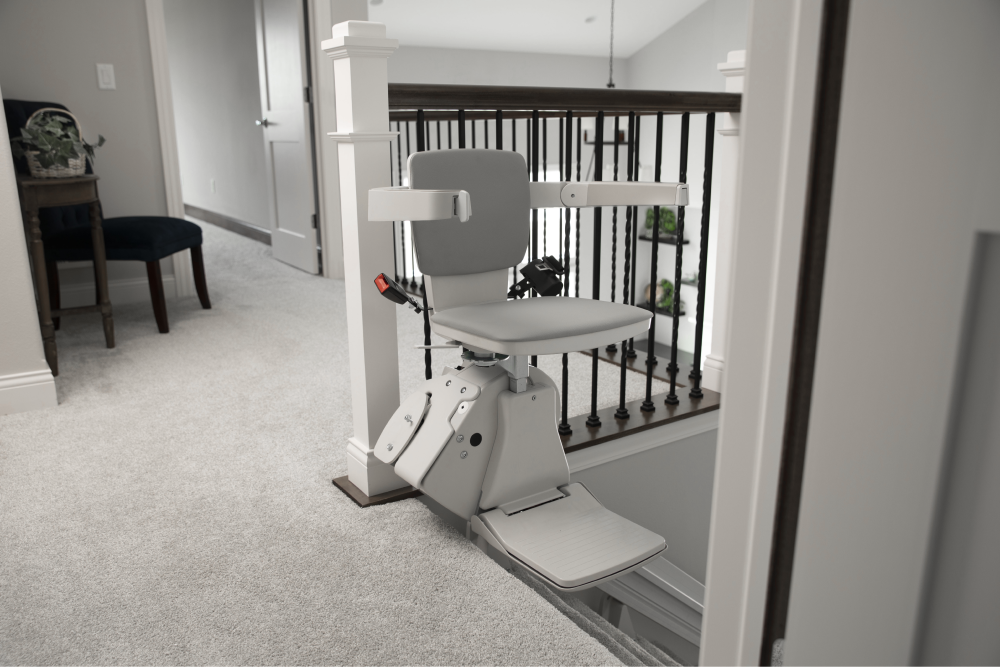
Using a railing that attaches to the stair treads and a motorized chair, stair lifts can easily move up and down the stairway. They can also include a variety of different safety features and add-ons. These include footrests, swivel seats, and battery backups.
Stair lifts come in a variety of models and design options. From straight stair lifts to more rare curved stair lifts, homeowners have access to several budget-friendly and customizable models.
Inclined Platform Lifts (IPLs)
When you have a staircase that’s compatible with stair lifts but need additional wheelchair support, inclined platform lifts (IPLs) are the perfect stair lift type. Using a platform, they carry the wheelchair along the length of the staircase, rather than requiring the user to transfer into a separate chair. They tend to have a slightly bigger footprint.
What Is a Residential Elevator?
Residential or home elevators are another limited mobility solution for seniors. They rely on a dedicated elevator shaft to traverse different floors. These in-home lifts can be powered by multiple different mechanisms, including cable- and motor-driven traction systems and fluid-powered hydraulic systems.
Regardless, elevator installation may require significant upfront expenses and home remodeling, setting them apart from your typical stair lift installation.
Vertical Platform Lifts (VPLs) and Shaftless Lifts
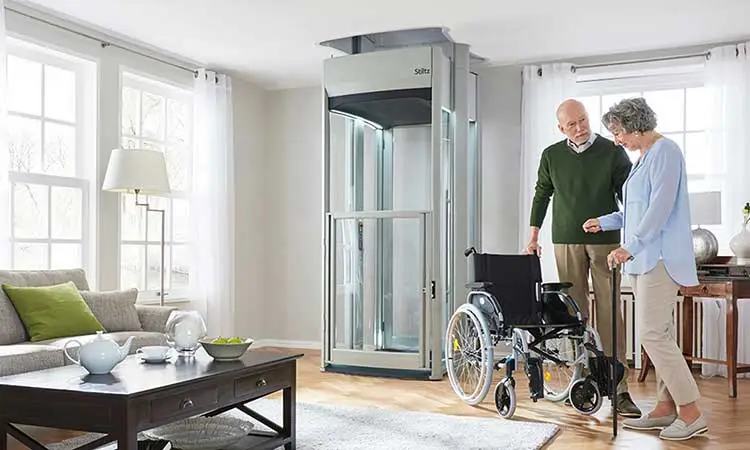
If you have a wheelchair and your staircase isn’t suitable for a traditional stair lift, vertical platform lifts (VPLs) can carry you up and down while sitting in your wheelchair. By moving vertically, much like an unenclosed elevator without a shaft, they can easily be placed adjacent to the stairs with minimal renovation.
Likewise, shaftless home elevators save space by operating within a compact self-supporting structure that usually fits into an existing closet or corner. For example, through-the-floor elevators use a small cutout between floors to facilitate vertical travel.
These two options might not have the same accessibility and safety features as a full residential elevator, but they are worth considering if you have space constraints or a limited budget.
Stair Lift vs. Home Elevator Costs and Functionality: Comparing Accessibility Solutions
Parts & Installation Costs
- Stair lifts: The average stair lift costs $8,450 to purchase and install. While curved stair lifts and additional safety features may add to the cost, it’s still a much more budget-friendly option compared to home elevators.
- Home elevators: Costs vary by type, with hydraulic elevators costing $47,500 on average, including installation, while traction elevators cost $55,750. This makes them a significantly more expensive investment.
Level of Mobility Needs
- Stair lifts: Best for seniors with low to moderate mobility needs, including those who can still walk with minimal support. The lift can easily be operated independently, but some users may need caregiver assistance to transfer in and out of the chair. Units can be designed with wheelchair accessibility in mind, but this is generally an added feature rather than a guarantee.
- Home elevators: The ideal solution for seniors with severe mobility challenges, including walker and wheelchair users. By granting roll-in access, elevators provide full accessibility across multiple floors for those who have difficulty transferring safely.
Number of Floors
- Stair lifts: Most stair lifts connect two adjacent levels, so three-story homes with multiple staircases may require multiple units. This can complicate installation and increase costs in taller buildings.
- Home elevators: Can be configured with doors that open on several different floors, providing continuous access to every level. In this way, an elevator might be more practical in high-rise homes, despite the higher upfront cost.
Weight Capacity
- Stair lifts: Most standard stair lifts support between 250 and 350 lbs, with some platform lifts (wheelchair lifts) capable of lifting 750 lbs or more. Because caregivers can continue to use the staircase as normal, their weight doesn’t need to be accounted for.
- Home elevators: Some shaftless and pneumatic vacuum elevators (PVE) can only lift around 350 lbs, but many other elevator models can be designed to lift well over 1,000 lbs. Your mobility devices, caregivers and any additional cargo (groceries, laundry, etc.) must all fall under the weight limit when traveling together.
Safety Features & Upgrades
- Stair lifts: For increased safety while moving up and down stairs, models can include seat belts, swivel seats, obstruction sensors, battery backups, and more. Optional upgrades like folding rails or ergonomic controls are also available.
- Home elevators: Modern elevators offer automatic gate systems, emergency alarms, and backup power. Additional upgrades include hands-free operation, intercoms, and customizable cab interiors for added quality of life.
Travel Speed and User Experience
- Stair lifts: Move at an average of 14 to 30 fpm, which is slower than most elevators, but allow you to stay seated while traveling. They also tend to have simple constant-pressure controls, usually a single toggle or joystick.
- Home elevators: Offer a faster travel speed, with models moving anywhere from 20 fpm (shaftless elevators) to 500 fpm (traction elevators). Though if you don’t have a wheelchair, you might need to stand while traveling. Push-button controls keep the overall user experience straightforward.
Space Requirements
- Stair lifts: Typically require minimal space, even when installed on curved staircases, as they attach directly to the treads. This makes the installation process simple and easy in smaller or older homes, as no major structural modifications are needed.
- Home elevators: Require more space and potentially stairwell modifications. For example, most home elevators will need a dedicated shaft and machine room for operation, which must be built prior to or during installation.
New Construction vs. Existing Homes
- Stair lifts: Easier to retrofit, especially on straight staircases, since they’re largely a bolt-on device that attaches within minutes, rather than requiring a shaft space, permits, or structural engineering.
- Home elevators: More suitable for new constructions or pre-planned remodels, as a dedicated shaft space, permits, and complicated engineering work are needed for full integration.
Installation Time
- Stair lifts: Offer timely installations, with most projects completed in just a few hours to a day, depending on the type of staircase.
- Home elevators: Typically take several weeks to months to install due to the need for permitting and structural changes.
Building Code Implications
- Stair lifts: Since the track is easy to install and remove without structural changes, building permits aren’t mandated in any US state. However, some municipalities may require specific permits or inspections if you live in a historic district, a duplex, or need to make electrical changes.
- Home elevators: Residential elevator codes typically require a building permit, engineering drawings and a post-installation inspection. Every state and municipality’s rules vary, but these legal processes are guaranteed to add time and cost to the overall project.
Noise Levels
- Stair lifts: Tend to have a quieter operation between 45 and 65 decibels (dB); usually a low hum from the motor as it moves along the track. If your bedroom or living room is near the stairs, sound mitigation can be difficult, as the track must be placed on a compatible staircase.
- Home elevators: Noise levels vary by drive type, with cable-driven models running quieter (50 to 60 dB) than pneumatic elevators (up to 85 dB). Extra customization in the form of insulated shafts or careful motor room placement can help dampen noise.
Long-Term Maintenance
- Stair lifts: The most cost-effective solution. Stair lifts can usually stay functional with basic upkeep, including regular inspections and battery replacements. We recommend annual service to keep everything operating smoothly, with many companies offering maintenance contracts or extended warranties that turn these costs into a predictable yearly payment.
- Home elevators: Also require regular upkeep, but with the added maintenance of lubricating hydraulic systems or servicing electrical ones. Depending on your state’s laws, the unit may require an inspection or additional servicing every few years—five being typical. Maintenance contracts and extended warranties are common here too but don’t offset the increased cost of ownership compared to stair lifts.
Average Lifespan
- Stair lifts: Have an average lifespan of 11 years, with indoor lifts usually capable of lasting up to 15 years, while outdoor stair lifts average only 7 to 10 years due to weather exposure. The regular maintenance mentioned above can extend the lifespan by 5 years or more, but neglected units may only last 3 to 5 years.
- Home elevators: Home elevators have an average lifespan of 23 years, generally outlasting stair lifts. Lifespan depends heavily on drive type: machine-room-less (MRL) elevators last as little as 10 years due to their more complex, harder-to-reach mechanisms, while traditional machine-room traction elevators can last up to 35 years thanks to their simpler pulley-and-counterweight design.
Property Value Impacts
- Stair lifts: Will likely have little impact on the home’s resale value, and are easily removed if new buyers don’t need them. Even when removed, only small, easily sealable screw holes are left behind.
- Home elevators: Cannot easily be removed, but may also add to the value of your home. A well-installed residential elevator is considered a luxury upgrade and may attract more buyers, positively affecting your property value.
Visual Impact and Concealment
- Stair lifts: While most stair lift seats fold away when not in use, helping to make space for people to walk unobstructed on narrow staircases, you can’t really hide the rail that runs along the length of the staircase.
- Home elevators: Because the mechanism is enclosed and largely concealed, blending with the existing decor might be easier, especially when you add custom cab finishes and lighting. With the right eye, the elevator appears as a luxury upgrade rather than a utilitarian fixture.
Strategies for Improving Affordability
Stair Lifts
- Health insurance: Original Medicare won’t cover stair lifts or home elevators, but some Medicare Advantage and long-term care insurances will provide financial assistance for medically necessary stair lifts.
- Grants: It’s possible to receive financial assistance through Medicaid, specific state programs, nonprofits, or the Department of Veterans Affairs (VA). HCBS waivers are the most common method, with the VA also providing access to VD-HCBS waivers and HISA, SAH or SHA grants to eligible veterans. Nonprofits have their own unique programs.
- Financing: Many manufacturers and dealers offer in-house financing or payment plans, breaking the total cost into manageable monthly installments with low interest rates.
- Rentals: If you’re recovering from surgery or temporarily living with a family member, many companies offer stair lift rentals at a fraction of the purchase price. This allows you to return the unit when it’s no longer needed.
Home Elevators
- Grants: Similarly, some homeowners may qualify for state or nonprofit home modification grants, and veterans can access useful VA grants. This is especially true if a doctor deems the elevator medically necessary.
- Financing: Given the higher upfront cost, many home elevator companies offer financing plans or partner with third-party lenders, allowing buyers to spread the expense across several years. Home equity loans are another possibility for financing.
The Bottom Line: Choose a Mobility Solution That Fits Your Needs
For seniors looking to age in place, anything from stair lifts and ramps to complex home elevators can help address mobility issues. However, the ideal installation largely depends on your budget, mobility needs, and home layout.
Senior wheelchair users might benefit from the access that the best home elevators provide, but for those with milder mobility issues, stair lifts are often a more cost-effective solution. Overall, we encourage you to understand your unique needs before you invest.
Which In-Home System Is Right for You?
| Your Situation | Best Fit |
|---|---|
| Tight budget | Stair lift, as the average cost is nearly six times less than that of a home elevator |
| Wheelchair user | Home elevator, VPL or IPL, as these units have built-in platforms that lift the wheelchair along with the user |
| Space constraints | Stair lift or shaftless elevator, as no dedicated hoistway or major remodel is needed |
| Multiple floors (3+) | Home elevator, as the unit is faster and less physically demanding across many trips |
| Need fast installation | Stair lift, as they can be installed in a matter of hours, rather than weeks or months |
| Aging-in-place long-term | Home elevator, as they withstand decades of use and more easily adapt to changing mobility needs |
| New construction or a planned remodel | Home elevator, as it’s easier to integrate a new shaft when it’s factored into the home’s design from the start. |
| Renting or temporary living situation | Stair lift, as it’s easy to remove the full system without structural changes. |
Frequently Asked Questions (FAQs) About Home Elevators vs. Stair Lifts
The best stair lift installations are highly affordable and require minimal structural modifications but are less accessible for wheelchair users or seniors with other severe mobility issues.
Home elevators are highly useful for seniors with severe mobility issues and can also potentially increase property values. On the other hand, they’re also far more expensive and invasive than stair lift models.
While both options work for wheelchair users, platform lifts are generally better for those on a budget, while residential elevators provide extra safety and accessibility.
Help us improve our cost data! Email your latest home elevator or stair lift quote to [email protected]. Rest assured, your personal details will remain completely confidential.