
Retirement Living takes an unbiased approach to our reviews. We may earn money when you click a partner link. Learn More
Straight Stairlifts: Cost, Installation, & FAQs
The average cost of a straight stair lift is $5,750, with professional installation accounting for $500 to $2,000 of that total.


Updated:
At a glance:
- Straight stair lifts cost between $2,500 and $9,000 on average, depending on the length of the track and added safety features—seat belts, footrests, folding rail, etc.
- Straight stair lift options are generally less expensive than curved stair lifts, as the latter option requires custom measurements and components.
- If a new stair lift is too expensive, common straight staircase measurements make it easy to invest in more affordable used or refurbished straight stairlift models.
If you’re a senior looking for an affordable aging-in-place solution and have a straight staircase, it might be time to consider installing a stair lift. Compared to home elevators or curved lifts, you can expect to pay a fraction of the cost for straight models. However, understanding typical prices and installation details is still key to ensuring you get the best stair lift.
Our stair lift experts have outlined the costs you can expect to pay based on the most popular straight stair lift models, so you can invest in a high-quality lift that keeps you safe.
What Is a Straight Stair Lift?
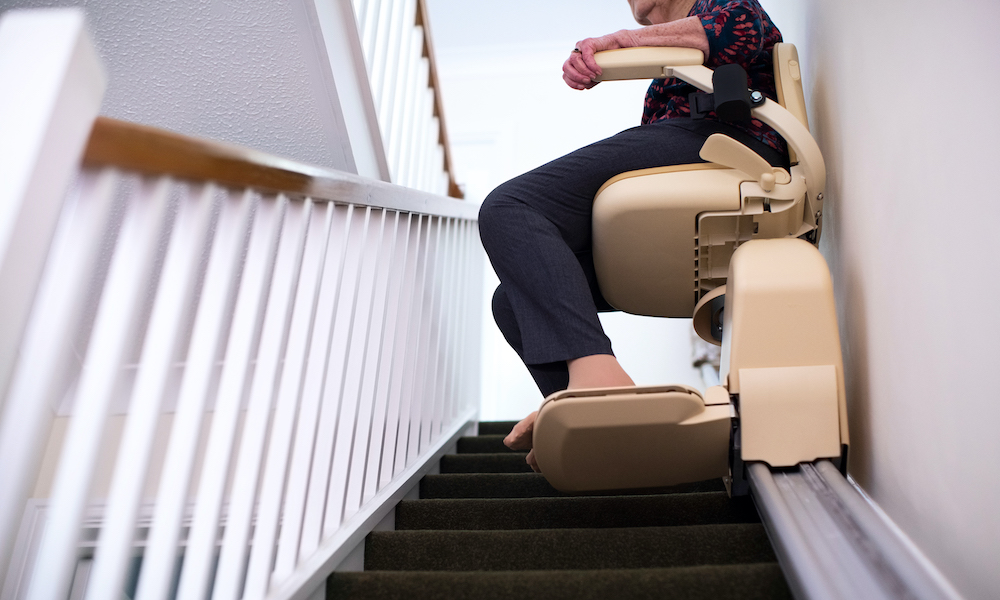
For seniors looking for improved home access, straight stair lifts are one of the most affordable options. They work by attaching a secure rail to the stair treads, which then supports a motorized chair. The motor is typically powered by electricity—either directly from your home or a dedicated battery. At the push of a button or remote control, seniors can move up and down the stair lift rail while sitting comfortably.
Straight Stair Lift Features
Beyond the chair and track, some stair lift features are standard, meaning they’re included within the base price. Others cost extra but add to your daily comfort, convenience, and safety. Overall, considering both upgrades and ease of use is vital for users with higher fall risk or cognitive concerns.
Comfort Features
Standard features:
- Manual swivel seat: A basic cushioned seat that turns toward the landing so riders can step off safely.
- Adjustable or folding armrests: Make it easier to sit down and get up.
Upgrades:
- Powered swivel seat: Turns automatically at the top of the stairs.
- Upgraded upholstery: Offers more color choices or premium materials.
Convenience Features
Standard features:
- Folding seat and footrest: Keeps the staircase clear when the lift is not in use.
- Remote controls: Most models include at least one wireless remote that lets you call or send the chair from either end of the stairs.
Upgrades:
- Powered folding rail: Lifts the bottom of the track out of the way, which preserves space in doorways or tight hallways.
- Additional remotes: Useful if more than one person uses the lift.
Safety Features
Standard features:
- Seat belt: Keeps seniors secure during the ride.
- Safety sensors: Obstruction sensors and safety edges stop the lift if something blocks the track.
- Emergency stop: Lets the rider halt the lift immediately.
- Key switch: A lockable switch that prevents unauthorized use.
- Battery backup: Allows battery-powered models to keep working during a power outage.
Upgrades:
- Backup battery for plug-in models: An optional add-on that keeps the lift running if the power goes out.
Will a Straight Stair Lift Fit on My Staircase?
Before you get an official quote, you should double-check that your staircase is compatible with common straight stair lift model measurements:
- Stair width: The wall-to-wall width of the staircase should be between 28 and 30 inches, though some Acorn models can fit in spaces as small as 26 inches. Chair lift seats are usually 17 to 20 inches wide when unfolded.
- Rise and run: Measure the rise (the height of a single step) and the run (the depth of the tread, front to back), as installers can use your findings to calculate the rail length and angle. Standard residential stairs have a rise of about 7 to 8 inches and a run of about 9 to 11 inches, with steep stairs sometimes needing a specialized model.
- Total staircase length: Measuring from the base of the bottom step to the top step edge, following the slope of the stairs, tells you how long the stair lift rail needs to be.
- Landing clearance: Measure the open floor space at both ends of the stairs; 24 to 36 inches of clear space at the bottom is ideal, while at the top landing, make sure the swivel seat has room to turn without blocking a doorway or hallway (12 to 18 inches).
- Left or right side installation: Stair lift rails attach to the stair treads, not the wall, so you can usually choose whether you want a right- or left-side installation. Generally, you should pick based on the side with the most free space.
- Weight capacity and seat width: Straight stair lifts can have a weight limit anywhere from 250 to 600 lbs, with heavy-duty models built to lift loads heavier than 400 lbs. Consider which lift models have seat widths and weight capacities that are compatible with current user size and consider future needs as well.
Ultimately, most providers will send a professional installer to your home to take precise measurements early in the process. Afterward, they can help you choose the most fitting model and best installation location while also making sure the staircase is sturdy enough to support the weight of the lift.
Straight vs. Curved Stair Lifts: The Effect on Pricing
The type of stair lift you need plays a major role in both installation time and potential costs. For example, straight stair lifts are usually cheaper than their curved counterparts due to:
- Standardized components: Unlike curved stair lifts, where turns often require custom-made railings to meet safety regulations and weight capacity requirements, pre-made straight lifts can simply be cut to the size of your straight staircase.
- Simple installation: Straight stair lifts feature a simpler design, resulting in shorter installation times and lower labor costs.
- Rental and refurbished availability: Because many indoor and outdoor stair lifts for straight staircases can be cut to size, you can save money on rentals or refurbished models. On the other hand, the customization required for curved lifts makes pre-owned availability less likely.
Overall, a new straight stair lift costs most seniors between $2,500 and $9,000, while curved models can reach up to $14,000. Of course, those who need curved models may not be able to avoid the extra expenses if they want a stair lift installed. If you need help covering the cost of a straight or curved lift, reach out to your current insurance provider or local Agency on Aging (AAA).
Straight Stair Lift Costs by Model
Our team compared reliable straight stair lift companies, including the features and price ranges of their most popular models. For more detailed pricing information, we recommend reaching out to these companies for free quotes, insurance info, and warranty details.
| Brand / Model | Known for | Features | Pricing |
|---|---|---|---|
| Bruno Elite Straight Stair Lift | Heavy-duty capacity and indoor/outdoor versatility | – 400 lb capacity – Folding rail, armrest, and footrest options – Indoor and outdoor options | $3,000 to $5,500 |
| Harmar Pinnacle Stairlifts | Heavy-duty capacity and a compact rail for tight spaces | – 400 lb capacity – Ultra-slim rail for tight spaces – Easy folding seat and footrest | $3,500 to $5,500 |
| Handicare 1000 Straight Stairlift | Highest weight capacity and a lower starting price | – 350 – 440 lb capacity – Swivel seat for safe entry/exit – Optional powered hinge for bottom landing | $2,000 to $5,000 |
| Acorn 130 Straight Stairlifts | Modular design with quick installation and easy upgrades | – 280 – 350 lb capacity – Modular design for quick installation and upgrades – Foldable arms and seat | $2,800 to $5,000 |
| Savaria Alpha Straight Stairlift | Compact folded width and battery-powered operation | – 350 – 400 lb capacity – Compact folded width – Battery-powered operation | $3,500 to $5,000 |
| AmeriGlide Rave 2 Stair Lift | Budget-friendly pricing and a compact fold | – 350 lb capacity – Ultra-compact when folded – Swivel seat for safe entry/exit | $2,200 to $4,000 |
Once you have two or three models in mind, request a home assessment, itemized quote and warranty information. This not only helps you determine if the lift fits your staircase but also allows you to compare offers. Additionally, you can ask for a demo ride if one is available, since seat comfort and control ease are easier to judge from first-hand experience.
Straight Stair Lift Warranty Coverage and Reliability
The price you pay upfront for a stair lift is one thing, but as a long-term purchase, you should also consider warranty coverage, service contracts, and ultimately how long the lift might last.
Typical Warranty Coverage and Terms
Every brand is different, but most stair lift warranties cover both parts and labor for one to two years after the installation date. Certain parts like the motor, drive system, and rail can retain a longer warranty period (two to five years), but you’ll need to pay labor costs after that initial timeframe. Reconditioned or used lifts have shorter coverage, usually 90 days to one year.
Here is a list of parts and how long they’re usually covered:
- Motor and drive system (two to five years)
- Rail and track (two to five years)
- Battery (one to two years)
- Circuit boards and electronics (one to two years)
- Remotes and call/send stations (one to two years)
- Safety sensors (one to two years)
- Seat, armrests and footrest (one to two years)
What’s Not Covered By a Warranty
Your stair lift warranty won’t cover damage caused by misuse, water exposure or exceeding the weight capacity. Any warranty-related repairs must be done by an authorized technician, as opting for someone out-of-network could prevent coverage. Skipping out on annual inspections can also void your warranty in some instances, so be sure to read the warranty policy carefully.
Overall Lifespan and Service Contracts
A well-maintained straight stair lift can run for 10 to 15 years or longer. To keep your lift functional over time, you can invest in a service contract once your manufacturer’s warranty ends. For an average cost of $100 to $600 per year, these agreements cover annual inspections and repairs.
Straight Stair Lift Installation Costs and Timeline
The cost to install a straight stair lift depends on your stair length, the brand and any additional safety features. However, most homeowners can expect to pay around $1,250 in labor costs, which is 64% less than the average curved stair lift installation cost of $3,500. The average rate is around $75 to $100 an hour and includes cutting and mounting the rail, installing the chair, and testing the lift. Still, you should ask for an itemized quote for a more thorough cost breakdown.
Optional upgrades that can add to your quote include a powered swivel seat, powered folding rail and upgraded upholstery. These extra equipment costs are generally more worth it if they help improve safety for someone with limited mobility but should always be factored into your budget before you buy. Additionally, every model has different options and limitations, so ask the manufacturer what’s available.
What to Expect on Installation Day
Installing your new lift is generally a simple process that involves drilling the railing to the stair treads using small screws, followed by securely mounting the motorized chair and power systems. Expect short bursts of drill noise. Dust is minimal, and installers usually clean up debris before they leave. We recommend asking them for a walkthrough of the controls, safety sensors, battery backup, and manual lowering feature before they leave.
Most installations take between two and four hours, but some modular models can be installed in as little as one hour. Many companies include installation costs in the final price, but you can inquire about the details.
For refurbished lifts, the installation process is generally the same. Installers cut the railing to size before continuing with the rest of the installation.
How to prep your home:
- Clear the stairs and landings of obstructions
- Locate a nearby outlet and confirm that it’s compatible with the lift’s battery
- Keep pets and children away from the work area
- Arrange for the user to stay on one level during installation
Can You Get a Free Straight Stair Lift?
Several financial assistance options can reduce or even fully cover the cost of a straight stair lift, including Medicare Advantage, Medicaid, long-term care insurance, VA benefits, state programs, and nonprofit organizations. These programs may provide waivers and grants that cover home accessibility upgrades like stair lifts, but age, disability, or income may limit eligibility.
If you still can’t afford the upfront cost or aren’t eligible for those options, other common routes are dealer financing with monthly payments, 0% interest promotions or rent-to-own agreements. Of course, credit approval and fees also vary. For a full breakdown of your options, see our guide on how to pay for a stair lift.
Comparing Stair Lift Types: Which Fits Your Needs?
| Factor | Straight stair lift | Curved stair lift | Inclined platform lift (IPL) |
|---|---|---|---|
| Staircase type | Straight run with no turns (addressing multiple landings requires separate tracks/chairs) | Staircases with turns, curves or intermediate landings | Curved or straight models available |
| Wheelchair use | Rider must transfer into a seat, with the wheelchair stored at each level | Same as a straight lift | Wheelchairs or scooters can roll directly onto the platform |
| Space required | Stair width of about 28 to 30 inches, plus clearance at the top and bottom | Stair width of 30 to 34 inches, with extra space needed around turns and landings | Needs at least 10 to 18 square feet of space for the platform |
| Installation | Modular rail pieces only take a few hours to cut and install | Custom-rail pieces might take up to a day to install | May need structural modification and take a few days to install |
| Budget | $2,500 to $9,000 | $8,000 to $14,000 | $2,000 to $15,000 |
Ultimately, straight stair lifts are best for seniors who can still walk and transfer safely but want extra support going up and down a straight-run staircase. Curved lifts cover the same demographic but are needed when the staircase has multiple landings, curves or pie-shaped steps.
Platform or wheelchair lifts are more beneficial for seniors who rely on mobility aids. You can also opt for a vertical platform lift (VPL) that uses a fully vertical rail along the side of the steps, rather than a diagonal track, if the lift height is 14 feet or less.
Frequently Asked Questions (FAQs) About Straight Stairlifts
The average cost of a straight stair lift is between $2,500 and $9,000. This price may or may not include installation costs, depending on the manufacturer.
We recommend straight stair lift technology for seniors with straight staircases who have mild to moderate mobility issues. They’re affordable and quick and easy to install and uninstall. On the other hand, you should consider a VPL if you have a wheelchair or a curved staircase, as they’re beneficial for seniors with more severe mobility issues.
You can invest in both new and used straight stair lifts, as long as the track and railing are long enough to be cut to the length of your staircase.
To maintain your straight stair lift, including regular inspections, lubrication, cleaning, and battery checks, you should expect to pay between $100 and $400 annually. Most manufacturers recommend an annual service visit to catch small problems before they become costly repairs, with many offering unique maintenance plans.
Here are some simple ways to keep your stair lift safe and functional long-term:
– Wiping down the rail and chair upholstery weekly
– Keeping an eye out for loose bolts or odd noises
– Applying lubrication as recommended by the stair lift manufacturer
– Scheduling an annual inspection
Help us improve our cost data! Email your latest stair lift quote to [email protected]. Rest assured, your personal details will remain completely confidential.