
Retirement Living takes an unbiased approach to our reviews. We may earn money when you click a partner link. Learn More
Tube Rail vs. Flat Rail Stairlift: What’s the Difference?
Understanding the differences between tube and flat rail stairlifts can help you choose the right rail for your staircase, budget, and mobility needs.


Updated:
At a glance:
- Tube rail uses one or two hollow tubes bent to follow the staircase, while flat rail uses a wider, rigid track that can be custom-curved or assembled from modular sections.
- Tube rail systems can cost less and offer flexible installation, but custom flat rail generally provides greater rigidity, higher weight capacities, and a smoother, more consistent ride.
- Custom flat rail typically costs more and takes longer to fabricate, while modular rail systems can reduce installation time and provide a more budget-friendly option.
Tube Rail vs. Flat Rail Stairlift
The core difference between tube rail and flat rail stairlifts is the shape and construction of the track that carries the chair lift. Tube rail uses hollow metal tubing, while flat rail uses a wider steel or aluminum track with a flatter profile.
Curved stairlifts require a rail that follows the shape of the staircase. Depending on the design, the rail may need to navigate tight corners, intermediate landings, spirals, or changes in direction. Retirement Living’s existing stairlift guide notes that curved stairlifts can be customized for complex staircases, while custom-built rails are designed to closely conform to an individual staircase.
Lifeway Mobility identifies three major curved stairlift track designs: hollow tube rail, modular flat rail and custom-made flat rail. Its comparison notes that hollow tube rail can be less expensive than custom flat rail, while custom flat rail generally provides greater rigidity, a higher weight capacity, and a smoother, more consistent ride.
| Feature | Tube Rail | Flat Rail |
|---|---|---|
| Rail construction | One or two hollow tubes bent to follow the stairs | Wider, flatter track that can be custom-curved or modular |
| Ride quality | Generally smooth, but can have more flex | Custom flat rail typically provides the smoothest, most consistent ride |
| Weight capacity | Varies by model, commonly around 275–350 pounds | Varies by model, with some systems reaching 400 pounds |
| Gear rack | May be more exposed | Can be concealed within the rail design |
| Space | Can provide a slim profile, depending on the model | Custom flat rail can sit close to the wall |
| Lead time | Custom tube rails may require fabrication | Custom flat rails also require fabrication; modular systems can be faster |
| Cost | Usually, the more budget-friendly custom option | Custom flat rail generally costs more |
| Best for | Buyers seeking flexibility and lower upfront cost | Buyers prioritizing ride quality, rigidity and higher capacity |
The distinction is not always as simple as “tube equals inexpensive” and “flat equals premium.” Manufacturers use different rail designs and capacities. For example, Savaria’s Stairfriend 23 uses a custom-fabricated twin rail with a standard 300-pound capacity and an optional 350-pound capacity, while Handicare’s Freecurve uses a single-tube design rated at 275 pounds.
Bruno’s Elite curved stairlift takes a different approach, using a handcrafted rail designed specifically for each staircase and offering a 400-pound capacity.
Which Manufacturers Use Tube or Flat Rail?
Several major manufacturers offer tube or twin-tube curved rail systems, while Bruno is particularly associated with custom flat-rail technology.
- Harmar: The Helix uses a custom-fabricated rail and is rated for 350 pounds, while Harmar’s modular UP Stairlift supports up to 275 pounds.
- Handicare: Its Freecurve uses a single-tube rail, while the Handicare 4000 uses a twin-rail design.
- Savaria: Its Stairfriend 23 uses a custom twin-rail system. Savaria also sells the Handicare 4000 and Freecurve under its stairlift lineup.
- Stannah: Its Siena and Starla curved stairlifts use twin-rail designs, with rails tailor-made to fit the staircase.
- Acorn: The Acorn 180 uses a proprietary modular rail system rather than a traditional custom-bent tube rail. It has a maximum capacity of 265 pounds and is designed for rapid installation.
- Bruno: The Elite curved stairlift features a handcrafted rail specifically designed for the staircase and supports up to 400 pounds.
Because manufacturers can use different rail constructions within their product lines, shoppers should compare the specific model rather than assuming every stairlift from a particular brand uses the same rail.
Tube Rail Stairlifts Pros and Cons
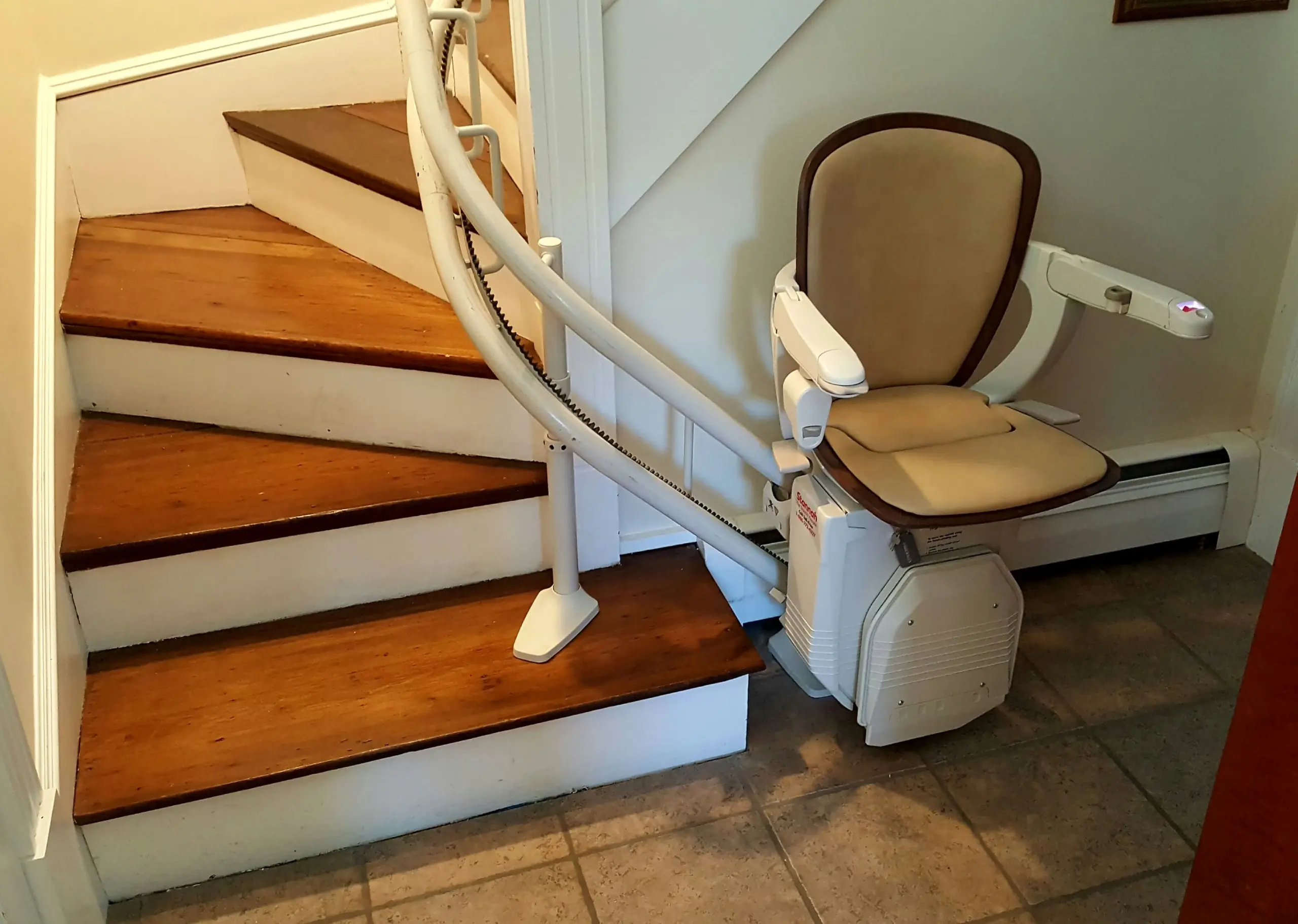
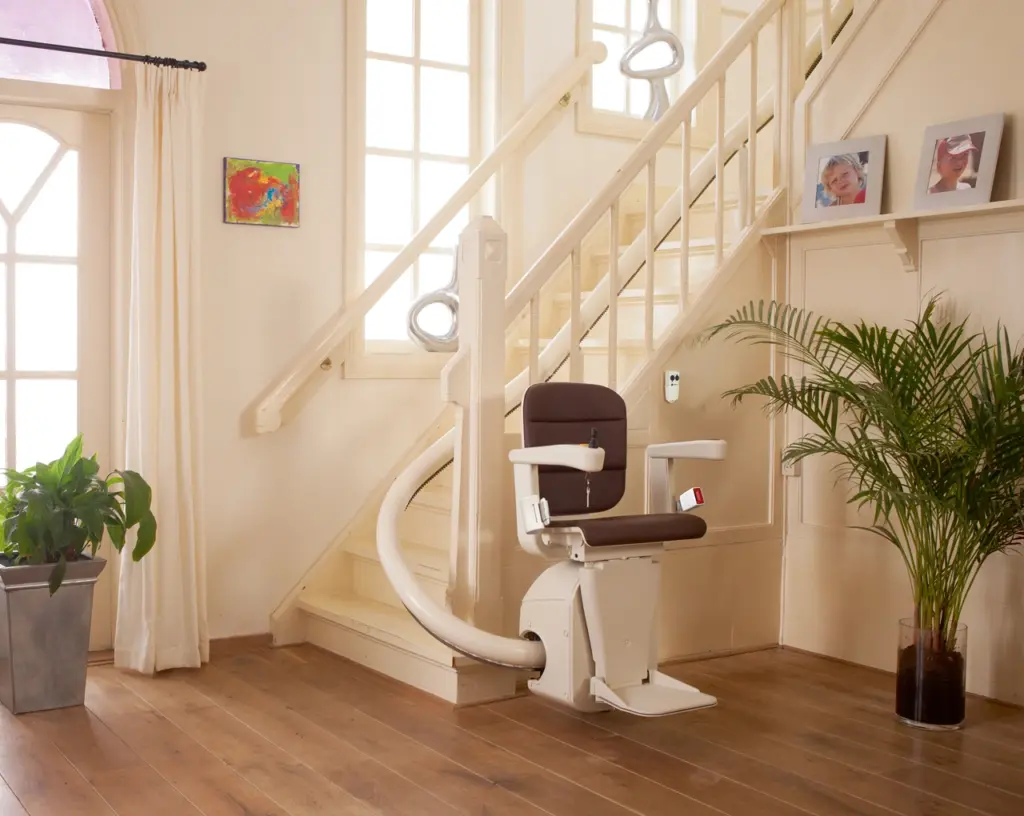
Tube rail stairlifts use one or two hollow metal tubes that are bent to follow the contours of a curved staircase. The design has been used for years and can provide a practical option for staircases with tight turns and complex layouts.
A major advantage is that tube rail can be less expensive than a custom flat rail. The tradeoff is that hollow tubing can have more flex than a rigid custom flat track, which can affect ride consistency.
Ride Quality and Speed
Tube rail stairlifts can provide a comfortable ride, but the amount of flex in the rail can affect how consistently the carriage travels through curves. Lifeway Mobility describes tube rail as potentially offering a slower and less consistent ride than custom flat rail.
Actual speed depends on the model rather than just the rail type. For example, Harmar’s Helix has a nominal speed of 20 feet per minute, while Savaria’s Stairfriend 23 travels at 20 feet per minute on straight sections and slows to 12 feet per minute through curves.
A properly fitted tube rail can still provide a smooth ride. The quality of the rail fabrication, carriage, footrest, and installation all influence how the stairlift feels in use.
Weight Capacity Limits
Tube rail stairlifts do not have a universal weight limit. Capacity varies significantly by manufacturer and model.
For example:
- Handicare Freecurve: 275 pounds
- Savaria Stairfriend 23: 300 pounds standard, 350 pounds optional
- Harmar Helix: 350 pounds
- Stannah models vary by configuration
For this reason, don’t choose a rail based only on its construction. Check the specific stairlift’s rated capacity and make sure it accommodates the rider comfortably, including clothing or items carried during normal use.
Exposed Gear Rack and Maintenance
Many stairlifts use a rack-and-pinion drive system to move the chair along the rail. Bruno explains that modern stairlifts use a motor, gearbox, and drive system, such as a rack-and-pinion, to move the chair along a fixed track.
On some tube-rail designs, the gear rack is more visible or accessible than on flat-rail systems that incorporate the rack into the track. A more exposed rack can make cleaning and maintenance more important, as dust and debris can accumulate around the drive components.
That doesn’t mean a tube-rail stairlift is inherently unsafe. Look for standard safety features such as seatbelts, obstruction sensors, emergency stops, and seat-swivel locks. These features are common across modern stairlift designs.
Typical Costs and Lead Times
Tube rail can be a lower-cost alternative to custom flat rail, although the final price depends heavily on the staircase and stairlift model. Curved rail stairlifts are significantly more expensive than straight stairlifts because the rail must be custom-fitted to the home’s layout.
Retirement Living currently estimates the average curved stairlift at $10,000 to $14,000, with customization and additional features affecting the final stairlift cost.
Custom tube rails still require fabrication, so buyers should not assume a tube system will always be available immediately. By comparison, modular systems can be assembled from standardized rail sections and installed more quickly.
Flat Rail Stairlifts Pros and Cons
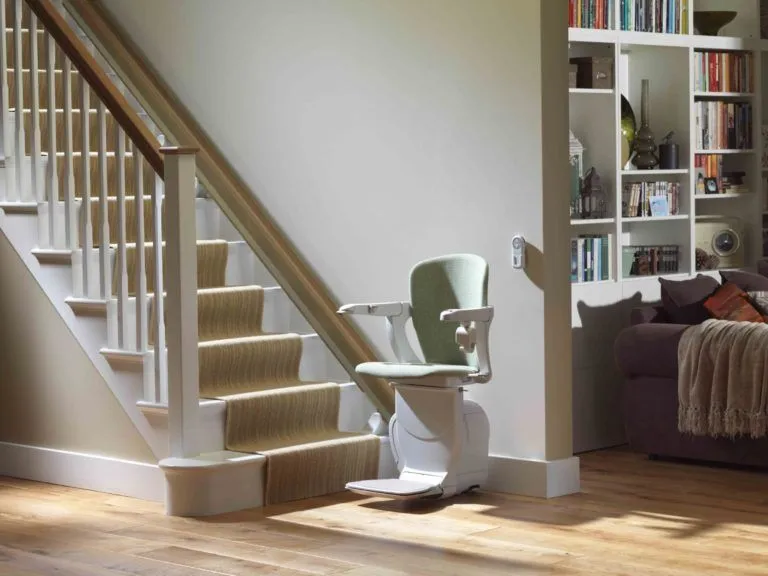
Flat rail stairlifts use a wider, flatter track rather than a round tube. The rail can be custom-curved to match a staircase or constructed from modular pieces that are assembled during installation.
The main advantage of a custom flat rail is rigidity. Lifeway Mobility notes that custom flat rail is typically stronger and more durable than hollow tube rail and can provide a higher weight capacity.
Custom Flat Rail vs. Modular
There are two important types of flat rail: custom and modular.
Custom flat rail is manufactured specifically for the staircase after the installer takes measurements. Bruno’s Elite curved stairlift is an example of a custom-designed system. Bruno says each Elite curved rail is handcrafted specifically for the staircase and rated for 400 pounds.
Modular flat rail uses standardized sections that can be combined and adjusted during installation. The modular approach can reduce fabrication time and speed installation, but it may not match the precision of a factory-built rail designed specifically for one staircase.
Acorn’s 180 is an example of a curved stairlift using a modular rail system. Acorn says its FastTrack system allows the rail to be installed in a matter of days rather than waiting weeks for a custom rail to be manufactured.
Ride Smoothness and Reliability
Custom flat rail generally has an advantage when ride consistency is the priority. Its rigid construction allows the rail to be manufactured to precise measurements, helping the carriage maintain a consistent path through curves.
Bruno describes its Elite curved stairlift as featuring a handcrafted rail that follows the staircase for a smooth ride. Savaria similarly describes its custom Stairfriend 23 rail as being fabricated for a precise fit.
Modular systems can still provide a comfortable ride, but the assembled sections may not deliver the same level of precision as a custom-fabricated rail.
Gear Rack Safety and Cleaning
Flat rail designs can incorporate the drive rack into the rail, reducing the amount of the gear system exposed. Lifeway Mobility specifically identifies the hidden gear rack on its custom flat rail as an advantage over the exposed gears found on some tube-rail designs.
A concealed rack can also give the stairlift a cleaner appearance that may better complement the home’s decor. However, the presence or position of a gear rack should not be the only factor used to judge safety.
The stairlift should also include appropriate safety systems. Common features include obstruction sensors, seatbelts, emergency stops, and controls that prevent the lift from operating when the seat is not properly positioned.
Space Near Walls and Stairs
The rail’s shape and mounting position can affect the amount of usable space on the staircase. A slimmer rail can be especially valuable on narrow stairs where other household members still need to use the steps.
Stannah says its curved stairlift rails are designed to sit close to the wall and attach to the staircase rather than the wall. Its twin-rail designs are intended to preserve space for other people using the stairs.
Savaria’s Stairfriend 23 also installs directly onto the stairs and is designed to maximize clearance when the stairlift is not in use.
If your staircase is narrow, ask the installer to measure the remaining walking space with the chair both folded and unfolded. The rail profile alone doesn’t determine how much room you will have.
Weight Capacity and Durability
Flat rail systems can accommodate higher weight capacities, but the exact rating depends on the model.
Bruno’s Elite curved stairlift has a 400-pound capacity, while Savaria’s Stairfriend 23 offers a standard 300-pound capacity and an optional 350-pound capacity.
A higher-capacity lift may be worth considering even if the current rider falls below the standard limit. Choosing a model with enough capacity provides a larger safety margin and can make the stairlift useful if the rider’s needs change.
Choosing the Best Rail For You
The best stairlift rail depends less on whether tube or flat sounds better and more on the specific staircase, rider and household. A professional home assessment can determine which rail systems can safely navigate the turns and available space.
Consider these factors before choosing:
- Staircase shape: Tight turns, landings, and spirals may require a highly customized rail.
- User weight: Compare the specific model’s weight capacity rather than relying on general tube or flat rail assumptions.
- Children or pets: Consider how exposed components, moving parts, and parking locations affect your household.
- Narrow stairs: Measure the remaining walking space when the stairlift is in use and when it is in the fold-up position.
- Budget: Tube and modular systems may offer cost-effective alternatives to premium custom flat rail.
- Timeline: Ask how long it will take to fabricate the rail and when stair lift installation can occur.
- Ride quality: If a smooth, consistent ride is a priority, compare custom rail designs and request a demonstration.
- Local service: Check whether trained technicians and replacement parts are readily available in your area.
When A Custom Flat Rail Is Worth the Extra Cost
Custom flat rail can make sense when ride quality, rigidity, or weight capacity are more important than minimizing the initial purchase price.
It can also be a good fit for a complicated staircase where precise rail fabrication can improve how closely the lift follows the top of the stairs to the bottom of the stairs. Bruno’s Elite, for example, uses a handcrafted rail designed specifically for each staircase and offers a 400-pound capacity.
However, a custom rail isn’t automatically the right choice for every home. A modular system may be more practical if installation speed and price are your top priorities.
When Tube Rail May Be the Better Choice
Tube rail can make sense when you want a curved stairlift that balances customization with cost. Twin-tube designs can also work well for staircases with tight turns, and several manufacturers offer tube-based systems with capacities of 300 pounds or more.
The key is to compare complete stairlift systems, not just the type of rail. Seat design, drive system, safety features, warranty, and local service can all affect the lift’s long-term value.
Get an In-Home Assessment
Because curved stairlifts depend heavily on staircase geometry, an in-home assessment is one of the most important steps before purchasing. The installer should measure the stairs, evaluate available clearance and determine where the stairlift can safely park.
Retirement Living’s existing stairlift guide notes that custom-built curved stairlifts can conform closely to individual staircases, while modular systems use standardized components assembled to follow the staircase path.
Get quotes from more than one manufacturer or dealer when possible. Ask each provider to identify the rail type, weight capacity, expected lead time, installation cost, and warranty included in the quote. Comparing these details can help you choose the right mobility solution for your home.
Frequently Asked Questions (FAQs) About Tube Rail vs. Flat Rail Stairlifts
The main curved stairlift rail types are hollow tube, modular flat rail and custom flat rail. The right option depends on the staircase, desired ride quality, budget, and installation timeline. For comparison, a straight staircase typically uses a straight stairlift rail rather than a curved configuration.
There is no single stairlift brand that is the most reliable for every home because reliability depends on the model, installation, maintenance and local service. Brands such as Bruno, Harmar, Handicare, Savaria, Stannah, and Acorn offer curved stairlift options with different rail designs and specifications.
A stairlift does not necessarily devalue a house, and it can make a home more usable for people who want to age in place. Because stairlifts are generally installed directly onto the stairs, they can also be removed if the homeowner no longer needs one. Stairlifts can be one option among various home modifications for improving accessibility.
Tube rail or flat rail can both work on narrow and straight staircases, so the better choice depends on the specific rail dimensions and staircase configuration. Stannah, for example, says its slimline curved rail designs are intended to preserve space for other people using the stairs.
Help us improve our cost data! Email your latest stair lift quote to [email protected]. Rest assured, your personal details will remain completely confidential.