
Retirement Living takes an unbiased approach to our reviews. We may earn money when you click a partner link. Learn More
How High Can a Wheelchair Lift Go?
Residential wheelchair lifts typically have a maximum travel distance of 14 feet, with the exact limit depending on the type of lift and local building codes.


Updated:
AT A GLANCE:
- According to ASME A18.1, both residential and commercial wheelchair lifts should rise no higher than 14’. Inclined Platform Lifts (IPLs) travel distance limitations are not specified.
- Lead-screw-driven lifts have a standard height of 147”, or just over 12’, while hydraulic-drive systems can reach 171″, or just over 14’. IPLs with rope drive (cable drive) systems can travel up to 164’.
- Custom curved IPLs can travel farther (up to 164’) than straight IPLs (up to 80’), but standard models for both typically stay within the 12’ to 14’ range.
When you rely on a wheelchair or another mobility device, modern accessibility solutions can help you navigate your home. After all, from simple porch lifts to multi-level IPLs, wheelchair lifts are one of the most space-saving ways to get from point A to point B.
However, because these lifts can’t travel as high as traditional home elevators, it’s important to know if they’ll be compatible with your home layout. Below, we discuss the travel height limitations of various wheelchair platform lift types so you can find the best installation for your situation.
How Wheelchair Platform Lift Type Impacts Travel Distance
While the American Society of Mechanical Engineers (ASME A18.1) sets general standards for wheelchair lifts, the maximum height ultimately depends on lift type.
Commercial vs. Residential Wheelchair Lifts
Lifts for commercial and residential usage fall under the same ASME A18.1 mechanical and safety standard: enclosed lifts have a maximum travel height of 14’. However, commercial units have some additional regulations that residential options do not. For instance, unenclosed commercial lifts are capped at 5’ (60”) and require a platform gate. They also need a maximum weight capacity of 750 lbs, while residential lifting capacity can range from 350 to 800+ lbs, depending on the model and drive type.
Vertical Platform Lifts vs. Inclined Platform Lifts
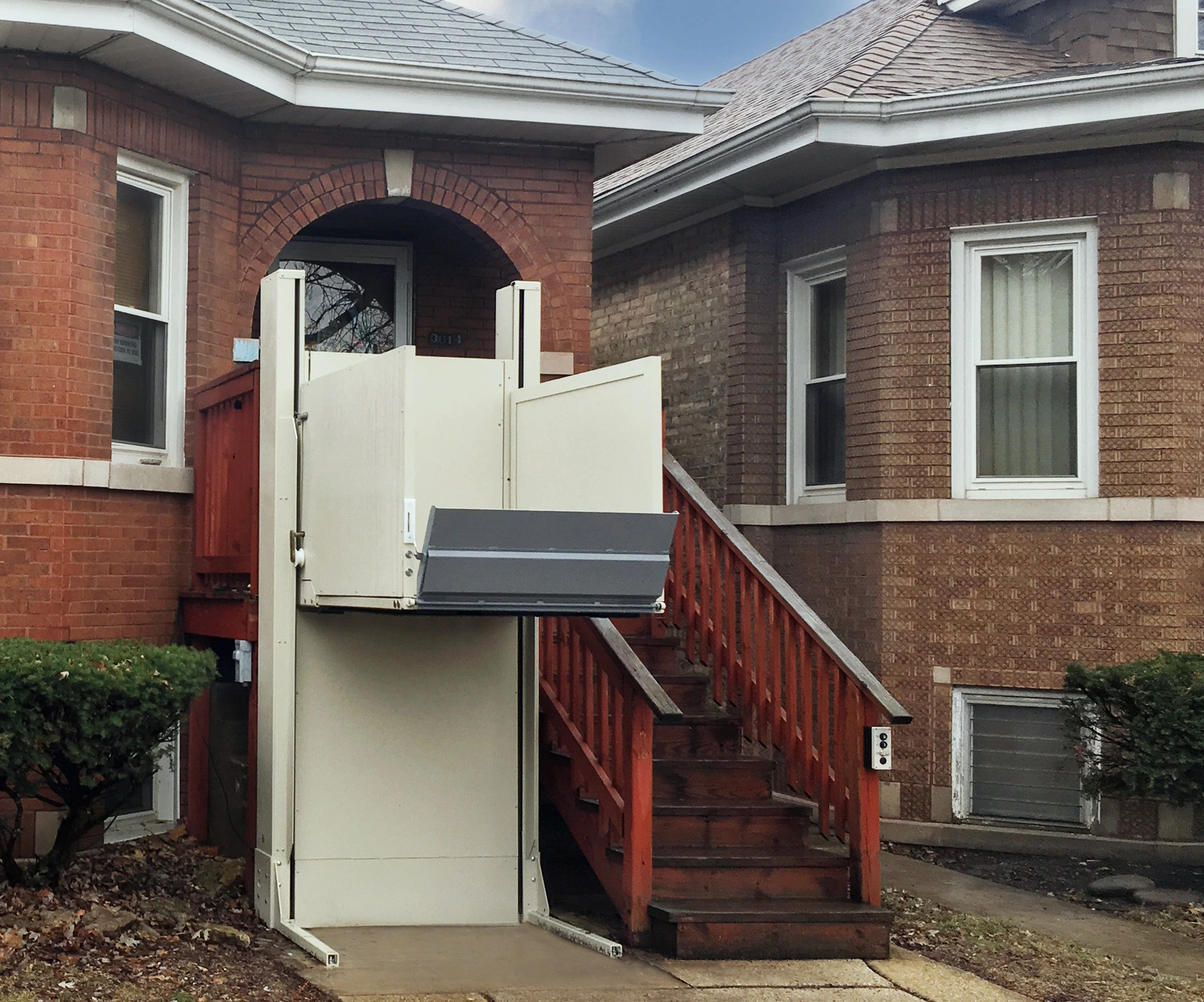
Aside from multi-level IPLs, which have the potential to travel further, both VPLs and IPLs usually have a maximum travel distance of 14’. Their key difference is in how the lift travels, not how far it can go. IPLs work similarly to stairlifts, moving a wheelchair-accessible platform along a rail anchored to the stair treads. VPLs, on the other hand, are vertical wheelchair lifts that move straight up and down along a mast or guide column, much like an open-air elevator. They’re a great outdoor wheelchair lift option because they can be easily placed next to porches, decks, side entries, and more.
Wheelchair Lift Drive Types
Wheelchair lifts generally use one of two drive systems: hydraulic or lead screw. Hydraulic drive systems are typical for VPLs and rely on pumped fluid pressure to reach 171”, or just over 14’. The latter is more common in IPLs, and it works by turning a threaded rod that drives the platform up a rail. Most models have a standard lift height of 147” (just over 12’). Some commercial-grade curved IPLs utilize rope systems (cable systems) that allow them to travel much higher (up to 164’) and stop at intermediate landings on the staircase. Unlike elevators, they won’t require a hoistway (shaftway).
Lift Heights for Common Wheelchair Lift Types
| Wheelchair Lift Type | Max Lift Height (feet) | Weight Capacity | Platform Size |
|---|---|---|---|
| Straight IPL | 80′ (standard 12′ 3″) | 350 – 750 lbs | 36″ – 48″ L x 26″ – 36″ W |
| Curved IPL | 164′ | 350 – 750 lbs | 36″ – 48″ L x 26″ – 36″ W |
| VPL | 14′ | Up to 800 lbs | 48″ – 60″ L x 36″ – 42″ W |
| Commercial unenclosed lift | 5′ | Min. 750 lbs | Varies by model |
The Importance of ASME, Local Building Code, & ADA Compliance
How high your wheelchair lift can go ultimately comes down to national and local regulations, rather than its physical limitations. Aside from municipal building codes, which vary widely, there are two main standards at play here: ASME A18.1 sets mechanical limits, and the ADA addresses how height-related features must function for accessibility. Once those standards are met, your local building department has the final say on what’s permitted at your address.
- ASME A18.1 is the reason a 14’ cap is the baseline mechanical and safety standard for every commercial and residential platform lift. It also ties height to other safety requirements, such as requiring VPLs to install a gate or barrier at every landing to protect users. Additionally, any lift that reaches the upper landing of the second floor needs obstruction sensors and emergency stop controls built into the run.
- ADA requirements don’t mention a maximum travel height but do dictate how the “reachable” parts of a lift are positioned along that height. For instance, call stations and controls need to sit within 15″ to 48″ from the floor for forward reach or 9″ to 54″ for side reach. That way, users can access important buttons without stretching, no matter how tall the lift is. Platform enclosure walls must also rise a minimum of 42” to secure riders.
- Your Authority Having Jurisdiction (AHJ) has the final say on height limitations and can tell you exactly what’s permitted for your address. This is because counties and states add their own restrictions on top of the baseline standards, such as stricter height limits, different permitting requirements, or added inspection steps once a lift is installed. Before committing to a lift height or model, it’s worth calling your local building department to confirm that your plans are compliant.
The Bottom Line: Most Wheelchair Lifts Can Travel Up to 14’
For wheelchair-bound seniors with limited mobility, wheelchair lifts are a great way to improve accessibility to porches, decks, patios, or upper floors. In most cases, your residential installation can reach 14’ max, with the exception of IPLs that can travel further because they follow a staircase. For the most part, though, 14’ is more than enough to reach the second floor or elevated outdoor spaces.
To ensure your code is compliant with national and local regulations, you should contact both your Authority Having Jurisdiction (AHJ) for building code information and the wheelchair lift company for a model’s specific dimensions.
Frequently Asked Questions (FAQs) About How Far a Wheelchair Lift Can Travel
Typical IPLs can travel just over 12’, with some curved models capable of going much farther (up to 164’) to reach each intermediate landing. VPLs have a maximum lifting height of 171″, or just over 14’.
Most wheelchair lifts are capped at 14’, so their weight capacity is dependent on the company/model itself, rather than lift height. Generally speaking, IPLs can carry anywhere from 350 lbs to 750 lbs, while VPLs consistently have a lifting capacity of at least 750 lbs.
Yes, though it ultimately depends on local regulations. Nationally, lifts that approach the 14’ cap will require additional safeguards, such as emergency stop controls, obstruction sensors, and landing gates or barriers. VPLs reaching multiple floors also tend to need more robust enclosures and structural support than shorter, single-level lifts.
Yes. According to ASME A18.1, unenclosed lifts are capped at 60″ (5′) in height, so anything taller requires a full enclosure.
ADA-accessible wheelchair lifts need a minimum floor clearance of 48″ L x 30” W next to the lift, accessible approach routes (at least 36” across), and wheelchair-accessible control and call stations.
Help us improve our guides! If you’ve recently purchased a vertical platform lift or have insights on how yours works, we’d love to hear from you. Share your experience with us at [email protected]. Your personal details will stay completely confidential.