
Retirement Living takes an unbiased approach to our reviews. We may earn money when you click a partner link. Learn More
Inclined Platform Lift: Cost, Pros, & Cons
Explore inclined platform lift costs, installation requirements, benefits, and drawbacks before choosing one for your home.


Updated:
At a glance:
- Inclined platform lifts carry wheelchair users between floors without requiring them to transfer from their wheelchairs.
- Straight models typically cost $20,000 to $30,000 installed, while curved and spiral staircases require custom rails and may cost more.
- IPLs use the existing staircase rather than a separate elevator shaft, but require enough space for the rail, platform, and wheelchair.
An inclined platform lift carries a wheelchair and its user along a rail fitted to a staircase. Straight models typically cost $20,000 to $30,000 installed, while curved models may cost more. This guide covers lift requirements, installation costs, benefits, and drawbacks.
What Is an Inclined Platform Lift?
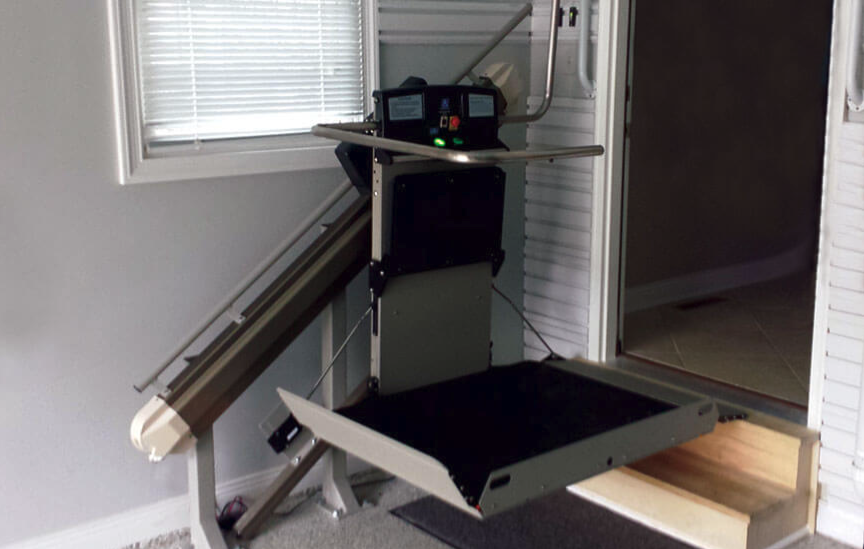
An inclined platform lift (IPL) carries a person and their wheelchair along a rail fitted to a staircase. Unlike a seated stairlift, it lets wheelchair users travel between floors without transferring from their wheelchair. Seated stairlifts generally cost less and take up less space, but require users to transfer safely.
How Does an Inclined Platform Lift Work?
An IPL uses a rail or track that follows the staircase. A motor moves the wheelchair platform along this track between floors. Depending on the model, the drive system may use rack-and-pinion, rope-sprocket, or wire-haul technology.
The platform may fold against the wall when not in use. It can include ramps for boarding and controls that require users or caregivers to hold a button while the lift moves. This is known as constant-pressure operation.
Does Your Wheelchair Fit an Inclined Platform Lift?
Inclined platform lifts typically have platforms around 26 to 36 inches wide and 36 to 49 inches long. Most models support 550 to 660 pounds, including the user and mobility device. Larger power wheelchairs and mobility scooters may need more platform space or a higher weight capacity.
The staircase also needs enough clearance for the lift to operate. Many installations require a staircase at least 38 inches wide and around 10 feet of clear space at the bottom landing. Requirements vary with the lift design, stair angle, and boarding configuration.
Check these measurements against your wheelchair and home layout before choosing a lift. An installer can confirm whether the platform, staircase, and landings provide enough room for safe access.
If you’re comparing accessibility options for your home, explore our guide to the best wheelchair lifts to find the right solution for your needs.
Inclined vs. Vertical Platform Lifts
Both inclined and vertical platform lifts (VPLs) carry wheelchair users between levels. However, their travel paths, installation requirements, and costs differ.
- Travel path: An IPL follows the staircase, while a VPL moves vertically between floors.
- Installation: An IPL uses a rail attached to the stairs or support posts. A VPL may require a concrete base, support structure, or shaft.
- Cost: A straight IPL typically costs $20,000 to $30,000. A residential VPL generally costs $12,000 to $30,000 installed.
What Affects Inclined Platform Lift Installation Costs?
Installation costs vary depending on the staircase layout, lift configuration, and additional work required. The final price depends on several factors:
- Staircase layout: Straight staircases use standard rails. Curved stairs and intermediate landings require custom rail fabrication, which increases equipment and installation costs.
- Mounting requirements: Installers attach the rails to the staircase or supporting structures. Additional support or structural modifications can increase labor and material costs.
- Platform size and capacity: Larger platforms and higher weight capacities can increase equipment costs.
- Electrical work: Inclined wheelchair platform lifts typically use a standard 120-volt power supply to charge their battery systems. New wiring or outlet installation can add to the project cost.
- Permits and labor: Permit fees depend on local requirements and the property. A standard straight lift can typically be installed in about one day, while more complex projects may take longer.
Before choosing a model, arrange an in-home assessment and request an itemized quote. Ask the installer to separate equipment, custom rail fabrication, installation labor, electrical work, structural modifications, permits, delivery, and testing. Confirm whether the quote includes the warranty and any ongoing maintenance costs.
The Pros and Cons of Inclined Platform Lifts
An inclined platform lift can make a multi-level home more accessible for wheelchair users. However, it requires staircase space and can involve a high upfront cost. Consider these advantages and limitations before choosing one.
The Pros
- No wheelchair transfer required: Users can travel between floors while remaining in their wheelchairs. This helps people who can’t safely transfer to a seated stairlift.
- Straight and curved staircase options: IPLs are available for different staircase layouts. Some models are also designed for outdoor use.
- Safety features: Depending on the model, features may include emergency stop buttons, battery backup, safety sensors, and boarding ramps.
- No separate lift shaft: IPLs follow the existing staircase and generally don’t require the shaft or enclosure used by many vertical platform lifts.
- Folding platforms: Many platforms fold against the wall when not in use, reducing the space they occupy.
The Cons
- High upfront cost: IPLs can cost more than seated platform stairlifts, particularly when a staircase requires custom curved rails.
- Staircase space: Even folded platforms and rails take up space. This can narrow the staircase and affect access for other household members.
- Potential operating noise: The motor and moving platform can produce noise during operation. The level varies by model and installation.
- Installation limitations: Not every staircase or landing can accommodate an IPL. The available space and staircase layout may limit installation options.
How to Reduce the Cost of an Inclined Platform Lift
Eligible homeowners may qualify for government assistance, nonprofit grants, or financing to help pay for an inclined platform lift. Available options depend on individual eligibility and location.
Government Assistance Programs
Medicare generally doesn’t cover inclined platform lifts as home modifications. However, some Medicare Advantage plans may offer additional benefits. Medicaid Home and Community-Based Services (HCBS) waivers may also cover accessibility modifications for eligible individuals.
Veterans with qualifying service-connected disabilities may receive VA housing grants, including Specially Adapted Housing (SAH) grants, to fund certain home modifications.
Nonprofit and Community Grants
Nonprofits, disability foundations, and local community organizations may offer grants or equipment assistance for home accessibility projects. Contact your local Area Agency on Aging to find programs in your area.
Financing and Tax Considerations
Some lift providers offer financing plans that spread payments over time. Compare interest rates, fees, and repayment terms before signing an agreement.
Medically necessary home modifications may also qualify as tax-deductible medical expenses under IRS Publication 502. However, deductions depend on IRS eligibility rules and generally require itemizing deductions.
Frequently Asked Questions (FAQs) About Inclined Platform Lifts
Routine maintenance includes checking the drive system, platform, safety sensors, controls, batteries, and rails. Technicians may also inspect moving parts and test safety functions. Follow the manufacturer’s maintenance schedule to keep the lift operating safely.
Help us improve our guides! If you’ve recently installed an inclined platform lift or have insights on how yours works, we’d love to hear from you. Share your experience with us at [email protected]. Your personal details will stay completely confidential.