
Retirement Living takes an unbiased approach to our reviews. We may earn money when you click a partner link. Learn More
Platform Lift vs. Elevator: What’s The Difference?
On average, platform lifts are less expensive than home elevators ($22,000), but have a maximum travel distance of 14 feet, while home elevators cost an average of $52,500 and can travel much farther, usually up to 50 feet in residential settings.


Updated:
AT A GLANCE:
- Inclined platform lifts (IPLs) and vertical platform lifts (VPLs) generally cost between $9,000 and $35,000, with the former being more expensive. Home elevators, on the other hand, cost between $20,000 and $85,000+, with different elevator types having unique price ranges.
- While through-the-floor elevators can only travel between two floors (14 to 20 feet), most residential elevators can legally reach 50 feet. Platform lifts can usually only travel up to 14 feet.
- Both installations tend to have similar weight capacities (300 to 1,000 lbs), with variations depending on the type of lift or elevator, but can each support mobility devices like wheelchairs and scooters.
For seniors with mobility issues looking to improve home accessibility, both enclosed passenger elevators and open platform lifts can provide safe vertical travel. However, with so many different types available, comparing the two can feel overwhelming. From considering the overall cost of structural modifications and added safety features to determining whether a specific model will travel as high or lift as much as you need, careful comparison is key.
Below, we compare the most important differences between platform lifts and home elevators so seniors in need can find the best residential lift for their home layout and budget.
Understanding Platform Lift & Home Elevator Variety
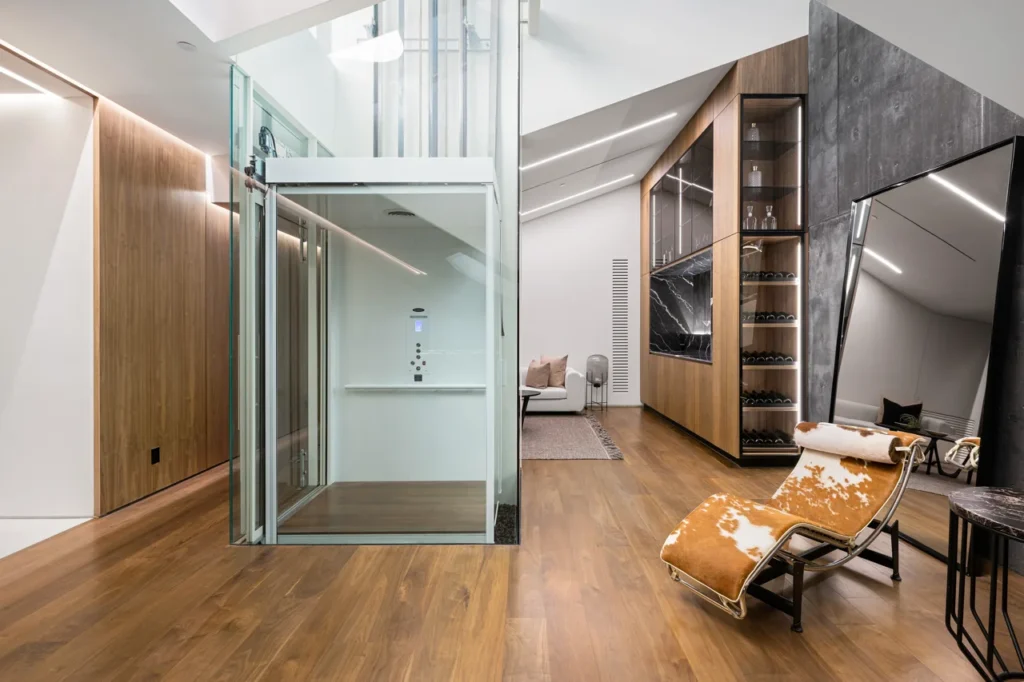
The primary difference between platform lifts and home elevators is that platform lifts have open-air or partially enclosed designs, while home elevators have fully enclosed cabs. Elevators also tend to have a hoistway, though this isn’t always the case.
In fact, there is a lot of variety in platform lifts and home elevator designs. For example, there are shaftless elevator types, like through-the-floor and pneumatic vacuum elevators (PVE), that save space because they don’t require a hoistway. Likewise, some elevators save space with modern machine-room-less functionality.
When it comes to platform lifts, IPLs are clearly different from elevators in the sense that they lift users upwards at an angle (usually following the stairs). VPLs can be tricky to tell apart from elevators if you add an enclosed cab as an optional safety feature, since they also travel vertically.
Below, we compare the key differences between platform lifts and home elevators to provide the most accurate comparison.
Types of Platform Lifts
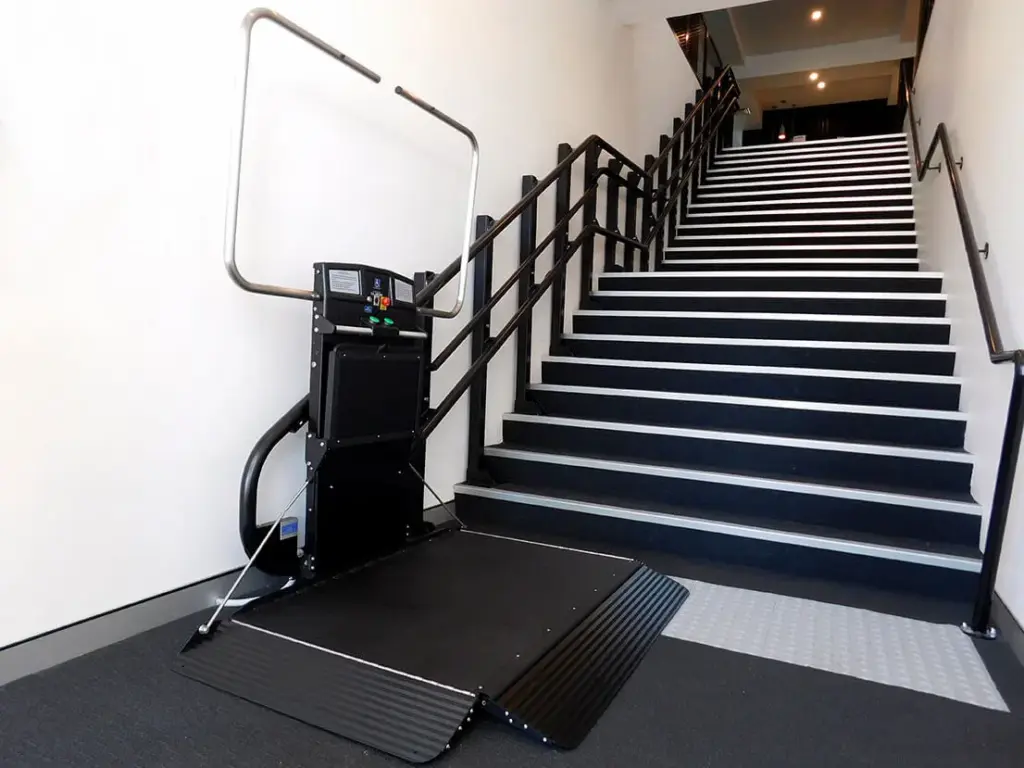
- Inclined Platform Lifts (IPLs): IPLs are essentially wheelchair-accessible stairlifts, or stairway chairlifts. They transport users on a flat platform diagonally along a staircase, keeping the wheelchair secure with physical platform barriers, wheelchair brakes, and safety straps. The lift folds flat when not in use, saving space.
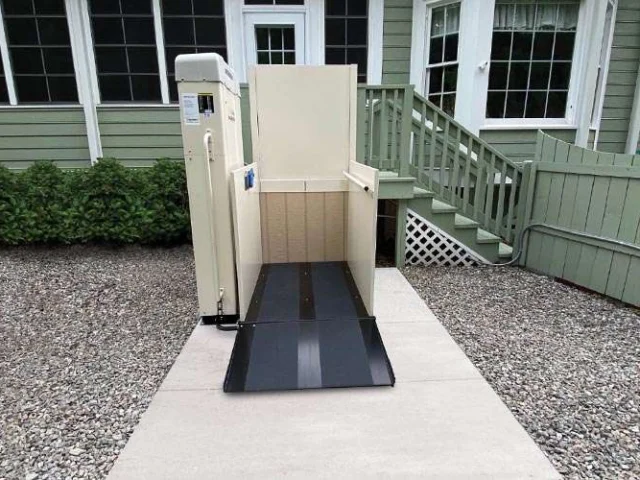
- Vertical platform lifts (VPLs): Another type of wheelchair lift, these installations abandon the search for an accessible route along the staircase in favor of fully vertical transportation alongside it. Most are open platforms that run along a mast or guide column, though some offer enclosed platforms as an optional addition. They’re popular for indoor and outdoor use, as they can be designed to rise only a few feet up porches, decks, and patios.
Types of Home Elevators
- Traction elevators: One of the most space-demanding elevator types, these units usually require an elevator shaft (hoistway), a pit, and a separate machine room. Functionally, a power-operated motor and pulley (sheave) raise the cab along guide rails inside the shaft, while a counterweight balances the system, reducing energy consumption. They have some of the highest travel distances among home elevators, easily reaching the residential cap of 50 feet.
- Hydraulic elevators: Also require a lot of space for a pit, hoistway, and machine room, but achieve lift using pressurized hydraulic fluid rather than a purely mechanical system. More specifically, an electric motor powers a hydraulic pump that forces fluid into a cylinder, moving the piston that raises the car. To descend, the system returns the fluid to its storage unit. They’re great for wheelchair users because they tend to have higher weight capacities compared to other elevator types.
- Winding drum elevators: Operate like a human-sized dumbwaiter, using an electric motor and steel cables to achieve lift. The system directly winds the cables onto a drum to raise and lower the car, usually without using counterweights. They require a hoistway but no separate machine room.
- Through-the-floor elevators: Compact and requiring minimal structural modification, through-the-floor lifts travel through a precisely cut floor opening supported by a small guide rail system. When not in use, the opening is sealed with a safety lid or panel. The most prominent cost of this space-saving design is that these elevators typically travel only between two floors.
- Pneumatic elevators: These self-supporting lifts don’t require a hoistway or machine room, and they come with the perk of reaching the maximum residential travel distance of 50 feet (when applicable). They use air pressure differences to raise and lower the cab within a clear vertical tube. Removing air from above the cab creates lift, while gradually releasing it back into the chamber allows for a smooth descent.
Platform Lift vs. Home Elevator Comparison
If you’re deciding between a platform lift or home elevator installation, understanding cost ranges, the installation process, travel distance/speed, weight capacity, and maintenance requirements can also help you make an informed decision. Below, we’ve outlined what to expect:
1. Overall Costs
- Platform lifts: Generally cheaper than home elevators, with IPLs being the more expensive option ($12,000 to $35,000) compared to VPLs ($9,000 to $20,000).
- Home elevators: Expect a wide cost range. Winding drum elevators can start as low as $20,000, but most elevator types fall between the $35,000–$85,000 price range.
2. Installation Process
- Platform lifts: Both VPLs and IPLs are quick to install and minimally invasive. Most models skip structural work, such as a hoistway or pit, and installation typically takes just a few days to a week.
- Home elevators: Wide variation based on elevator type. Shaftless elevators require less structural modification and can be installed in only a few days. On the other hand, traction and hydraulic elevators require significant renovation of the hoistway, pit, and, often, a machine room. They can take several weeks to install.
3. Travel Distance
- Platform lifts: VPLs and IPLs can travel only 12 to 14 feet along or next to stairs, or the distance between floors.
- Home elevators: Travel distance varies; through-the-floor lifts can travel only 14 to 20 feet, while most other elevator types can easily reach the residential maximum of 50 feet. Some commercial and freight elevators have essentially no maximum height limit.
4. Travel Speeds
- Platform lifts: Move at a slower pace, more similar to stairlifts (between 1.5 and 30 feet per minute), largely because trips are short and need to keep wheelchairs steady.
- Home elevators: Most units are faster than platform lifts, averaging 30 to 50 feet per minute, depending on the model. Traction elevators tend to be the quickest, while hydraulic and pneumatic elevators run slightly slower due to their unique power sources.
5. Weight Capacity
- Platform lifts: Usually support at least one wheelchair user and have capacities ranging from 300 to 750 lbs. Some heavy-duty VPLs can be designed to lift more.
- Home elevators: Generally support 350 to 1,000 lbs, with through-the-floor lifts having the lowest range (350 to 500 lbs), while hydraulic lifts can hoist well over 1,000 lbs when needed.
6. Maintenance & Operation
- Platform lifts: Less maintenance required overall, with the most important tasks including occasional lubrication, battery checks (for battery-backup models), and inspection of safety straps or sensors. Many states and counties don’t have inspection laws for these systems.
- Home elevators: Different types of elevators have unique maintenance requirements. Hydraulic and traction elevators require more frequent professional servicing due to their motors, pulleys, or fluid systems, while pneumatic and through-the-floor systems tend to have fewer moving parts and lower upkeep costs. Across the states, you can expect laws that require annual inspections by a licensed technician.
Which Installation Is Best For Your Home?
Whether you need a porch lift or one that reaches the third floor, you should always examine your budget, mobility needs, home layout, and number of floors to determine the best lift for aging in place. For instance, elevators take up more than just floor space, with shafted elevators requiring 7–10 feet of additional overhead clearance and 4′ x 4′ to 5′ x 7′ (16–35 sq. ft.) for a separate machine room.
IPLs and VPLs also only travel between two floors, so if you live in a high-rise building, you may need to invest in a traction, hydraulic, or pneumatic vacuum elevator. These systems might cost more, but are required to meet your needs in this instance.
Luckily, both platform lifts and home elevators are usually designed to accommodate wheelchair users, so either option should work with a mobility aid.
Our Takeaway: Platform Lifts Offer Value, While Elevators Offer More Flexibility
For seniors with mobility issues, both platform lifts and elevators provide safe transportation up and down stairs. If you’re replacing an outdoor porch ramp or have a wide-enough staircase, VPLs and IPLs are the more cost-effective option. However, home elevators can rise higher, travel faster, and lift more. Some shafted elevators require extensive home modifications to install, while shaftless models are less space-demanding.
Ultimately, you should carefully analyze your mobility needs, budget, and home layout to see which option is best for you. Contacting trusted elevator and platform lift companies is also a good way to get not only quotes but also more information about additional safety features and local requirements.
Frequently Asked Questions (FAQs) About Platform Lifts vs. Elevators
Usually, no. An elevator unit has an enclosed cab that travels vertically, either through a hoistway or a small cutout. Platform lifts, on the other hand, utilize open-air or partial-cab designs and often don’t need floor cutouts. However, the line is blurred slightly when it comes to vertical platform lifts (VPLs). Inclined platform lifts (IPLs) operate similarly to stairlifts in that they travel along a staircase, while VPLs travel vertically like an elevator would. However, most VPLs have an open-air cab design.
The best way to compare platform lift vs. elevator costs is to examine the different types, though each company will offer unique pricing. Here are some typical price ranges:
Platform Lifts
• VPL: $9,000 – $20,000+
• IPL: $12,000 – $35,000+
Home elevators
• Hydraulic: $25,000 – $70,000+
• Traction: $26,500 – $85,000+
• Winding drum: $20,000 – $40,000+
• Through-the-floor: $15,000 – $40,000+
• Pneumatic: $35,000 – $60,000+
Usually, platform lift maintenance is less complex and expensive, and most states do not require annual inspections. Basic maintenance includes occasional lubrication, safety sensor checks, and battery testing (for models with battery backup). Home elevator maintenance depends on the type and is usually mandated by state and local governments. Complex mechanisms such as motors, pulleys, or hydraulic systems require regular professional servicing.
Yes, platform lifts require far less overhead and floor space compared to home elevators. They require no hoistway or pit, just a small footprint for the mast, track, or base pad. Traditional elevators require 7-18+ square feet of shaft space and 7-10 feet of overhead clearance. Elevators with a machine room require even more space.
Generally, yes. Both platform lifts and home elevators come with emergency communication systems and basic safety essentials. Common safety features for platform lifts include barriers, wheelchair brakes, and safety straps. Elevators can have additional features, such as interior lighting, custom finishes, keypad or smartphone controls, and more, that platform lifts do not.
Yes. Platform lifts are so named because they transport seniors on a large platform that can support a wheelchair, rather than the chair you’d find on a stairlift. Most home elevators can also lift wheelchairs, though you should check the exact weight capacities of shaftless lifts (through-the-floor and PVE).
Platform lifts, especially IPLs, are the best option for seniors recovering from surgery or temporarily living in another home, as they require little to no structural modification. Both shafted and shaftless elevators are generally considered permanent installations.
Help us improve our guides! If you’ve recently purchased or installed a platform lift or elevator, or have insights on how yours works, we’d love to hear from you. Share your experience with us at [email protected]. Your personal details will stay completely confidential.