
Retirement Living takes an unbiased approach to our reviews. We may earn money when you click a partner link. Learn More
Best Voice-Activated Medical Alert Systems of 2026
Compare the top voice-activated medical alert systems for seniors—featuring the fastest response times, widest coverage ranges, and longest backup battery life.


Updated:
If you’re looking for a medical alert system that doesn’t require you to press a button, a voice-activated system may be the right fit. These devices respond to your voice and connect you to a live emergency monitoring center with a simple spoken command—no wearable pendant required. Our research identifies top picks Medical Guardian and GetSafe that offer the necessary features to keep you within a call away from emergency help without committing to a wearable device.
4.7
Medical Guardian’s tagline, “Life Without Limits,” shows its mission. The company aims to help customers live independently. Medical Guardian provides five in-home or mobile systems. They also have a medical alert smartwatch and the MGMini wearable alert button.
- Great variety
- Call chain for caregivers
- Sleek, stylish wearable devices
You can buy a wearable medical alert device from GetSafe, but the company caters to consumers who don’t want to wear a button. GetSafe offers medical alert system packages for homes ranging from one to five bedrooms.
- Great for large homes
- No wearable devices required
- Can service large homes up to five bedrooms
How We Chose the Best Voice-Activated Medical Alert
To identify the best voice-activated medical alert systems, we began with our own research, which included a deep dive into specs, personal testing by our team, conversations with experts, and a review of user reviews. This initial research identified the 12 best medical alert systems.
From there, we narrowed the field to those that offer the specific voice-activated type of medical alert systems – those that seniors can speak a command to reach the monitoring center without pressing a button. That means no mobile devices, cell phone, or even a phone number needed. We evaluated each system against the three main features: response time, coverage range, and battery backup life, which matter most to seniors who rely on this technology at home.
The result is two brands: Medical Guardian and GetSafe, which represent the best voice-activated personal emergency response systems available. Each gives you peace of mind and connects you to a 24/7 live monitoring center without a button press.
Compare the Best Voice-Activated Medical Alert Systems for Seniors
The following chart gives you a quick comparison of the best voice-activated medical alert systems for you and your loved one.
| Brand | Response Time | Coverage Range | Backup Battery Life | Voice Recognition Quality |
|---|---|---|---|---|
| Medical Guardian | 8 seconds | Up to 1,400 feet | 32 hours | Not specified |
| GetSafe | Not specified | Up to 800 feet | 32 hours | Not specified |
Voice-Activated Medical Alert Reviews
Medical Guardian Review
Great variety
|
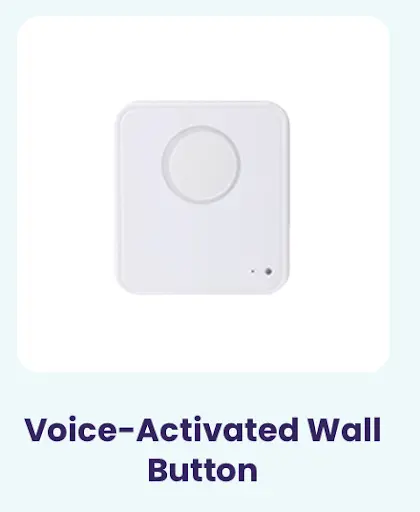
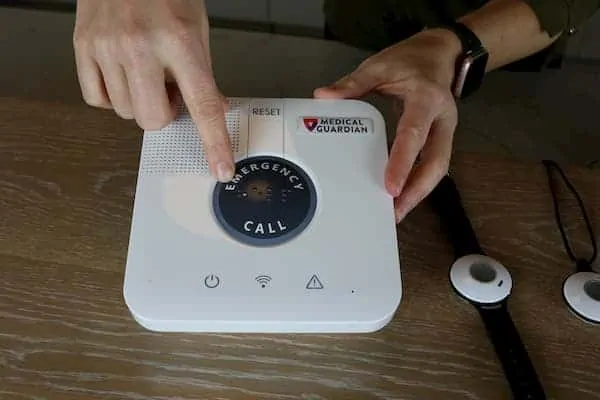
Medical Guardian is one of the most recognized names in the medical alert industry, and its voice-activation capability makes it an excellent choice for seniors who want hands-free emergency coverage. The company offers voice-activated wall-mounted buttons that can be placed anywhere in the home, including the bathroom, kitchen, or hallway. They’re activated either by pressing the button or by calling out “Call Medical Guardian.” These buttons connect to an in-home base unit, which is available with either a landline or a cellular connection.
What sets Medical Guardian apart is its response time. Medical Guardian reports that it connects users to a live operator in as little as 8 seconds, making it the fastest response time among brands on our list. Each voice-activated wall button has a range of up to 1,400 feet from the base station, which is sufficient to cover most home layouts. The system includes a 32-hour backup battery in case of a power outage.
To learn more, read our full Medical Guardian review.
GetSafe Medical Alert Review
Great for large homes
|
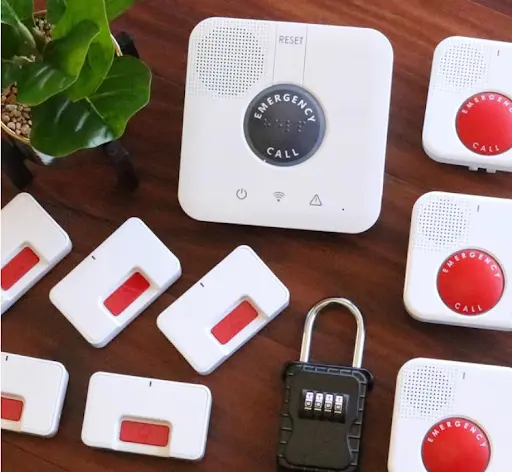
GetSafe is unique among medical alert providers because voice activation is not an add-on. Unlike other systems, it’s the core of how the system works. The system is built specifically for seniors who prefer not to wear a button. Instead of a wearable device, GetSafe places a control panel and voice-activated wall buttons throughout the home. Each button can be activated by pressing the center button or by calling out “Call 911, Call 911.” The control panel also responds to voice commands.
GetSafe only offers in-home coverage, making it ideal if you spend most of your time at home. The voice-activated wall buttons have an 800-foot coverage range from the base panel. The system connects via 4G LTE and features noise-canceling microphones built into each wall unit for clear voice recognition, even in noisy environments. The backup battery lasts up to 32 hours during a power outage.
GetSafe offers three package options based on the size of your living space, with the number of wall-mounted buttons corresponding to the size.
For more information, read our full GetSafe review.
How a Voice-Activated Medical Alert System Works
A voice-activated medical alert system responds to your voice. When you call out a predetermined word or phrase, such as “Call Medical Guardian” or “Call 911, Call 911”, the system activates and connects you directly to a 24/7 emergency monitoring center. This is different from a regular medical notification system, which requires you to press a button. The monitoring center then determines whether your medical emergency requires emergency responders or notification of your emergency contacts and caregivers.
Voice activation is also different from two-way communication in medical alert devices, which lets you speak with a monitoring agent after an alert is triggered by pressing a button. Voice activation is the trigger itself—no button press required.
It’s important to note that two of our picks, Medical Guardian and GetSafe, offer the voice-activated system as an add-on to their in-home systems, while GetSafe offers it as a standalone system.
Who Benefits From a Voice-Activated Medical Alert
Voice-activated systems are particularly useful for three groups of seniors:
- Seniors who prefer not to wear a device: Some older adults are resistant to wearing a pendant or wristband. Voice-activated systems stay in the background unless emergency help is needed.
- Seniors with limited mobility or dexterity: If arthritis, vision loss, or limited hand strength make pressing a small button difficult or impossible, being able to call for help verbally is faster and easier in an emergency.
- Seniors with early memory loss: For those who may forget to wear or charge a wearable device, a voice-activated system that is always on and plugged in takes the responsibility off them.
What to Look For in the Best Voice-Activated Medical Alert Systems
When choosing a voice-activated medical alert system, the must-have features below will determine how well the system actually protects you in an emergency or healthcare crisis. The two brands we recommend offer these features. Take a look:
- Response time: The faster a monitoring center agent answers your emergency call, the quicker you get help. Medical Guardian states emergency alert response times as fast as 8 seconds.
- Coverage range: The coverage range determines how far from the base unit the system can detect your voice. In a small apartment, 800 feet is enough. Larger homes or multi-story layouts need more like 1,350–2,000 square feet.
- Backup battery life: Most voice-activated systems are plugged into an outlet, but a backup battery ensures they continue to work during a power outage. We recommend a minimum of 30 hours, which our top picks provide.
- Voice recognition quality: A system with a noise-canceling microphone is more likely to correctly detect your voice in real-life conditions, such as when a TV is on or there is background noise. GetSafe specifically designs its wall buttons with noise-canceling microphone technology.
- 24/7 monitoring center: Both systems on this list connect to a live, U.S.-based call center around the clock.
Because these systems are voice-activated, automatic fall detection is not an included feature. Automatic fall-detection medical alert systems require you, the wearer, to wear a device that detects a fall, which defeats the purpose of these voice-activated options.
Price Considerations for Voice-Activated Medical Alert Systems
Medical alert system costs vary. Because these are voice-activated in-home medical alert systems, they generally cost less than GPS-enabled mobile devices. You should expect to pay between $30 and $60 per month. They also come with a one-time activation fee and equipment costs that vary by brand. Here is a breakdown of costs by brand:
| Brand | Starting Monthly Fee | Equipment Costs | Activation Fee |
|---|---|---|---|
| Medical Guardian | $31.95 | None | None |
| GetSafe | $29.95 | Starting at $79 | None |
Optional Add-Ons
Optional add-ons across both brands include fall detection ($5–$10 per month) and caregiver apps. None of these brands requires long-term contracts, and both allow month-to-month billing.
Discounts and Financial Assistance
While Medicare (Parts A and B) doesn’t cover medical alert systems, Medicare Advantage might offer some coverage. You will need to check with your provider. Additionally, many brands offer a small discount if you pay annually rather than month-to-month.
Veterans’ benefits, Medicaid waiver programs, and community assistance programs are additional resources that may help offset costs. Check with your insurance provider or local Area Agency on Aging for programs available in your area.
Frequently Asked Questions (FAQs) About Voice-Activated Medical Alert
Yes. These are supplemental to the voice-activated system. Medical Guardian includes a wearable pendant as part of their in-home systems. GetSafe is designed specifically for seniors who do not want to wear a device and does not include a wearable button as a central component, though it is an optional add-on.
No. Medicare Parts A and B typically don’t cover medical alert systems. However, some Medicare Advantage (Part C) plans may offer partial coverage or wellness reimbursements. Contact your provider to find out what benefits are available to you.
For the most part, yes. These systems are designed to respond only to specific voice commands (such as “Call Medical Guardian” or “Call 911, Call 911”) and not to general conversation. GetSafe’s wall buttons include noise-canceling microphones specifically designed to reduce false triggers. Both systems allow you to cancel an accidental alert by speaking to the agent when they respond.
Concluding Thoughts on Voice-Activated Medical Alert
Bottom Line: The best voice-activated medical alert systems give seniors a hands-free way to reach emergency help quickly, without needing to press a button or wear a device.
Each of our picks connects to a live 24/7 monitoring center, provides you quick access to lifesaving emergency services, offers the right blend of must-have key features, and gives you and your family members peace of mind so you can continue to live at home and age in place.