
Retirement Living takes an unbiased approach to our reviews. We may earn money when you click a partner link. Learn More
Best Affordable Home Elevators of 2026
Our research highlights low-cost home use elevator brands that offer practical solutions without the high cost of traditional systems.


Updated:
Through extensive research, we identified 3 inexpensive home elevator brands, including Bruno, that provide safety features and reliable performance while offering a smaller footprint, simplified design, lower installation costs, and less maintenance to keep costs down.

Bruno Home Elevators provides reliable and stylish home elevator solutions. Bruno elevators are available in multiple models, including residential and small commercial lifts. They are ideal for individuals who need assistance navigating stairs due to aging, injury, or limited mobility.
- Customizable designs
- Versatile models
- Professional installation

Harmar’s platform lifts offer safe, compact access for wheelchairs and scooters. They offer durable designs, safety features, and options for indoors and outdoors. They’re a reliable choice instead of ramps.
- Vertical travel up to 14 feet
- Compact design fits spaces as small as 36” x 48”
- Compatible with mobility devices for indoor and outdoor use

Pneumatic Vacuum Elevators LLC
4.5
Pneumatic makes three models of air-driven home elevators. The cylindrical shape of the cabs takes up less room. Usually, they are 30 to 52 inches in diameter, depending on the model. The vacuum elevators use air pressure to raise and lower the cab. They use no electricity during the descent and about 4.7 kilowatts during the ascent. This makes them an energy-efficient option for you to use in your own home.
- Most Eco-friendly
- Air-driven, low-energy cost elevators
- Low-maintenance. Service calls every five years
How We Chose the Best Affordable Home Elevators
To identify the most affordable home elevators, we started with our review team’s list of the 9 best home elevators. This list was developed through research on leading brands, safety features, reliability, availability, industry trends, and expert and customer feedback.
We took this list and narrowed the focus to the brands that offer lower-cost solutions without sacrificing essential performance or safety. Using manufacturer specifications, consumer feedback, and industry research, we identified the companies that provide simpler designs, reduced installation requirements, lower maintenance requirements, and offer practical features better suited for budget-conscious buyers. The brands featured below represent the most affordable home elevator options based on our findings.
Comparing Affordable Home Elevators
Use the following chart as a quick reference when comparing low-cost home elevators.
| Feature | Bruno | Harmar | Pneumatic Vacuum Elevators |
|---|---|---|---|
| Price | Starting at $35,000 | Request a quote | Request a quote |
| Type | Shaftless, rail-driven | Shaftless, rail-driven | Vacuum, air pressure-driven |
| Cab Size | Starts at 21”x 29” | Starts at 31”x 42” | Range: 30”–52” diameter |
| Weight Limit | 500 pounds | 500 pounds | 350–525 pounds |
| Power Requirements | 110V standard outlet | 115V standard outlet | Starts at 220V, 25 Amp |
| Warranty | 2-year limited | 2-year parts and components | 1-year limited |
Affordable Home Elevators Reviews
Bruno Home Elevator Review
Customizable designs
|
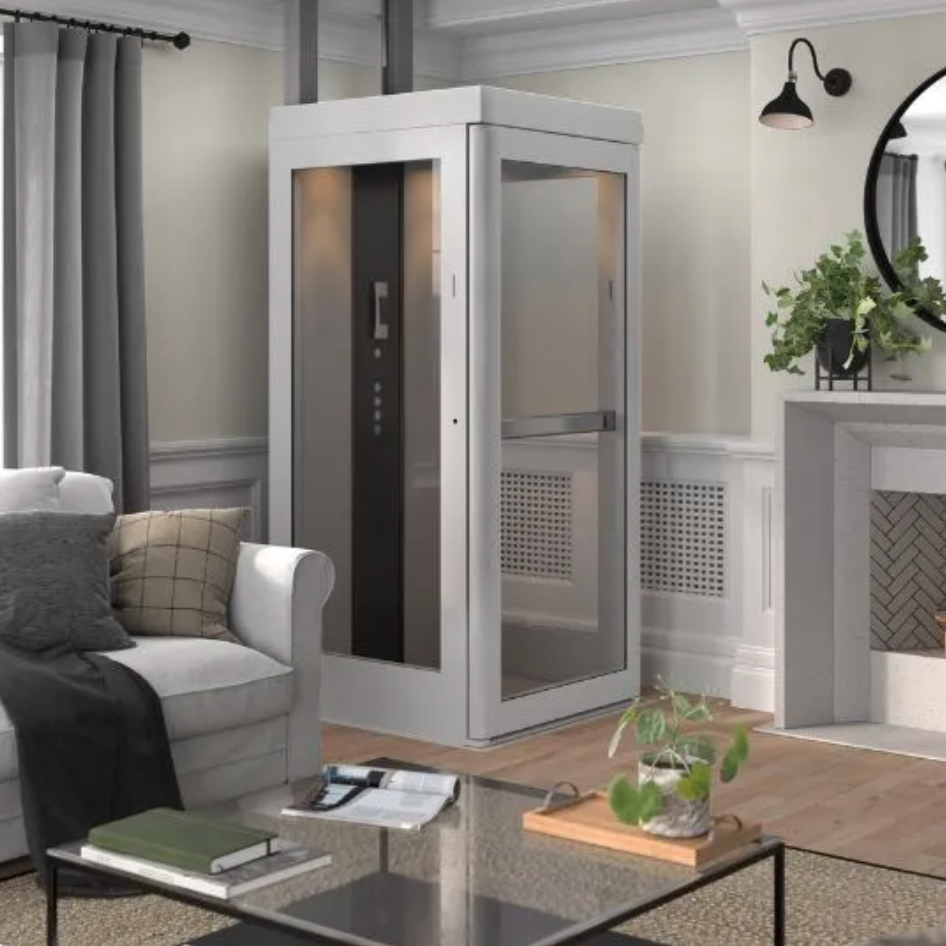
Bruno offers the Connect home elevator series. It’s a shaftless, freestanding, rail-driven elevator designed for retrofit installation in existing homes. It doesn’t require a shaft or a structural wall, which keeps installation costs down considerably.
There are three models in this line: Compact, Classic, and XL. The cab sizes range from the Compact size of 21″ x 30″ to the XL size of 33” x 49”, designed for one or two passengers, respectively. The weight capacity is 500 pounds.
These elevators run on standard household power (110V) and do not use hydraulic systems, which helps reduce installation complexity and ongoing maintenance. Safety features include interlocking doors, an emergency phone, and battery backup. Each carries a 2-year limited warranty.
The Connect series is an affordable home elevator option, with starting prices around $20,000 to $30,000 before installation. The total cost depends on the layout, configuration, and installation, but because of its simple design, it’s less expensive than traditional elevators. This makes it a practical option for homeowners who want an enclosed elevator without the cost and construction requirements of a high-end system.
For more information, read our full Bruno review.
Harmar Home Elevators Review
Vertical travel up to 14 feet
|
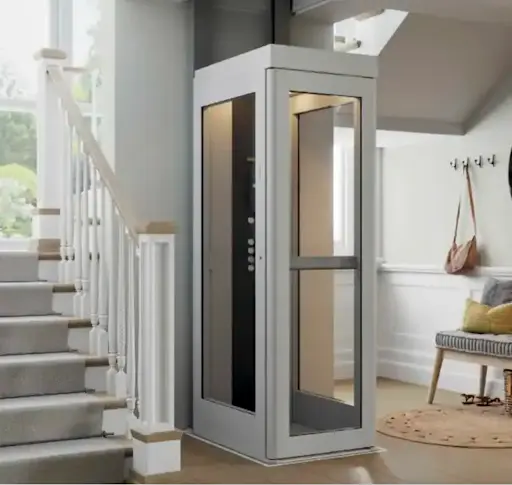
Harmar makes the Pollock residential elevator. It’s a shaftless, rail-driven system that operates through the floor for retrofit installation in existing homes. Since a traditional shaft or machine room isn’t required, installation and costs are kept to a minimum.
The Pollock elevator comes in three sizes, starting at a cab capacity of 31” by 42”. This can accommodate a single person, while the largest size is termed “accessible,” meaning it is designed to fit those with mobility challenges and their equipment, potentially even wheelchair-accessible (depending on the wheelchair size). All three sizes have a 500-pound weight limit. The Pollock runs on standard household power—a 115V standard outlet. Safety features include constant-pressure controls, a bottom tray, and a trapdoor sensor to detect obstructions, battery-powered lowering in case of a power outage, an in-cab telephone for emergencies, and an overspeed brake for added protection.
Harmar does not list pricing on its website, but with the simple installation process and design, this model is considered a more affordable home elevator option. It carries a two-year warranty on parts and components that will help keep early costs down.
For more information, read our full Harmar review.
Pneumatic Vacuum Elevators LLC Review
Most Eco-friendly
|
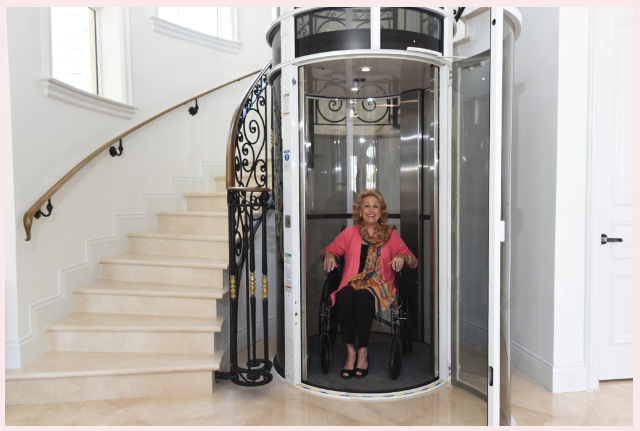
Pneumatic Vacuum Elevators (PVE) offer home elevators that use vacuum and air-pressure technology to move you from floor to floor, instead of cables or hydraulics. Because these home elevators use a different drive system, they are self-supporting and do not require a shaft, pit, or machine room, making them among the simplest home elevators to install. They also don’t require much maintenance. The manufacturer recommends maintenance every five years or 15,000 rides for a basic cleaning and seal check.
PVE elevators are available in multiple sizes, including small elevators for a single passenger and larger models that accommodate mobility solutions, such as a standard-size wheelchair with an attendant. Weight capacities vary by model, ranging from 350 to 525 pounds. The system runs on a dedicated circuit for high-power residential appliances. Safety features include emergency brakes, battery backup, and a controlled descent in the event of power loss. PVE home elevators come with a one-year limited manufacturer’s warranty.
Because the system is self-contained and uses fewer mechanical components, maintenance requirements are generally lower than those of traditional home elevators. Pricing is not listed on the website, but PVE emphasizes ease of installation and minimal structural impact, putting it in the affordable price range.
What Is a Home Elevator?
An affordable home elevator is a system that allows you to move between the floors of your home. But unlike a stairlift, residential lift, wheelchair lift, or platform lift, which are all open and move you shorter distances, a home elevator moves in its own space up and down between floors. While traditional, high-end systems cost more, affordable versions deliver the same functionality with a simpler design, fewer customization options, and easier installation, which helps keep costs down.
Features to Look For In Inexpensive Home Elevators
Affordable home elevators are defined by the features that keep both upfront and long-term costs down. Instead of focusing on luxury upgrades or customization, these systems prioritize simple designs, lower installation requirements, and essential functionality. The following are features to look for without all the bells and whistles:
- Basic safety: Look for safety features such as door interlocks, emergency stop controls, obstruction sensors, and battery backup. These important safety features should be included at no additional cost.
- Footprint: We mean the weight capacity and cab size. A small footprint means smaller equipment and lower complexity, which lowers the installation costs.
- Power requirement: To keep costs low, look for energy-efficient systems. Some run on standard household power and don’t need dedicated electrical upgrades.
- Warranty: A good warranty reduces costs by covering repairs early, especially for costly components.
Types of Home Elevators
The type of elevator you choose is a major factor in the overall cost because it determines installation, maintenance, space requirements, and power needs, all of which affect the price. On the budget end, you want to look for pneumatic vacuum elevators and shaftless elevator models. Machine room-less, winding drum, and hydraulic home elevators are moderately priced, while traction and glass elevators are on the higher end in price.
Cost of Affordable Home Elevators
In 2025, the cost of residential elevators ranged from $30,000 to $100,000, not including installation costs. Costs vary based on several factors, including the type of in-home elevator, the number of floors, and the extent of installation work required. Customizations and additional features to meet a wide range of elevator needs significantly increase the total price. If you want an inexpensive home elevator, start by choosing a model with a small or standard elevator size and basic features to keep costs down. While most elevator companies don’t list prices online, you can request a free quote.
Installation Cost Range
Picking a cheap home elevator is just the start. You still need to factor in professional installation. The cost to install a home elevator ranges from $1,500 to $20,000. Again, this price depends on the elevator type and the project’s complexity. For elevators that require a shaft, pit, structural modifications, hoistways, or electrical work, the cost will be much higher. Often, installation costs are bundled into the low-cost home elevator price, so it’s important to ask for a detailed quote to understand the full price range.
Maintenance Costs
Ongoing maintenance is another price factor. While the exact annual costs vary, more complex components, such as hydraulic elevators, may require more service over time. Simpler systems with fewer moving parts will have lower maintenance needs and be more cost-effective. While this doesn’t affect upfront costs, it’s something to consider in the long term. Additionally, a warranty will help ease costs should something go wrong in the first few years.
Frequently Asked Questions (FAQs) about Affordable Home Elevators
Residential home elevators typically cost between $30,000 and $100,000. The final price depends on the elevator type, the number of floors, and installation costs.
No, Medicare does not cover home elevators. Some local or state assistance programs might offer assistance, but coverage varies. It’s a good idea to inquire.
Home lifts, like vertical platform lifts, range in price from $5,000 to $25,000. They’re less expensive than full elevator lifts because they’re open, simple elevator systems that travel less distance and therefore require less construction.
Space requirements vary by type, but many home elevators need a footprint of about 3 feet by 4 feet or more. Shaftless and compact models are more space-saving, while traditional elevators with a shaft need additional room for construction and equipment.
Concluding Thoughts on Affordable Home Elevators
Bottom Line: If you’re looking for an affordable home elevator, focus on models that reduce installation complexity and avoid unnecessary customization.
You don’t have to sacrifice safety and reliability features to get an affordable home elevator. Choosing the right type and size, while skipping upgrades, will make a significant difference in your total cost. Shaftless, pneumatic, and compact systems are typically the most cost-effective because they require less construction and use simpler designs.
Look for affordable home elevators that prioritize safety, standard sizing, and efficient installation to get reliable performance without the added cost.