
Retirement Living takes an unbiased approach to our reviews. We may earn money when you click a partner link. Learn More
Modern Home Elevators: Cost & Design Options
Modern home lifts are elevators that combine a compact footprint and energy-efficient design with smart features, costing an average of $42,500 for parts and installation.


Updated:
AT A GLANCE:
- Modern shaftless elevators, including through-the-floor models ($15,000 to $40,000) and PVE ($35,000 to $60,000), don’t require a hoistway or machine room, giving them a small footprint.
- There are traction and hydraulic elevators with modern machine-room-less (MRL) designs that cost anywhere from $25,000 to $70,000+. They have a more compact design than traditional options but still require an elevator shaft.
- Examples of modern home elevator features include panoramic glass enclosures, wheelchair-accessible platforms/weight capacities, advanced smart home integration, battery backups, door sensors, and other options that improve safety and performance.
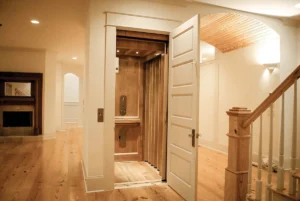
As accessibility solutions for seniors aging in place, in-home elevators have come a long way. Today, modern designs often don’t need a machine room or hoistway and come with a variety of safety, accessibility, and quality-of-life features that improve the user experience.
Below, we’ve analyzed modern machine-room-less and shaftless home elevator solutions, including parts and labor costs, so you can find the most cost-effective way to manage your mobility issues at home.
Examples of Modern Home Elevator Designs
While traditional home elevators, including traction and hydraulic models with a dedicated machine room, remain common in commercial settings, many modern home elevator designs have smaller footprints and improved energy efficiency. Some examples include:
Pneumatic Vacuum Elevators (PVE)
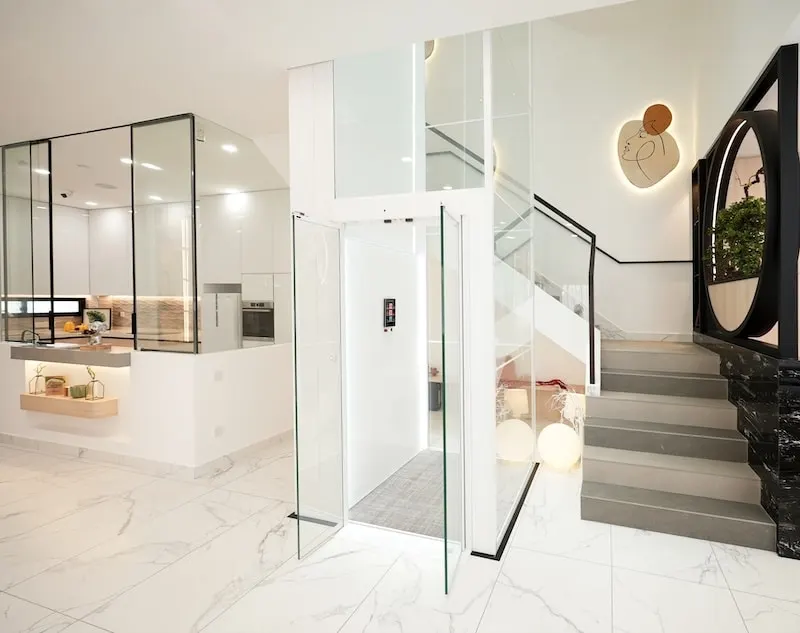
PVE lifts are a type of shaftless elevator that uses air pressure to move the cab between floors. Typically, it’s a glass elevator design that travels inside a self-supporting cylindrical tube, meaning that no cables, pistons, hydraulic fluid, or dedicated machine room is required. It’s one of the most compact modern elevator options available to seniors, but it also has a limited weight capacity and travel height compared to traditional home elevators and wheelchair lifts.
Key Features:
- No pit, hoistway, or machine room required
- Self-supporting, transparent panoramic design
- Up to 50 ft travel distance
- Energy-efficient operation using air pressure technology
- Fast installation compared to traditional elevators
- Minimal maintenance requirements
Best For: Homeowners looking for panoramic views, limited structural modifications, and monthly energy savings
Through-The-Floor Elevators
When a stair lift won’t fit, through-the-floor lifts are one of the cheapest modern home elevator options. While they can only travel between two floors, the fact that they only require a small cutout in the floor means you’ll save significantly on construction costs. No hoistway or separate machine room required.
Key Features:
- No elevator shaft or machine room required
- Compact footprint, often less than 10 square feet
- Quick installation with minimal structural modification
- Easy-to-use controls and accessibility features
- Energy-efficient electric drive systems
Best For: Homeowners with small homes looking for a budget-friendly mobility solution and monthly energy savings
Machine Room-Less (MRL) Elevators
Machine-room-less (MRL) traction and hydraulic elevators are modern innovations that eliminate the need for a separate machine room, making it easier for homeowners to accommodate the space needed for installation. They still require a pit and hoistway, but the drive equipment is integrated within the hoistway to reduce space requirements.
Hydraulic models run using pressurized hydraulic fluid (usually oil) to lift and lower the elevator cab. Conversely, traction elevators use a system of carefully balanced counterweights, an electric motor, and pulleys (also known as sheaves) made of steel ropes to lift the elevator cab. Both have unique pros and cons: hydraulic models generally have a higher potential weight capacity, while traction models have a higher potential lift height.
Key Features:
- No dedicated machine room required
- Supports larger cabs and higher weight capacities
- Smooth, quiet ride quality
- Suitable for wheelchair users and other mobility devices
- More custom home elevator options
Best For: Homeowners willing to undertake major renovations for the sake of a higher travel height or improved wheelchair accessibility.
Modern Home Elevator Costs
The average cost of a modern home elevator, including the elevator car, installation equipment, and labor, ranges from $15,000 to $70,000+. Ultimately, the actual price you pay will depend on the type of elevator, floor plan, added safety features, and even your state/region. Here’s what homeowners might expect to pay based on elevator type:
- Through-the-floor elevators: $15,000 – $40,000+
- Pneumatic Vacuum elevators (PVE): $35,000 – $60,000+
- MRL hydraulic elevators: $25,000 – $60,000+
- MRL traction elevators: $35,000 – $70,000+
Modern Home Elevator Interior Features & Costs
Today’s home elevators offer features that go far beyond those of traditional installations, making them safer and more convenient for seniors aging in place. Here are some additions you can expect to have access to; consider whether they’re right for your installation based on both the estimated price and your mobility needs.
| Feature | Price | Description |
|---|---|---|
| Emergency lowering systems | $500 – $2,000+ | Automatically lowers the cab to the nearest floor and opens the doors for passengers during a power outage. Usually paired with battery backup systems. |
| Telephone or intercom systems | $300 – $1,500+ | Required by several local building codes throughout the US, these built-in emergency communication lines connect passengers to help when needed. |
| Door sensors and safety edges | $400 – $1,200+ | Detect obstructions (objects, pets, people, etc.) in and around the doorway and prevent the doors from closing on them. |
| Weight and overload sensors | $300 – $1,000 | Alert riders when the cab exceeds its rated capacity, helping prevent mechanical strain and unsafe operation. |
| Gate interlocks and door locks | $500 – $1,500+ | Prevent the elevator from moving unless all doors and gates are fully closed and secured. |
| Handrails and non-slip flooring | $400 – $2,000+ | Helps seniors with mobility issues stay stable and safe inside the cab, especially while it’s moving. |
| Cab lighting | $300 – $1,200+ | Both standard interior lighting and battery-powered emergency lighting maintain visibility in the cab at all times. |
| Smooth-stop and soft-start technology | $1,000 – $3,000+ | Reduces jolting at the start and end of each trip, improving ride comfort and reducing long-term wear on mechanical components. |
| Panoramic glass enclosures | $5,000 – $20,000+ | A full 360-degree view of the outside from inside the cab; an expensive addition that provides scenic views and preserves natural light. |
| Smart home integration | $2,000 – $8,000+ | Integrating new elevator software with your existing home systems, including voice control, app-based operation, and automated scheduling. |
| Climate control and ventilation systems | $1,000 – $3,500+ | To maintain more comfortable temperatures and better air quality inside the cab. |
Modern Home Elevator Installation Costs
Many modern home elevator installations, including through-the-floor and PVE models, are designed specifically for a fast installation process that requires minimal home renovation. In many cases, they’re fully installed within two weeks or less. On the other hand, MRL traction and hydraulic elevators require shaft construction, reinforced flooring, and custom cab fitting that can take several weeks.
With that in mind, labor costs typically account for 20–30% of the total cost. With a price range between $15,000 and $70,000, that equates to $3,000–$21,000. Overall, the hourly rate typically ranges from $60 to $150, depending on your region, whether your home has luxury elevator features, and the contractor’s level of specialization.
Our Takeaway: Modern Home Elevators Are More Compact, Feature-Rich, and Easier to Install Than Ever Before
Unlike the bulky elevators of the past, which required a separate machine room to operate, many modern home elevators have a minimal footprint. Both PVE and through-the-floor models are completely shaftless, meaning that very little structural modification is required for their rapid installation. MRL traction and hydraulic elevators still require a hoistway but do not require a dedicated machine room.
Additionally, many modern home elevators come with advanced features that improve safety and performance. From battery backup systems and emergency lowering functions to smart home integration, today’s residential elevators make a great long-term investment.
Ultimately, you should always compare the costs, space requirements, and features available in each model/brand. That way, you know you’re getting a good deal on the best possible home elevator.
Frequently Asked Questions (FAQs) About Modern Home Elevators
Modern home elevators stand apart from their traditional counterparts because they have a smaller footprint, are more energy-efficient (by 40% to 75%), and include advanced technology that keeps passengers safe. For example, a modern home elevator is more likely to be shaftless and to offer sensor, smart-home, or touchscreen technology.
Installing a modern residential elevator costs between $35,000 and $70,000+, with labor accounting for 20–30% of the total price. Ultimately, the true cost will depend on the type of elevator (through-the-floor lifts are generally cheaper than MRL traction or hydraulic models), the additional features you choose, and even your location.
Modern home elevators include features like:
• Battery backups and emergency lowering systems
• Telephone or intercom systems
• Door sensors and safety edges
• Weight and overload sensors
• Gate interlocks and door locks
• Handrails and non-slip flooring
• Cab lighting
• Smooth-stop and soft-start technology
• Panoramic glass enclosures
• Smart home integration
• Climate control and ventilation systems
and more! If you’re not sure what the specific model or brand offers, contact the manufacturer for more information.
Trusted modern home elevator brands include Savaria, Stannah, Lifeway Mobility, Inclinator, and Pneumatic Vacuum Elevators LLC. For example, the Savaria Eclipse features a compact geared-chain drive system, customizable finishes, and a space-saving design that doesn’t require a separate machine room. You can read our individual company reviews for more information.
Yes, on average, modern home elevators are 40% to 75% more energy efficient. Older models can consume 1.0-5.0 kWh per day, while modern lifts generally consume less than 1.5 kWh.
Help us improve our cost data! Email your latest home elevator quote to [email protected]. Rest assured, your personal details will remain completely confidential.