
Retirement Living takes an unbiased approach to our reviews. We may earn money when you click a partner link. Learn More
How to Choose a Wheelchair Lift
For residential wheelchair lifts, vertical platform lifts are generally best for multi-story homes or compact spaces; inclined platform lifts can adapt to existing staircases; vehicle lifts help wheelchair users stay mobile on the go; and portable lifts offer flexibility for short-term recovery.


Updated:
AT A GLANCE:
- Before you buy, measure the space, confirm the required weight capacity, and understand local permit requirements.
- Common wheelchair lift types like vertical platform lifts (VPLs), inclined platform lifts (IPLs) and portable lifts each suit different budgets, spaces and indoor or outdoor uses.
- Safety features that improve quality of life, like obstruction sensors, emergency stops, and code compliance, should factor heavily into any final decision.
According to the CDC, one in seven adults under 65 and roughly 40% of those 65 and older struggle with mobility, making it the most common type of disability among American seniors. Whether you use a mobility scooter or electric wheelchair, wheelchair lifts make it easy to navigate stairs, decks, and vehicles with your mobility device.
However, choosing the right lift requires understanding your home layout, how much weight it needs to support, and what you can spend. After all, a VPL used as a porch lift will cost more than a portable lift used occasionally for a visiting friend or family member.
Below, we’ll walk you through how to measure your space, understand building codes, and evaluate safety features so you can make an informed decision.
Comparing Wheelchair Lift Types
| Lift Type | Best For | Average Cost Range | Space Requirements | Travel Distance | Key Limitations |
|---|---|---|---|---|---|
| Vertical platform lift (VPL) | Indoor and outdoor entryways, porches, and multi-level homes | $8,000 to $25,000+ | 48″ to 60″ L by 36″ to 42″ W, plus clearance at top and bottom landings | Up to 171″ (just over 14 feet) | Demands a stable, level installation area; outdoor units require weather-rated construction |
| Inclined platform lift (IPL) | Existing staircases where a hoistway or pit isn’t feasible | $4,200 to $15,700+ | Minimum stairway width of 30″; mounts on a rail that follows the stairs like a stairlift | Up to 147″ (just over 12 feet); can often follow the full length of the staircase | Can obstruct stair use when deployed; limited options based on staircase complexity |
| Portable platform lift | Temporary use for events, short-term recovery, or visiting family members | $1,000 to $4,000+ | Minimal footprint; can be set up and removed as needed | 52″ to 72″ (less than 6 feet) | Lower weight capacity and less durability for daily long-term use |
Understanding Vehicle Lifts
If you need to travel, wheelchair lifts are also designed to work with vehicles. When mounting the lift on a wheelchair-accessible van or SUV, you’ll have the option between single-arm or dual-arm designs and internally mounted or under-vehicle lifts. Each has unique trade-offs:
- Single-arm lifts: Use one pivoting arm to raise and lower the platform, making it fast and efficient but less capable of lifting heavy mobility devices.
- Dual-arm lifts: Have two arms for increased weight capacity, ultimately costing more but serving as a more effective scooter lift.
- Internally mounted lifts: Installed inside the vehicle’s cargo area and can be folded out of the way when not in use, but also reduce the interior cabin space available.
- Under-vehicle lifts: Stored beneath the vehicle and deployed from underneath, preserving interior space entirely, but requiring sufficient ground clearance.
Choosing a Wheelchair Lift: Step-by-Step
1. Measure Rise, Space, and Landings
First, measure the required lift height and the space available at the top and bottom landings to determine which ADA-compliant models will fit. A common footprint is roughly 52 inches by 66 inches, but every model is different. Some staircases are too narrow or curved for IPLs, making VPLs or home elevators a better option.
At the base of the stairs, IPL platforms require 54 to 75 inches of open space. The staircase should be at least 30 inches wide but may need to be wider for some models. Ultimately, make sure there’s enough space for a wheelchair/scooter to safely approach, turn, and exit the platform at each landing.
Most VPL platforms require 12 to 18 square feet and are usually located adjacent to the staircase. The concrete pad that serves as the platform’s foundation is usually at least 4 feet by 5 feet.
2. Choose Lift Type and Location
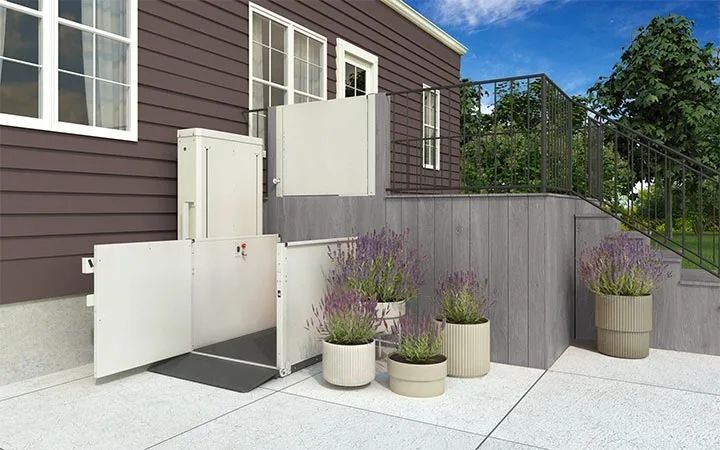
Based on the measurements you’ve taken, you can then determine which type of wheelchair lift will work best. For example, VPLs can effectively replace short wheelchair ramps (two to four steps long) leading to a porch with modern technology. In fact, they’re regularly used in outdoor settings (garages, decks, etc.), and many models offer full weatherproofing.
As mentioned, IPLs require a railing along the staircase to work, so they can save you money if you have a compatible staircase but may not be an option if you don’t. Some IPL models can fit curved staircases, though more customization also increases cost.
3. Confirm Weight Capacity and Platform Size
Location is only part of the equation, as you’ll next need to determine how much your mobility device weighs while you’re sitting in it. Your new lift must have sufficient weight capacity to support that load. Most IPLs can lift between 500 lbs and 750 lbs, while VPLs regularly lift up to 800 lbs or more. Portable lifts tend to have a more limited capacity.
Usually, it’s worth choosing a model with a weight capacity at least 20% higher than the combined weight of your mobility device and body weight. Platform size should also comfortably accommodate wheelchairs or scooters with room to maneuver, not just their footprint at rest.
4. Check Power, Weather, and Usage
Most wheelchair lifts in North America run on a dedicated 20-amp, 120 VAC single-phase power circuit, though some models include battery backup for outages. Outlets are usually easy to find indoors but are an important consideration for outdoor use.
Likewise, outdoor lifts will need to be rated for exposure to rain, snow, and temperature swings. The manufacturer can help you determine if a certain model is right for your climate.
Indoors or outdoors, factor in how often you’ll use the lift. Portable lifts are great for occasional use, but an IPL or VPL is needed to handle daily use for years at a time.
5. Plan for Permits, Codes, and Inspections
Most states require permits for permanent wheelchair lift installations and may have building code or inspection requirements you must follow. Requirements vary by municipality and lift type. Contact your local Building Department, often called the Building Division or Code Enforcement Office, for more information. If you choose professional installation, your technician can often help with this process.
Wheelchair Lift Safety and Code Needs
Residential wheelchair lifts generally have less stringent requirements compared to commercial units. For instance, ADA rules primarily apply to public lifts, not ones installed in private homes, so you don’t have to worry about achieving a high weight capacity or mandatory 24/7 emergency phone monitoring.
However, residential lifts still follow the baseline set by the American Society of Mechanical Engineers (specifically ASME A18.1). This safety standard includes obstruction sensors, emergency stops and interlocked gates, and it also mandates gates or barriers at each landing on VPLs.
From the gates and ramps to dedicated wiring and weatherproofing, good site prep is ultimately essential for meeting local building code or permitting requirements. This is especially true for outdoor units, which require materials and electronics rated for their climate: sealed control boxes, corrosion-resistant hardware, and drainage. We always recommend inspecting the foundation for any structural changes, new landings, reinforced framing, altered stair treads, etc., before installing lift equipment.
Checklist: Safety and Compliance Checks to Verify
- Ensure all obstruction sensors are installed and functioning beneath the platform
- Confirm that emergency stop controls are present and reachable while seated
- Test to see if landing gates/interlocks prevent operation unless the gates are closed and block them from opening mid-travel
- Verify that the platform size and other aspects of the lift meet ASME A18.1 minimums based on lift type
- Check that there is a dedicated, correctly rated electrical circuit in place; consider battery backup capabilities for outages
- Obtain permits and schedule an inspection based on the rules set by your local authority having jurisdiction (AHJ)
- Confirm that outdoor units have the electronics, drainage, and temperature resistance rated for local weather
- Verify that the installer is certified through the National Association of Elevator Contractors (NAEC) or authorized by the manufacturer
Frequently Asked Questions (FAQs) About How to Choose a Wheelchair Lift
The best type of wheelchair lift for home accessibility and use depends on your home layout and budget. For example, if you have a straight staircase that’s wide enough to accommodate an IPL, that might be the best option for your home. Conversely, if you need a system that lifts you the equivalent of a few steps to the top of your porch, a VPL may be more effective.
Sometimes Original Medicare (Parts A and B) will help you cover the cost of wheelchair lift equipment (not installation), but only if the model is categorized as Durable Medical Equipment (DME). When the model doesn’t fall under this category, you’ll need to look to Medicare Advantage, Medicaid, Veterans Benefits, or nonprofits for financial assistance. The cost of a wheelchair lift can vary widely, so it’s also helpful to understand how much a used wheelchair lift costs before deciding which option fits your budget.
The primary types of wheelchair lifts are:
• Inclined Platform Lifts (IPLs): Travel along a railing attached to the stair treads, similar to a stairlift but with a platform instead of a chair.
• Vertical Platform Lifts (VPLs): Similar to a home elevator, these open or enclosed units travel up and down vertically, usually adjacent to the staircase.
• Portable lifts: Freestanding units that can be moved between locations without permanent installation.
• Vehicle lifts: Mounted on a vehicle to raise a wheelchair or scooter inside for transport.
Wheelchair lifts can usually support at least 500 lbs, and some models can lift 1,000 lbs or more.
For most VPLs and straight IPLs, installation takes less than eight hours. However, curved or long IPLs could take up to three days to install.
Yes, a lift (specifically a VPL) is generally better than a wheelchair ramp for tight spaces because it moves straight up and down and requires a tiny horizontal footprint compared to the long run a ramp needs.
Bottom Line
When choosing the best wheelchair lift for your home, consider your available space (for ease of use), staircase layout and required weight capacity. The three main types available are IPLs, VPLs, and portable lifts, each with unique pros and cons. A single step or two may point you toward a VPL or portable lift, while an existing staircase with compatible measurements can better accommodate an IPL.
Ultimately, local code compliance is always a critical factor when evaluating a model’s measurements and safety features. Staying code-compliant not only spares you city fines or reinstallation but also keeps you safer long term. Working with a qualified dealer or specialist can help you confirm the right model, permits, and installation plan.
Help us keep our articles accurate! If you’ve recently installed a vehicle wheelchair lift, email us at [email protected] and share your experience. Your personal details will remain completely confidential.