
Retirement Living takes an unbiased approach to our reviews. We may earn money when you click a partner link. Learn More
Best Rechargeable Hearing Aids of 2026
Our research highlights the best rechargeable hearing aids with long battery life and easy charging.


Updated:
We evaluated 15 of the best hearing aid brands and consulted with audiologists to narrow our list to three companies whose rechargeable models stand out for battery life, charging speed, or price. Our picks include Starkey, a prescription brand, and Jabra Enhance and Elehear, both over-the-counter (OTC) brands.
Starkey Hearing Aids

4.2
- Great variety available
- Health and wellness tracking features
- Large, well-known hearing aid manufacturer
See More
Starkey Hearing Technologies is one of the only American-owned and operated hearing aid manufacturers. Starkey Hearing Aids are high-tech, reliable devices from one of the world’s largest and most trusted hearing aid brands. The company has hearing aids for mild to severe hearing loss available in multiple fits and styles.
Jabra Enhance Hearing Aids

4.7
- Trained audiology care team support
- 100-day free trial
- 3-year warranty
See More
Jabra Enhance is changing how you buy hearing aids. Jabra Enhance offers a direct-to-consumer website for purchasing hearing aids at lower prices. You don’t need a prescription, and customers receive aftercare virtually. Anyone with a compatible smartphone or tablet can use the hearing aids.
ELEHEAR

4.5
- Great Battery Life
- Rechargeable, app-controlled models
- AI noise reduction
See More
ELEHEAR hearing aids are rechargable, lightweight, and discreet for a BTE model. They are easy to program, and you can quickly adjust them according to your surroundings using a button or via the app.

Compare Our Top Picks
The following chart provides details to help you compare the best rechargeable hearing aids at a glance.
| Brand | Best for | Battery life | Charging time | |
|---|---|---|---|---|
| Starkey | Long battery life | Up to 51 hours | About 3 hours | Prescription |
| Jabra Enhance | Fast charging with audiology support | Up to 24 hours | 3 hours | OTC |
| ELEHEAR | Affordable | Up to 20 hours | Not specified | OTC |
Rechargeable Hearing Aids Reviews
Starkey Hearing Aids Review
Great variety available
|
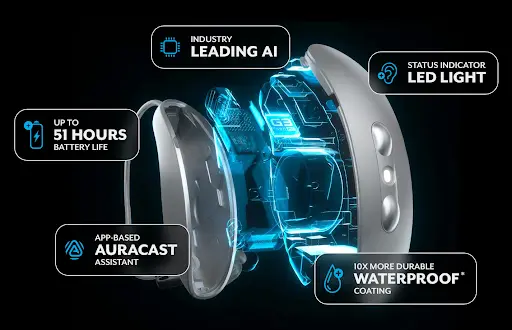
- Battery life: Up to 51 hours
- Charging time: Roughly 3 hours
- Bluetooth connectivity: Yes
- OTC available: No
Why we chose it
Starkey’s current lineup includes Omega AI, Edge AI, and G Series AI, plus its custom Signature Series, including the Signature Series completely-in-canal (CIC) model that Starkey calls the world’s smallest custom rechargeable hearing aid. All of them have built-in tinnitus relief technology. The Omega AI receiver-in-canal (RIC) model is rated for up to 51 hours on a single charge, the longest runtime among our picks, and is waterproof up to one meter. Edge AI carries the same rating, and Starkey’s custom rechargeable styles last up to 38 hours.
Pros
- Up to 51 hours per charge on Omega AI and Edge AI models
- Rechargeable custom in-the-ear styles available
- Charger doubles as a portable carrying case
Cons
- No pricing details
- It’s unspecified whether streaming affects battery life
- Requires a fitting appointment
Charging and battery details
A full charge takes about three hours, and the charger doubles as a carrying case. Starkey’s premium charger has a built-in battery that provides three extra full charges away from an outlet. That’s helpful for travel or a power outage.
What reviewers say
Customers often mention comfortable fit and clear sound. Complaints focus on long waits for warranty repairs and inconsistent service.
For more information, read our full Starkey review.
Jabra Enhance Hearing Aids Review
Trained audiology care team support
|
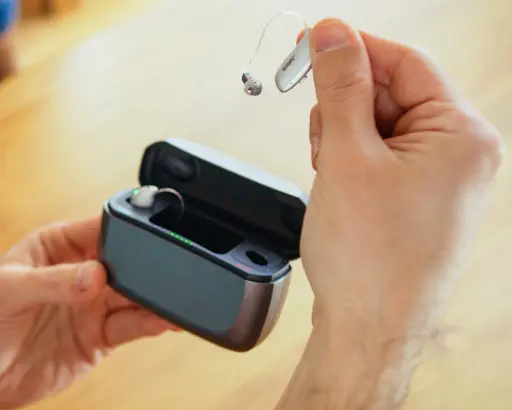
- Battery life: Up to 24 hours
- Charging time: 3 hours
- Bluetooth connectivity: Yes
- OTC available: Yes
Why we chose it
Jabra Enhance sells three OTC models: the Select M1, Select M2, and Select M3. The M3 is its smallest and most advanced model. All three come with technology that focuses on speech and cuts background noise to improve sound quality. They’re rated for about 24 hours per charge and come with a portable charging case, so you can choose based on sound features and budget. Quick charging and three years of included audiology care make Jabra Enhance a strong pick for first-time rechargeable users.
Pros
- Get 15 hours of use with one hour of charging
- Get three full charges from the charging case
- Carries a 100-day trial and 3-year warranty
Cons
- Shorter runtime than some prescription models
- Designed for mild to moderate hearing loss only
- Some reported Bluetooth hearing aid pairing problems
Charging and battery details
On select models, Jabra Enhance gives 24 hours of battery on a full three-hour charge, while an hour of charging gives 15 hours of battery life. You can even add two to two and a half hours with a quick 10-minute charge. The portable case holds three full charges, for up to 96 hours of battery life before the case itself needs to be plugged in.
What reviewers say
Customers are happy with the audiology team and long return window. Some reviewers report slow repairs and trouble keeping Bluetooth connected.
For more information, read our full Jabra Enhance review.
ELEHEAR Review
Great Battery Life
|
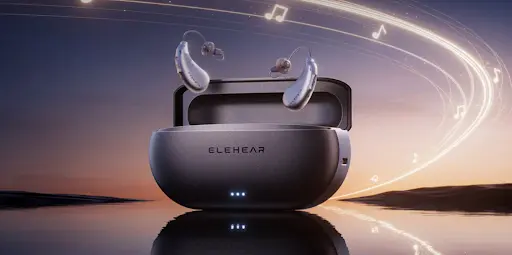
- Battery life: Up to 20 hours
- Charging time: Not specified
- Bluetooth connectivity: Yes
- OTC available: Yes
Why we chose it
ELEHEAR sells four OTC models, from the earbud-style Delight at $299 a pair to the new Beyond 2 Pro at $799. Each model is rechargeable, supports Bluetooth streaming, includes its VOCCLEAR 2.0 for speech clarity, and is water-resistant. The Beyond and Beyond Pro offer a good balance of price and runtime, with up to 20 hours per charge at $399 and $599 for a pair.
Pros
- Every model is rechargeable
- Prices start at $299 for a pair
- 15-minute quick charge on the Beyond Pro
Cons
- Full charge times aren’t published
- The charging case is on the bulky side
- Delight’s battery runs a shorter 13.5 hours
Charging and battery details
The Beyond and Beyond Pro have a long battery life of up to 20 hours per charge; the case holds four extra full charges. The Delight has a battery life of up to 13.5 hours, with two extra charges in its case. The Beyond Pro adds a quick charge, where 15 minutes gives you about six hours of use. Its case charges with a USB-C cable.
What reviewers say
Our tester found the Beyond lasted more than 20 hours per charge and stayed comfortable throughout the day. The main complaints are the large charging case and limited sound controls in the app.
For more information, read our full ELEHEAR review.
Methodology: How We Chose the Best Rechargeable Hearing Aids
We began our main hearing aid research with 32 hearing aid brands, including device testing and consultations with audiologists. In our best hearing aids guide, we narrowed the list down to the best 15 brands. For this guide, we narrowed the list further to companies whose rechargeable models stand out for battery life, charging speed, or price. We checked every battery and charging claim against the manufacturer’s own website. We also looked at quick charging, portable charging cases, and whether each brand says how streaming affects runtime.
Best Rechargeable Hearing Aids Buyer’s Guide
When choosing a rechargeable hearing aid, you should definitely evaluate battery performance, but that’s not all. You should also consider comfort, connectivity, and cost based on what you need. This guide outlines what to research and compare as you decide.
Key insights
- Our picks are rated for up to 20 to 51 hours per charge, depending on the brand. Bluetooth streaming can shorten that.
- Most rechargeable hearing aids use lithium-ion batteries, which typically last four to five years.
- Many models offer quick charging, so a short charge can extend battery life and get you through part of your day.
What to Look For in Rechargeable Hearing Aids for Seniors
To find the hearing aid that will be a hearing solution for your hearing health and fit your lifestyle, start by identifying which factors matter most to you and your daily routine. A good rechargeable model should last a full day, plus some, even with streaming turned on. Look for a battery rating on the manufacturer’s site, and check whether it says how streaming changes that number.
Types of Rechargeable Hearing Aids
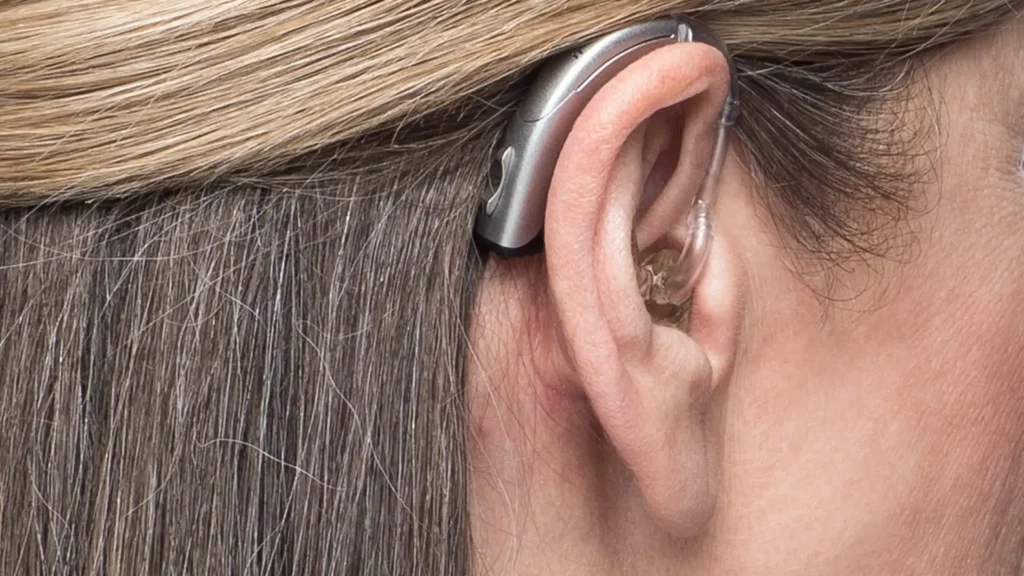
Most rechargeable hearing aids now use lithium-ion batteries. They’re built to last the life of the hearing aid. Older silver-zinc batteries needed replacing about once a year. Size matters too. Smaller in-ear models have less room for a battery, so they usually run shorter than receiver-in-canal (RIC) or behind-the-ear (BTE) styles.
The mobile app is where you’ll adjust volume and settings, so check what it offers before you buy. With a prescription hearing aid, a hearing care provider programs the device and shows you how to charge it, but requires an office visit or two. OTC models ship to your door, and you handle setup and charging yourself with phone or video support from the company.
Ease of Use
Whichever hearing aid suits your needs, make sure it’s easy to use. For most people, charging is simpler than changing batteries. You set the hearing aids in the case at night, and they’re ready in the morning. That’s easier than handling tiny disposable batteries, especially if you have arthritis or fine motor issues.
Also, look at how the hearing aids fit into the case. Clearly marked left and right slots help, and so do lights that show when charging is done. Jabra Enhance’s case, for example, uses blue and red bays with LED lights. If your eyesight isn’t what it used to be, try the case in person.
OTC models are set up through a smartphone app, so ask someone to help with the first pairing if you need it. With prescription models, your audiologist handles setup.
Features of the Best Rechargeable Hearing Aids for Seniors
While ease of use is a large factor in hearing aids, there are other features to consider. Here are the features to look for in rechargeable hearing aids.
- Battery life: Rated runtime among our picks ranges from up to 20 hours with ELEHEAR to up to 51 hours with Starkey. Most brands don’t say whether that figure includes streaming, so expect less time if you stream calls or TV often.
- Quick charging: Some models give you several hours of use from a short top-up. Jabra Enhance and ELEHEAR both publish quick-charge times.
- Portable charging case: A case with its own battery lets you recharge away from an outlet. Among our picks, cases hold two to four extra full charges.
- Bluetooth streaming: Hands-free calling, music, or TV audio uses more battery than regular listening.
Limitations of Rechargeable Hearing Aids
Rechargeable hearing aids are a great option, but do come with some drawbacks. The biggest is that you can’t just replace the battery when it dies. Instead, you’ll need to carry the charger or case, and while this helps, portable cases need charging too.
Rechargeable hearing aids use Lithium-ion batteries that slowly lose their strength over time. Typically, they last about four to five years. Once the battery wears out, it needs to be replaced by the manufacturer, or you need a new pair of hearing aids altogether. Ask about battery replacement policies and costs before you buy.
Disposable batteries may make more sense if you camp or travel where power isn’t reliable. Disposable hearing aid batteries last anywhere from three to 10 days, depending on the battery type and your usage.
Rechargeable Hearing Aids Cost and Pricing
Hearing aids typically have an upfront cost from around $100 to $8,000 or more. Prescription models are at the top of that range because the price includes an initial appointment, an in-person or online hearing test, fittings, and follow-ups with a hearing care professional. Technology level, streaming, and AI-based noise reduction also push the price up.
Among our picks, ELEHEAR’s rechargeable models cost $299 to $799 a pair. Jabra Enhance hearing aids range from $1,195 to $1,695 a pair. Starkey doesn’t publish prices since cost depends on your provider and technology level.
With a rechargeable model, you won’t have to keep buying disposable batteries. Other costs can come up, though. You may pay for follow-up care, a replacement charger, or a battery replacement once the warranty ends. Jabra Enhance includes three years of audiology care in its price.
Pros and Cons of Rechargeable Hearing Aids
Rechargeable hearing aids trade tiny battery changes for a nightly charging routine. Most people find that an easy swap, but it does come with a few trade-offs.
| Pros | Cons |
|---|---|
| No small batteries to carry around and change | Must carry a portable charger |
| Easier to handle and charge with arthritis | Can’t swap out batteries easily |
| Fewer batteries going in the trash | Battery life fades over a few years |
| Portable charging case provides quick charges when on the go | The manufacturer must replace batteries |
| Quick charging on most models | Bluetooth streaming shortens time between charges |
Frequently Asked Questions (FAQs) about Rechargeable Hearing Aids
In our research, we found the best rechargeable hearing aid brands to be Starkey, Jabra Enhance, and ELEHEAR. Starkey offers the longest battery life, up to 51 hours on some models. Jabra Enhance pairs quick charging with included audiology care, and ELEHEAR is the most affordable.
Most rechargeable hearing aids have a battery life of about 20 to 24 hours on a full charge. Starkey, a prescription hearing aid brand, has a model that lasts up to 51 hours. Some usage behaviors, like streaming calls or music, can shorten that.
For seniors with arthritis and dexterity issues, yes. Rechargeable hearing aids are easier to handle because you don’t have to change tiny batteries; you just charge them overnight.
Rechargeable hearing aids are a great option, but they do have some limitations, including the fact that you need regular access to a charger and you can’t swap in a new battery if they die. The built-in battery also wears down over several years and has to be replaced by the manufacturer.
To clean and maintain your rechargeable hearing aids, wipe them down with a soft, dry cloth each day and make sure they’re dry before charging. Store the charger in a cool, dry place away from the bathroom.
Concluding Thoughts on Rechargeable Hearing Aids
Rechargeable hearing aids save you from changing tiny batteries, and most last a full day or longer on a single charge. To choose the best rechargeable hearing aids for your needs, start by deciding whether you need a prescription device or an OTC model. Compare battery life and charging time. Explore whether Bluetooth streaming affects the battery run time. A trial period gives you time to see whether the charging routine fits your day.