
Retirement Living takes an unbiased approach to our reviews. We may earn money when you click a partner link. Learn More
Best Hearing Aids for Musicians of 2026
Our research points to hearing aids built for natural sound, improved sound processing, and all-day comfort for musicians, on stage or in the practice room.


Updated:
Standard hearing aids are tuned to improve sound quality — not necessarily to preserve the timing and tone that make music sound like music. To help musicians specifically, we researched popular hearing aid brands and spoke with experts to identify the best hearing aid providers for musicians, vocalists, and serious listeners who need accurate, dedicated music programs. Our results below are three prescription devices and one over-the-counter (OTC) hearing aid.
4.4
Widex hearing aids provide unmatched, natural high-definition sound. They reduce distortion, especially in complex settings. The prescription-only models come in a variety of styles.
- Great Natural Sound
- Noise suppression for enhanced clarity
- Provides tinnitus relief
Phonak is an award-winning leader in hearing aid technology. The company offers six lines of hearing devices, each with a variety of models. Phonak produces crisp, natural sound that adjusts to your environment.
- Broad Product Line
- Has an extended wear option
- Models for all types of hearing loss
4.4
Oticon is a tech leader. Its high-quality products are pricey but seen as top-notch.
- Innovative Products
- Various styles of hearing aids
- Mobile application

4.5
ELEHEAR offers affordable OTC hearing aids available for purchase online. The three offerings are rechargeable with app-based sound customization and AI noise reduction. ELEHEAR provides remote support and a risk-free trial period.
- Great Battery Life
- Rechargeable, app-controlled models
- AI noise reduction
How We Chose the Best Hearing Aids for Musicians
The Retirement Living research team evaluated 32 well-known hearing aid brands, examining cost, features, reputation, and more to identify the best hearing aids. From there, we identified the providers that offer processing speed, dedicated music programs, and streaming features that matter most to musicians — rather than general-purpose speech-in-noise settings alone.
Our research has been directly vetted against manufacturer websites and includes input from experts. Our top picks prioritize low processing delay, strong enough feedback cancellation for stage and rehearsal settings, and Bluetooth streaming built for practicing along with backing tracks or recordings. Our results revealed three prescription options and one over-the-counter (OTC) pick for those musicians with mild to moderate hearing loss who want a music-friendly option without the cost and time associated with prescription hearing aids.
Best Hearing Aids for Musicians Reviews
Widex Review
Great Natural Sound
|
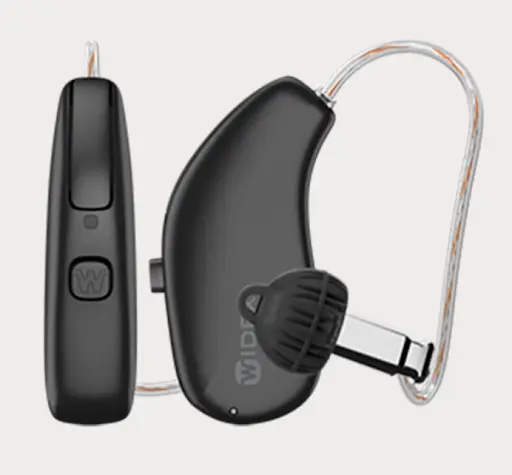
When it comes to Widex, musicians should forgo the Widex Moment and instead pick the newest, Allure platform, which is built around ZeroDelay processing. It keeps the gap between the directional microphone and receiver to about 0.5 milliseconds — compared to the 5 to 8 milliseconds typical of older sound processing. That matters for musicians because a longer delay lets processed sound clash with the instrument’s natural sound reaching the ear directly, creating a hollow, phased distortion called comb filtering.
The Allure Line comes with the PureSound program, which is designed to preserve the natural harmonics and tone of speech and music with minimal processing. It comes in receiver-in-canal (RIC), behind-the-ear (BTE), and in-the-ear (ITE) styles, each with Bluetooth connectivity and an app that includes an AI Sound Assistant for saving custom settings — useful for keeping separate profiles for rehearsal, performance, and everyday listening.
Because Widex sells exclusively through hearing care providers and audiologists, exact pricing depends on where you’re fitted.
For more information, read our full Widex review.
Phonak Hearing Aids Review
Broad Product Line
|
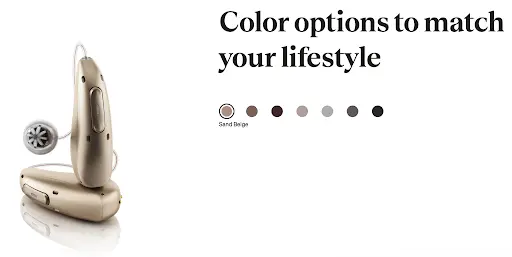
Phonak’s most advanced model is the Audéo Infinio Ultra Sphere, a RIC hearing aid built around what the company calls the industry’s first dedicated AI chip for separating speech and other sounds in real time. Called Spheric Speech Clarity 2.0, it’s useful for musicians rehearsing with vocalists or bandmates in acoustically busy practice spaces.
The Sphere-equipped Audéo is built specifically to isolate sound sources, making it the best of Phonak’s offerings for musicians. The Sphere Ultra comes in two technology levels — a 90 (premium) with the full feature set, and a 70 (advanced) with many of the same core capabilities at a lower price point. Both pair via Bluetooth, including low-latency Bluetooth LE Audio, and feature an ActiveVent receiver that automatically switches between an open and a closed acoustic seal. That combination makes it easier to stream a backing track or metronome app with less noticeable lag, and up to 56 hours of battery life helps it hold up through long rehearsal or gig days.
Phonak sells prescription hearing aids available through hearing specialists. Pricing depends on the provider and the technology level you choose.
For more information, read our full Phonak review.
Oticon Review
Innovative Products
|
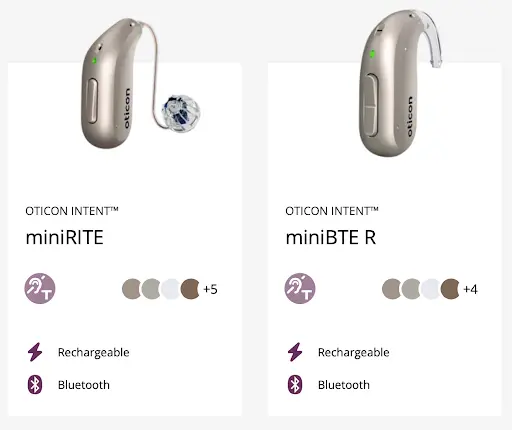
Oticon’s top-tier line, the Intent, is a hearing aid family built around what the company calls 4D Sensor technology. An embedded motion sensor tracks your head and body movement, while acoustic sensors read sound level, signal-to-noise ratio, and conversation activity. Together, these help musicians keep track of a conductor, bandmates, or an audience without losing the sound of their own instrument.
This combination isn’t part of Oticon’s other current families, like the more discreet Zeal or the battery-powered Verit, which is what makes Intent the standout Oticon option for musicians. Paired with Oticon’s Deep Neural Network (DNN) processing, it adjusts what it emphasizes in real time based on where you’re looking and moving, rather than reacting only to sound level.
The Intent comes in two styles: the single-button miniRITE and the miniBTE R, which adds a second button and two fitting power levels for a wider range of hearing loss. Both are rechargeable and include a telecoil.
Oticon doesn’t publish set prices online. Hearing aids are sold and fitted through providers, and the cost varies by technology level and where you’re fitted.
For more information, read our full Oticon review.
ELEHEAR Review
Great Battery Life
|
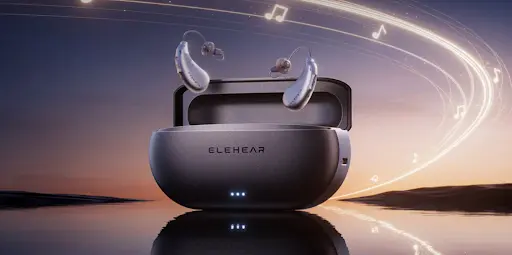
ELEHEAR is an OTC brand that offers the Beyond Pro, which includes a Music Mode with extended frequency range response beyond its standard settings. This preserves more high-frequency detail, like cymbals, strings, and vocal shimmer, than a typical speech-focused setting. The Beyond Pro also includes Bluetooth streaming for calls and practice tracks, as well as full app-based customization.
Unlike our three prescription picks above, it’s an OTC device that’s FDA-registered for adults with self-perceived mild-to-moderate hearing loss. Self-fitting is done through the app rather than by a hearing care provider, which keeps the cost well below prescription options but also means it isn’t built to handle more significant hearing loss. ELEHEAR hearing aids have a 45-day trial and a 1-year warranty.
For more information, read our full ELEHEAR review.
Hearing Aids for Musicians Compared
Use the following chart for a quick glance at how our best hearing aids for musicians compare.
| Brand | Type | Specific Music Program | Processing Delay | Bluetooth | Feedback Cancellation | Battery Life |
|---|---|---|---|---|---|---|
| Widex | Prescription | Yes | ZeroDelay | Yes | Yes | Up to 38 hours |
| Phonak | Prescription | No | Not specified | Yes | Yes | Up to 56 hours |
| Oticon | Prescription | No | Not specified | Yes | Yes | Up to 20 hours |
| ELEHEAR | OTC | Yes | Not specified | Yes | Yes | Up to 20 hours |
What Causes Hearing Loss in Musicians?
Musicians face a specific, cumulative hearing loss risk that most listeners don’t: repeated, prolonged exposure to loud sound from their own instrument, amplified monitors, and the musicians around them. Research from 2025 on musicians’ hearing found significantly higher rates of noise-induced hearing loss among musicians than in the general population, with risk varying by genre and the number of hours a person performs or practices each week.
Orchestral musicians aren’t exempt either — sustained exposure to a full ensemble can reach levels loud enough to cause gradual hearing damage over a career, even without amplification.
Hearing protection use tends to be low among musicians, partly because standard earplugs can dull or distort the sound of the music itself. Likewise, musicians might be tempted to put off hearing aids for the same reason. If you’re questioning your hearing, it’s best to address it right away to prevent further damage. A few signs it may be time to get your hearing checked include:
- Ringing, buzzing, or muffled hearing after rehearsals or performances that lingers for hours
- Needing to turn up an amp, monitor, or in-ear mix louder than your bandmates seem to need
- Trouble hearing certain notes, consonants, or higher-pitched instruments clearly
- Friends or bandmates mentioning that you’re playing or singing louder than usual
Unique Hearing Aid Needs for Musicians
Because musicians spend so much of their time listening to their own sounds, bandmates, recordings, practices, live music, and performances, they have unique needs when it comes to hearing amplifiers and hearing aids. Here are the features that make the biggest difference for musicians who need hearing aids:
Low Processing Delay
Hearing aids work by briefly holding onto sound before amplifying it. If that gap is too long, the delayed sound and the instrument’s real, un-delayed sound reach your ear at slightly different times and clash— making music sound thin or hollow instead of natural. You want a hearing aid with a very low processing delay.
Dedicated Music Program
Music uses a much wider dynamic range than speech, so a program with less compression preserves more of that range instead of flattening loud and soft passages.
Feedback Cancellation
Musicians spend more time near monitors, amps, and other loud, reflective sound sources than the average wearer, which increases feedback and the need for feedback suppression.
Bluetooth Streaming and Wireless Connectivity
Useful for practicing with backing tracks, apps, recordings, or simply streaming music without having to pull out headphones.
Program Memory
Different memory settings for quiet practices, loud rehearsals, and live performances help sessions go off without manual adjustments.
Battery Life
Rehearsals and gigs can run long, and there’s daily life, too. To seamlessly switch between the three, you need a long-lasting battery.
Style Flexibility
The preference is yours, but options make it easier to find the right pair. Open-fit styles like RIC preserve more of an instrument’s natural, unprocessed sound, while BTE and custom styles offer more power or a snugger fit under headphones and in-ear monitors.
Over-the-Counter vs. Prescription Hearing Aids for Musicians
OTC hearing aids like our pick, ELEHEAR, with its specific Music Mode setting, are FDA-registered for adults with mild to moderate hearing loss. They’re more affordable, don’t require office visits for a hearing test and fitting, and work for some people. That said, many musicians need a more custom experience, higher power, and more specialized features that come with prescription hearing aids.
Prescription hearing aids, such as our picks Widex, Oticon, and Phonak, are for mild to profound hearing loss and are tuned to your specific audiogram by an audiologist, which matters for many musicians. The drawback is that they’re typically more expensive once fitting and follow-up care are included.
If you have more significant hearing loss, tinnitus, or want an audiologist to set up separate programs for rehearsal and performance, a prescription device is generally worth the cost; if your hearing loss is mild to moderate and you mainly want a music-friendly, budget option, ELEHEAR is a reasonable place to start.
Costs of Hearing Aids for Musicians
Hearing aids typically cost from $1,000 to over $12,000. Widex, Phonak, and Oticon are sold through licensed hearing care providers rather than over the counter, so they don’t publish a fixed price online. Instead, the price depends on the technology tier and provider you choose, and can vary significantly between providers. ELEHEAR is an OTC hearing aid brand that currently lists prices ranging from $369 to $599.
Frequently Asked Questions about Hearing Aids for Musicians
There’s no single hearing aid that every professional musician uses, but Widex is the brand many musicians turn to for its ZeroDelay processing, which minimizes the distortion that can occur while playing or singing.
Many working musicians also use Phonak or Oticon for Bluetooth streaming and situational awareness, and some pair hearing aids with custom in-ear monitors for live performances.
Widex is generally considered the top pick for pure sound quality with music, thanks to its ZeroDelay processing (about 0.5 milliseconds) and PureSound program, which preserves natural harmonics with minimal signal processing.
That said, “best” depends on your hearing loss and budget — Phonak, Oticon, and the OTC brand ELEHEAR each handle different aspects of music well, too.
Yes. Most musicians can play or perform while wearing hearing aids, and features like feedback cancellation and dedicated music programs make it more comfortable to do so. It’s worth testing your hearing aids in a rehearsal setting before a live performance, particularly around loud monitors or amps.
Yes. All four hearing aid brands in this guide handle both, and most modern hearing aids include separate programs so you’re not stuck choosing one over the other. Devices with a dedicated music program, like Widex’s PureSound or ELEHEAR’s Music Mode, are built to switch between clear-speech and less-compressed music processing depending on the setting.
Concluding Thoughts on Hearing Aids for Musicians
Bottom Line: The right hearing aid should disappear into your music, not compete with it.
Musicians need more from a hearing aid than clearer speech — they need accurate timing, a wide dynamic range, and settings that hold up near amps, monitors, and other musicians. The fastest processing on the market won’t help if it isn’t paired with a program built to preserve music’s full range, and streaming features are only useful if the latency stays low enough to practice in time.
Widex, Phonak, and Oticon each bring a different prescription-grade strength to the table, from ultra-low processing delay to situational awareness, while OTC ELEHEAR offers a genuine music- focused feature at a fraction of the cost for musicians with mild to moderate hearing loss. We recommend that you talk to an audiologist who understands musicians’ needs and ask about separate programs for practice and performance.