
Retirement Living takes an unbiased approach to our reviews. We may earn money when you click a partner link. Learn More
Best Standing Stair Lifts of 2026
Our top standing stairlift picks increase mobility and reduce strain on your joints.


Updated:
We reviewed top stair lift companies and identified brands that offer standing stair lifts, focusing on their reputation, service, and features. We then narrowed the list down to the three best providers: Stannah Stairlifts, Arrow Lift Stair Lifts, and Handicare Stair Lifts.

Stannah makes several stair lift types, including straight, curved, and outdoor models. Its lift designs can accommodate those with back and hip pain and limited mobility.
- Ample customizations
- Cost-conscious options
- Rental options available

Shop stair lifts, luxury home elevators, and quality, custom wheelchair lifts in one of many showrooms across the Midwest and California. Arrow Lift also offers comprehensive service and maintenance plans on all products, including extended warranty options.
- Knowledgeable technicians and representatives
- Test-drive lifts in showrooms
- Professional installation included

4.3
Handicare stair lifts can accommodate all types of stairs. All models come with two remotes, a manual emergency stop switch, and various seat options.
- Great additional features
- Lifetime warranty on some models
- Highly customizable
How We Chose the Best Standing Stair Lifts
We evaluated 11 stair lift companies and selected the three best choices after careful research. We compared customer reviews, costs, reputation, quality, and features to create our final list.
Additionally, the Retirement Living editorial team has conducted 200 hours of research, consulted experts, reviewed the latest products, and visited a showroom to test models in person. All the companies listed below have undergone strict evaluation.
Standing Stair Lift Comparison
Here’s a side-by-side comparison of our top picks for standing stair lifts:
| Company | Standing Option | Rail Type | Weight Capacity | Standout Features |
|---|---|---|---|---|
| Stannah Stairlifts | Dedicated Sadler model | Curved | 300 pounds | Assisted seating and immobilizer seat belt |
| Arrow Lift Stairlifts | Perch-seat attachment | Custom curved | 300 to 400 pounds, depending on the model | Seat belt safety switch and power footrest |
| Handicare Stairlifts | Perch seats available for the 1000 and 4000 | Straight or custom curved | 300 pounds for both, with a 350-pound option for the 4000 | Optional five-point harness and powered features |
The Best Standing Stair Lift Reviews
The Retirement Living team considered user data, brand reputation, and online presence to determine the best standing stair lifts for seniors. Below are the top stair lift brands that provide dedicated standing models or perch-seat attachments.
Stannah Stairlifts Review
Ample customizations
|
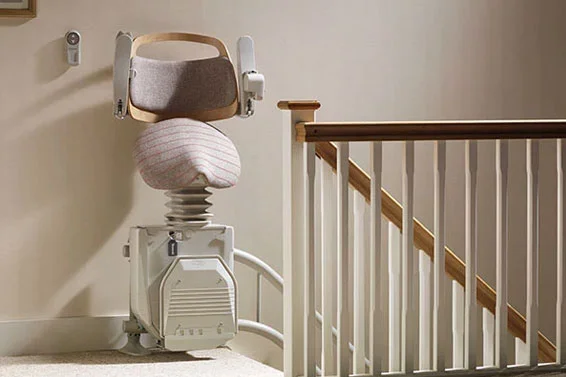
Stannah’s standing stair lift is called the Sadler. Its perch-style seat carries users in a supported, near-standing position, reducing joint stress and limiting how much they need to bend their hips and knees.
Stannah Stairlifts primarily recommends the Sadler for those with limited back, hip, or knee flexibility, though its compact design also suits narrow staircases. The Sadler has a nonslip, adjustable-height seat and an immobilizer seat belt that prevents the stair lift from traveling unless the belt is securely fastened.
- Weight Capacity: 300 lbs
- Rail Type: Curved
- Features: Immobilizer seat belt, nonslip seat, and assisted seating
The seat is designed to help you get on and off through assisted movement. It reclines gently as you sit and tilts back up with you as you stand. Additionally, when you fold the armrests up, the footrest automatically rises as well, meaning you don’t have to bend down.
To learn more, read our full Stannah Stair Lift review.
Arrow Lift Stair Lifts Review
Knowledgeable technicians and representatives
|
Arrow Lift Stair Lifts doesn’t list a specific standing stair lift model, but it offers standing lifts with raised perch seats and custom curved rails. Perched seats are designed for those who have difficulty sitting due to hip, knee, or joint pain but have the balance and endurance to stand safely throughout the ride.
Arrow Lift uses custom curved rails that extend onto a level landing space. This allows users to get on and off without turning or swiveling while standing.
- Weight Capacity: 300 to 400 pounds, depending on the model
- Rail Type: Curved
- Features: Safety belt, safety switch, power footrest, and battery backup
Arrow Lift Stair Lifts installs a special safety switch on every standing stair lift, which prevents the lift from moving unless the safety belt is in use. Every standing lift also comes with a power footrest that folds up at the push of a button.
To learn more, read our full Arrow Lift review.
Handicare Review
Great additional features
|
Handicare Stairlifts by Savaria offers perch-style seating on two stair lift models: the Handicare 1000 for straight staircases and the Handicare 4000 for curved staircases. Both support users in a semi-standing position and are intended for those with limited knee or hip flexibility. Handicare’s perch seats are available in three colors: cacao, sand, and slate.
The main difference is the rail. The 1000 for straight staircases uses a slim, anodized aluminum rail and offers an optional hinge that can keep the rail from obstructing doorways or walkways. The 4000 uses a custom curved twin-rail system designed to fit the staircase.
- Weight Capacity: 300 pounds for both models, with an optional 350-pound capacity for the 4000
- Rail Type: Straight (1000) and curved (4000)
- Features: Fold-up seats, safety and obstruction sensors, key switches, and battery backups
Both the 1000 and 4000 offer a body harness. This is a great feature for those who may need extra support and stability while riding the lift. You can also choose to add a powered footrest for added comfort.
To learn more, read our full Handicare review.
Standing Stair Lift Buyers Guide
Standing stair lifts can help people with limited hip, knee or back flexibility move between floors without lowering themselves into a traditional seat. Despite the name, most of these lifts use a raised perch seat that supports the rider in a semi-seated position. Standing stair lifts’ compact design can also make them useful for narrow staircases.
This buyer’s guide explains how standing stair lifts work, who can use them safely and what to consider when comparing models. It also covers staircase fit, installation, maintenance, and cost.
What Is a Standing Stair Lift?
A standing stair lift works like a traditional stair lift, giving people with mobility issues a safe and comfortable way to move between floors. However, unlike traditional stair lifts, the chair is smaller, positioned higher, and angled. This position allows the user to “perch” on the seat in a half-standing, half-sitting position.
This seating style is best for people with limited joint flexibility or those who struggle to safely rise from a seated position. Many perched seats are also adjustable so that you can adjust for your height and comfort.
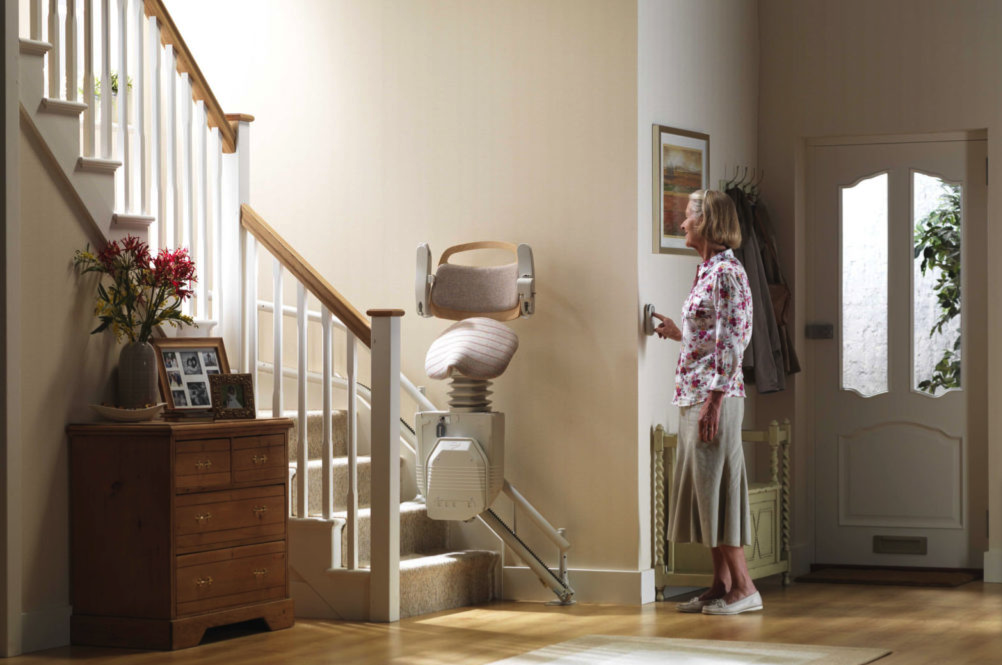
Standing stair lifts tend to have a lower weight capacity than chair models, so keep that in mind when considering your options. Additionally, to reduce the risk of falls, most standing stair lifts don’t include a swivel seat option since this could throw off the user’s balance when dismounting. That is why some manufacturers, like Arrow Lift, curve the rail at the top and bottom landings to improve safety.
Standing stair lifts can be installed on both straight and curved stairs, and the installation process is practically identical to installing a traditional stair lift. The rail the perch-style seat travels along attaches to the stair treads, not the wall, and the rails can be customized to fit your specific stairwell.
How to Choose a Standing Stair Lift
These are the main things to consider when looking into standing stair lifts:
- Physical Ability of the Passenger: Make sure the user can safely stand and balance while moving.
- Support Features: Look for a stair lift with adjustable footrests, backrests, and a secure seat belt for a safe, comfortable ride.
- Safety Sensors: Ask the provider what safety sensors are included. The most common sensors are obstacle detection and pressure sensors.
- Controls: The person who will use the lift most should test the controls before purchasing. Consider grip strength, hand mobility, and ability to operate the lift quickly under stress. Controls should be easy to reach and operate, and emergency stopping should be straightforward.
- Staircase Size and Type: Standing stair lifts typically require a staircase width of at least 26 to 28 inches. You’ll also need enough headroom to remain upright throughout the ride and sufficient landing space to get on and off. Have an installer measure the staircase and check for doors, handrails, and other obstructions before choosing a model.
- Budget: When weighing costs, consider which features matter most. Pricing can vary significantly, so prioritize safety and functionality.
- Installation: Ask who will install the stair lift. If you plan on DIY installation, make sure an authorized installer isn’t required to maintain warranty coverage. Confirm what professional installation costs include and ask how long the process will take.
- Warranty and Support: Check the warranty and ongoing service options before buying a stair lift to stay fully informed.
You should also have a professional consultation with the provider before choosing a unit. Not only will they be able to provide you with a free quote, but they can also help you determine which type of stair lift is best for you and your loved ones.
Standing Stair Lift Installation and Maintenance
We highly recommend having your standing stair lift professionally installed to ensure proper function and safety. Many manufacturers and providers only honor warranties when a professional installs the unit, so while DIY installation is technically possible, it may not be a good idea.
Stair lift installation, whether for a traditional or standing lift, involves securing the rail to your stair treads, following the curve if present, and securing the chair, motor, and other components.
Additionally, standing stair lifts require regular maintenance to ensure optimal performance and longevity. Common issues that standing stair lifts sometimes develop include track obstructions, battery failure, and sensor malfunctions.
Regular maintenance, however, which typically includes lubricating moving parts, replacing batteries, and checking safety features, helps prevent issues before they become major problems.
Standing Stair Lift Price
The cost of a stair lift depends on the type, model, and added features. You can expect standing stair lift prices to range from $2,000 to $15,000. The average price of a standing stair lift at the time of publishing is $8,500.
The configuration of your staircase can significantly affect the price, with curved and outdoor stairlift models generally costing more:
- Straight: $2,000 to $5,500
- Curved: $8,000 to $15,000
- Outdoor: $8,000 to $12,000
Other factors that influence the cost of a standing stair lift include the manufacturer, the model, included safety features, and any add-ons you choose. Added features, like power armrests or upholstery upgrades, will influence the overall stair lift cost.
Keep in mind that installation will add to the total and can range from an additional $500 to $3,000, or 15% to 20% of the total price. However, initial stairlift quotes typically include installation costs unless otherwise noted.
Standing Stair Lift Benefits
The main benefit of a standing stair lift is that it lets people with limited back, hip, or knee flexibility and joint pain move from floor to floor in their home. The perch-style chair helps keep users stable and in a near-standing position, providing a suitable alternative to the traditional seated stair lift.
Standing stair lifts can also:
- Fit narrow staircases more easily than full-seat models
- Help users move between floors without climbing stairs
- Support greater mobility and home accessibility
Frequently Asked Questions (FAQs) About Standing Stair Lifts
A standing stair lift is usually best for people with limited mobility in their hips, back, or knees; those recovering from surgery or injuries; and those with enough balance to maintain a semi-standing posture while in motion. Standing stair lifts are also ideal for homes with narrow staircases due to their reduced size.
Standing stair lifts typically require:
• A minimum staircase width of 26 to 28 inches
• Enough headroom for the user to remain upright throughout the ride (typically 71 to 79 inches)
• Landing space to get on and off while upright, typically 16 to 24 inches at the bottom and 24 to 31 inches at the top
• A power outlet within 10 feet of either the top or bottom of the stairs
Installing a standing stair lift usually takes two to five hours. However, curved lifts require additional lead time because the rail is custom-made for the staircase layout. Designing and manufacturing a curved rail typically takes two to five weeks.
Those with poor balance or frequent dizziness should not use standing stair lifts. Also, those who might have difficulty remaining upright throughout the ride may be better suited to a seated stair lift.
Concluding Thoughts on Standing Stair Lifts
For people who have difficulty sitting because of limited hip, knee or back flexibility, a standing stair lift can be a useful addition during an aging-in-place remodel. It may also work well in narrow staircases where a full seated model won’t fit. A professional assessment can help determine whether the user has the balance and strength to operate one safely.